·amura·
37
Los tiempos cambian
Las grandes etapas de su historia son las de la comu-
nidad original que empezó a habitar en el siglo XIV, el
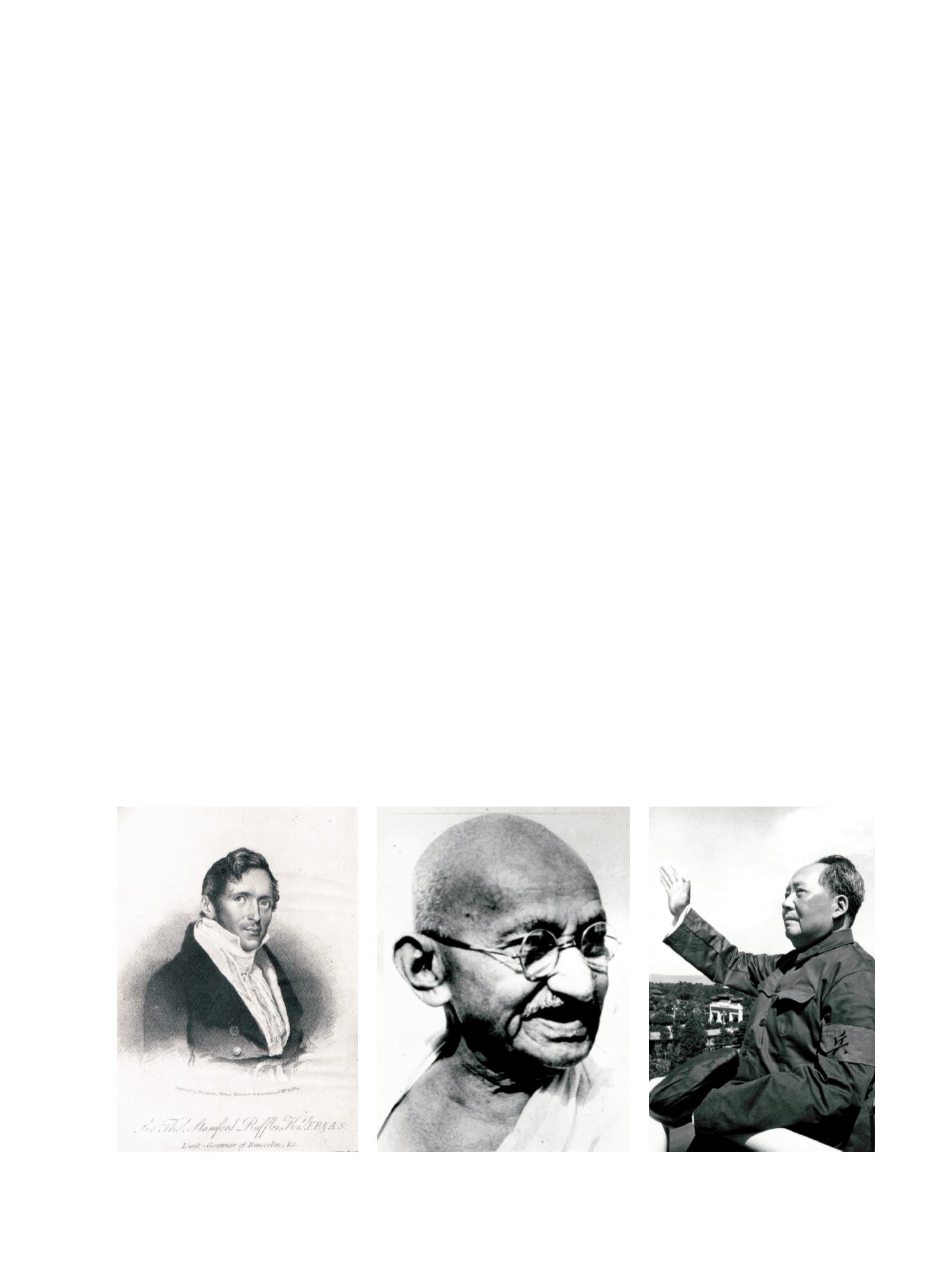
colonialismo inglés, que se instauró a partir de 1819,
cuando Sir Thomas Stamford Raffles decide estable-
cer allí un puerto comercial, tras ser expulsado de Java
por los holandeses. Bajo la corona inglesa, Singapur se
desarrolló como puerto comercial.
Sacudida la región, primero por la independencia
de la
India alimentada por la no violencia de Mahatma Gan-
dhi en 1947, seguida por la revolución popular China
de Mao Tse Tung, ambas en proporciones distintas que
reciben la influencia y apoyo del polo socialista sovié-
tico, atribuyéndole nuevas relaciones y fronteras a
esta región de Asia, que vuelve a cambiar con la caída
de la URSS y la orientación hacia la industrialización y
el mercado de la China popular.
Los habitantes de Singapur no creían viable, en
el aislamiento, la falta de recursos naturales y su li-
mitado espacio geográfico, el surgir como una nue-
va nación. Así se adhirió a la Federación de Estados
de Malasia en 1963. Posteriormente, las diferencias
irreconciliables entre el gobierno chino de Singapur
y el malasio-musulmán de la Federación llevaron a
su expulsión y a su nacimiento como ciudad-Estado
independiente en 1965. Centro-urbano en la selva,
que es una novedosa forma de puerto-comercial-de-
servicios con una bien planificada economía y desa-
rrollo urbano, con el manejo inteligente de los recur-
sos naturales. Todo esto sin terminar de despejar los
vínculos subjetivos entre sociedades ancestrales que
comparten una historia y cohabitan en el mismo espa-
cio geográfico que se plantea una nueva cultura en la
aldea global para hacer otro sujeto humano libre, ca-
paz de romper con ataduras y prejuicios inútiles.
Esta cultura que se levanta sobre el multilingüis-
mo conlleva a que la enseñanza institucional pública
imparta dos idiomas, la lengua nativa y el inglés, que
cumple con el propósito de unificación nacional.
compás int • int compass
The times change
The major stages of its history are those of the origi-
nal community that began to dwell in the 14th cen-
tury, English colonialism, which was established
from1819, when Sir Thomas Stamford Raffles decides
to establish a commercial harbor there, after being
expelled from Java by the Dutch. Under the English
Crown, Singaporewasdevelopedas a commercial port.
The region was beaten, first by the independence
of the India fed by the non-violence of Mahatma Gan-
dhi in 1947, followed by the popular revolution China
of Mao Tse Tung, ten years later, both in different pro-
portions receiving the influence and support of Soviet
Socialist polo, originating fromnew relationships and
boundaries to this region of Asia, which will change
with the fall of the USSR and the orientation towards
industrialization and the popular Chinamarket.
The inhabitants of Singapore believed not vi-
able, in isolation, lack of natural resources and its
limited geographical, emerge as a newnation space.
Thus the island acceded to the Federated States of
Malaysia in 1963. Subsequently, the irreconcilable
differences between the Chinese Government of
Singapore and the Malaysian-Muslimof the Federa-
tion led to their expulsion and birth as independent
in 1965 City-State. Center City in the jungle, which
is a novel form of port trade in services with a well-
planned economy and urban development, with
the management of natural resources. All this un-
finished clear subjective ties between ancient so-
cieties that share a history and cohabit in the same
geographic space posed a new culture in the global
village to make another free human subject, able to
break ties and useless prejudices.
This culture rises onmultilingualism that brings
to public institutional education imparts two lan-
guages, the native language, and the English, which
complies with the purpose of national unification.
But if you see carefully, this policy shows inequality.
“El trabajo es algo
que tu vendes,
entonces dale más
valor agregado
mediante la
educación”
“Work is something
you sell, so you
must give more
added value
through education”
Lee Kuan Yew


