55
compás int •
compass int
·amura·
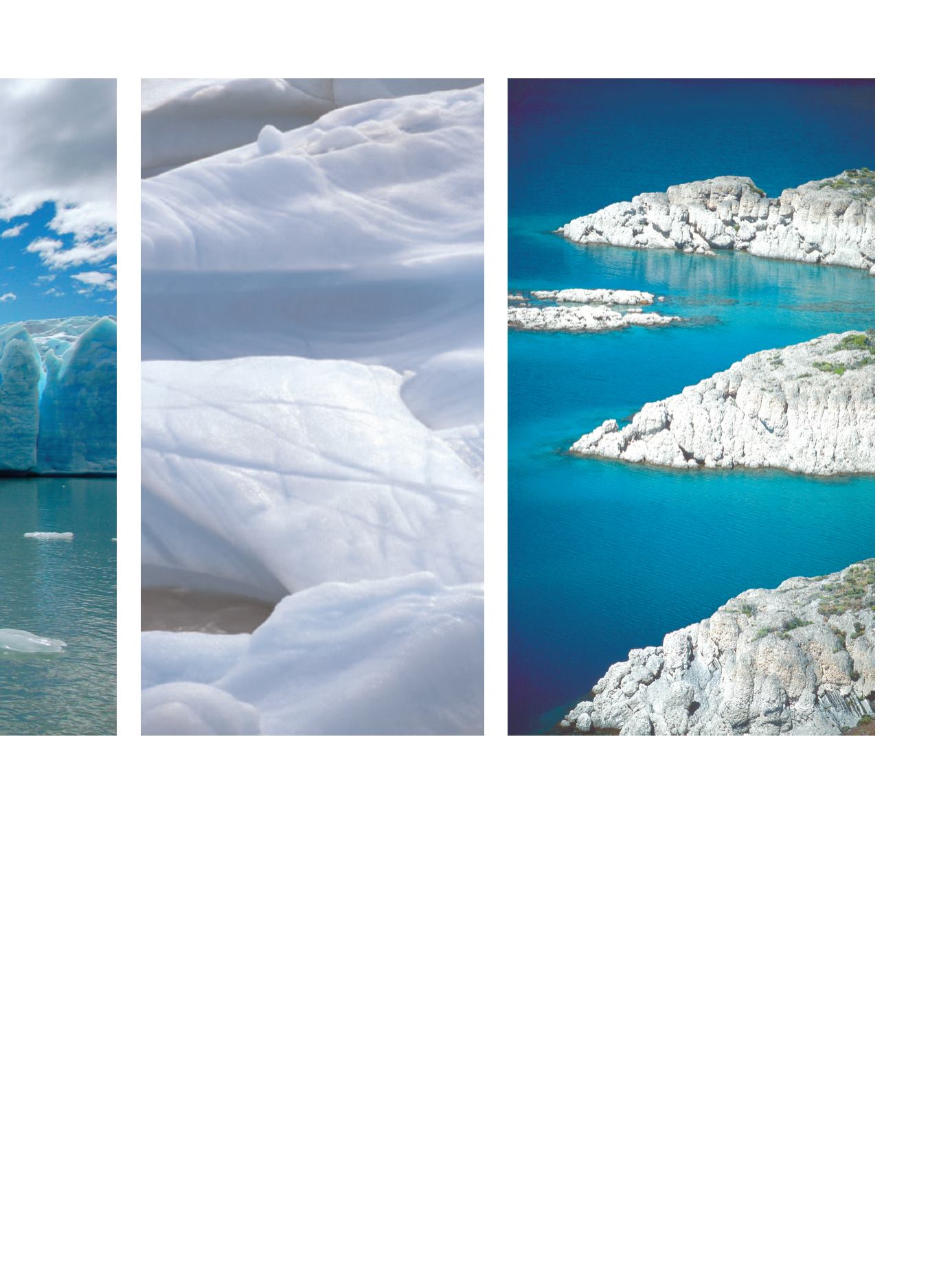
Most of Patagonia’s glaciers have registered
backward movement during the last one hundred
years. Among the exceptions is the glacier of Perito
Moreno in the locale of El Calafate in Argentina.
Glacier science studies permitted the measure of
its advance, nearly 2 meters per day.
Geological Profiles
The landscape of Torres del Paine is dominated by
formations – unique in their beauty – of rocks of
great heights, like the mythic towers to whom
they owe their name.
The geological processes that carry the construc-
tionandmodelingof these imposing structureshave
their origin in the erosive effects of the glaciers, but
also correspond to other type of natural phenomena.
A great part of the mountainous area of Torres
del Paine – a complex of peaks separated by glacial
valleys – is taken up by intrusive granite mass.
This is a whitish colored rocky body that 12million
years ago was injected asmagma between layers of
dark brown rocks belonging to the formation
called Bull Mountain.
The thickness of this granite body reaches
nearly 2,000meters and is identified in the section
En la mayoría de los glaciares patagónicos se han
registrado fenómenos de retroceso durante los últi-
mos cien años. Entre las excepciones está el glaciar
de Perito Moreno en la localidad de El Calafate en
Argentina. Estudios glaciológicos permitieron medir
su avance, cercano a los 2 metros por día.
Perfiles geológicos
El paisaje en Torres del Paine está dominado por forma-
ciones - únicas en su belleza - de rocas de gran altitud,
como las míticas torres a quienes debe su nombre.
Los procesos geológicos que llevaron a la cons-
trucción y modelación de estas imponentes estruc-
turas tienen su origen en los efectos erosivos de los
glaciares, pero también corresponden a otro tipo de
fenómenos naturales.
Gran parte del macizo de Torres del Paine – un
conjunto de picachos separados entre sí por valles
glaciares – está ocupado por un intrusivo granítico.
Se trata de un cuerpo rocoso de color blanquecino
que hace 12 millones de años se inyectó como
magma entre capas de rocas de color pardo oscuro,
pertenecientes a la formación llamada Cerro Toro.
El espesor de este cuerpo granítico alcanza casi
2,000 metros y se puede identificar en el tramo com-


