En 1949 Gaspar Cassadó ejecutó por primera vez
su
Concierto para chelo y orquesta
. La obra forma un
contraste con las anteriores. Es moderna y experi-
mental y cuando se escucha por primera vez, suele
producir un efecto negativo por el sabor astringen-
te que encierra. El movimiento lento central es una
hermosa elegía que encanta al oído. Además de su
lugar como compositor, Joaquín Rodrigo se ha dis-
tinguido como conferencista y crítico musical. Su
biógrafo Federico Sopeña dice: “la personalidad mu-
sical de Joaquín Rodrigo ejerce influencia directa
sobre la juventud intelectual de España”. Como pro-
fesor de Historia de la Música en la Universidad de
Madrid tuvo la oportunidad de influir directamente
en la juventud universitaria de su país, pocos han
estado en esta posición y la enorme responsabilidad
que representa es algo que Rodrigo comprendió per-
fectamente. Por esa etapa transcribió el
Concierto de
Aranjuez
para arpa por encargo del genial arpista Ni-
canor Zabaleta, que lo grabó magistralmente.
Rodrigo fue incorporado a la nobleza españo-
la por el rey Juan Carlos I con el título hereditario
de Marqués de los Jardines de Aranjuez. Recibió el
prestigiado nombramiento de Príncipe de Asturias
en 1996, el reconocimiento más alto para un civil en
España. El gobierno francés le nombró comandante
de la Orden de las Artes y Letras en 1998.
Se casó en 1933 en Valencia con Victoria Kamhi,
una pianista nacida en Turquía que había conocido
en París, suhija Cecilia nació en 1941. Rodrigomurió
en 1999 a la edad de 97 años y su hija heredó el nom-
bramiento de Marquesa de los Jardines de Aranjuez.
Joaquín Rodrigo y su esposa Victoria, reposan en el
cementerio de Aranjuez.
In 1949 Gaspar Cassadó played the premiere for
his
Concerto for Cello and Orchestra
. This compositor
contrasts with the previous concertos. It is modern
and experimental and when Heard for the first time
it produces a negative effect due to the astringent
taste that it has within. The central slow movement
is a beautiful elegy that enchants our senses. Also,
besides is place as a composer, Joaquín Rodrigo was
a distinguished teacher with many conferences
and music critic. His biographer Federico Sopeña
says:”Themusical personality of JoaquínRodrigo has
influenced the intellectual youth of Spain”. As a pro-
fessor of history of Music at the university of Madrid
he had the opportunity to transmit his knowledge to
his university students and few have occupied this
position and the enormous responsibility it meant
was fully understood by Rodrigo. During this period
he transcribed the
Concierto de Aranjuez
for Harp at
the request of the genial musician Nicanor Zabaleta,
who recorded it wonderfully.
Rodrigo was incorporated to the spanish nobil-
ity by King Juan Carlos I with the hereditary title of
Marquis of the Gardens of Aranjuez. He was given
the prestigious title of Prince of Asturias in 1996,
the highest recognition in Spain. The french gov-
ernment named him Commander of the Order of
Arts and Letters in 1998.
He was married in 1933 in Valencia with Victoria
Kamhi, a pianist born in Turkey and who he met in
París. Their daughter Ceciliawas born in1941. Rodrigo
died in 1999 at the age of 97 years and his daugh-
ter inherited the title of Marquise of the Gardens of
Aranjuez. Joaquín Rodrigo and his wife Victoria are
buried in the Cementary of Aranjuez.
·amura·
125
Meet the music • Música
8 9
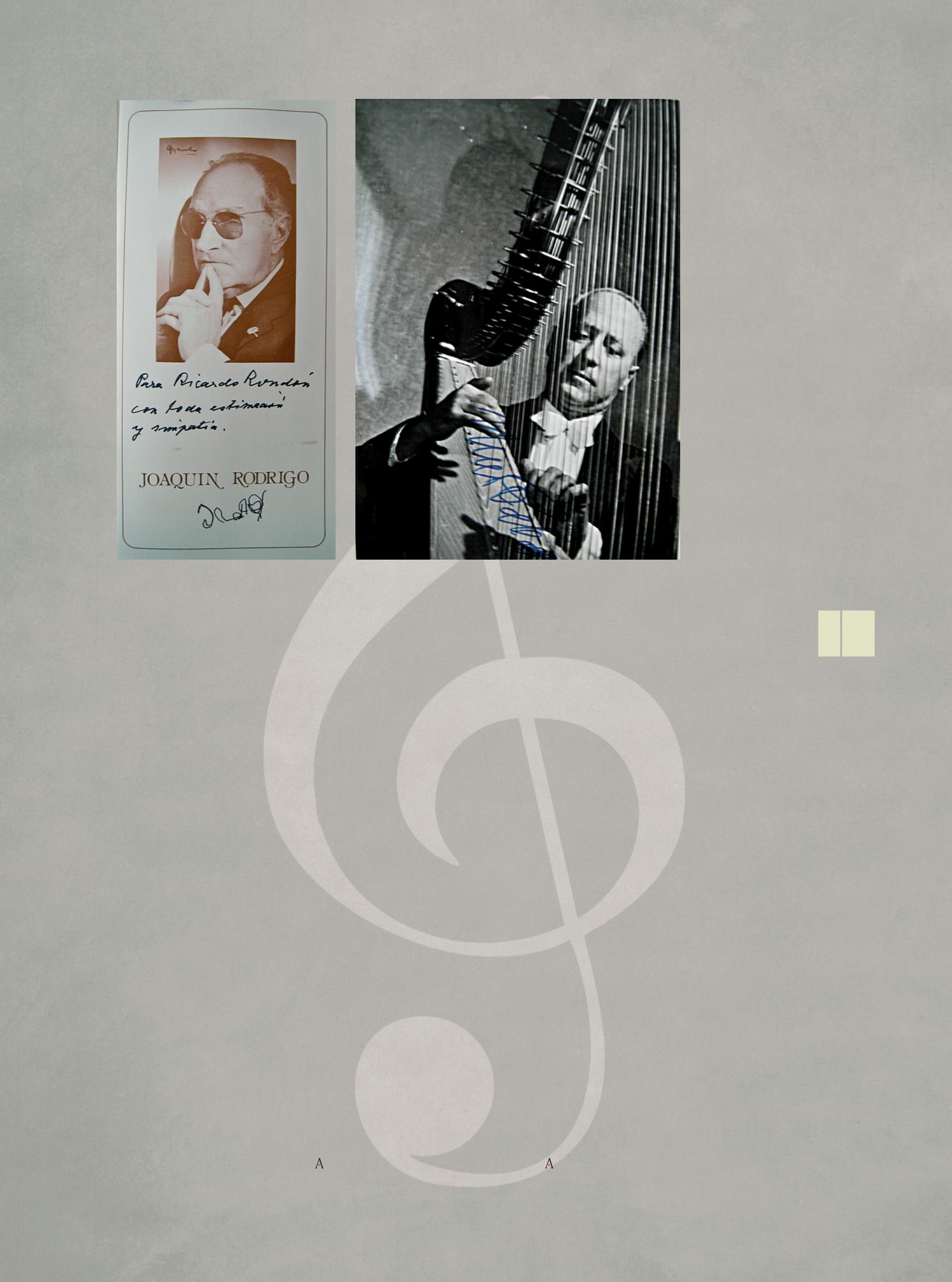
8.Autografiadopor
JoaquínRodrigocon
dedicatoria porsu
esposaVictoria./
Autographed by
Joaquín Rodrigo
dedicated by his
wife Victoria.
9.NicanorZabaleta,
elarpistamásgrande
delmundo./
Nicanor Zabaleta,
the world’s
greatest harpist.


