37
compás int •
compass int
·amura·
Hindu Fun an empire. The Champa Empire appeared
approximately in the actual Da Nang at the end of
the IInd century, and it extended towards the south
of the actual Nha Trang. The Chinese conquered the
Red River’s delta in the IInd century, and kept their
domain for a period of thousand years. During this
period, the Vietnamese resistances did not give up
in their attempt to get rid of the Chinese rule,
although, at the same time, this long periodwas also
decisive in the formation of a Vietnamese culture of
their own that assimilated the knowledge of the
invading culture.
In the IXth century the Vietnamese defeated the
forces of the Chinese Han Dynasty, putting an end to
a millennium of vassalage. In the XIIth century they
rejected the Mongolians of Genghis Khan and their
grandsonKublai Khan –whose namewas an inspira-
tion for Samuel Taylor Coleridge in his homonym
poem - , and repelled the Chinese of the Ming and
Ching dynasties in the XVth and XVIIth centuries.
After all those conflicts, the hero countryman,
Nguyen Hue, was able to displace the feudal lords,
defeated the army of the Qing’s and reunify the
country in the XVIIIth century.
About the middle of the XIXth century, the
French forces invaded the country and in 1884 a
French protectorate was established over all the
Vietnamese territory.
Since then, the working class resistance move-
ments bursted everywhere; however, all of them
failed. Until Nguyen Ai Quoc, who was later on
known as the president Ho Chi Minh, founded the
Communist Party in 1930. Under his leadership,
Vietnam recon quested its independency, consti-
tuted the 2 of September of 1945 as the Democratic
Republic of Vietnam.
Funán. El imperio Champa apareció aproximadamen-
te en la actual Da Nang a finales del siglo II, y se
extendió hacia el sur de la actual Nha Trang. Los chi-
nos conquistaron el delta del río Rojo en el siglo II, y
mantuvieron su dominio durante mil años. Durante
este periodo, las resistencias vietnamitas no cejaron
en su intento por liberarse de la dominación china,
aunque, al mismo tiempo, este largo periodo tam-
bién fue determinante en la formación de una cultu-
ra vietnamita propia que asimiló la sabiduría de la
cultura invasora.
En el siglo IX los vietnamitas vencieron a las fuer-
zas de la dinastía Han china, poniendo fin a casi un
milenio de vasallaje. En el siglo XII rechazaron a los
mongoles de Gengis Khan y su nieto Kublai Khan –
cuyo nombre sirvió de inspiración a Samuel Taylor
Coleridge en su poema homónimo - , y repelieron a
los chinos de las dinastías Ming y Ching en los siglos
XV y XVII.
Después de todos estos conflictos, el héroe cam-
pesino, Nguyen Hue, logró desplazar a los señores
feudales, derrotó al ejército de los Quing y reunificó
al país en el siglo XVIII.
A mediados del siglo XIX, las fuerzas francesas
invadieron el país y en 1884 un protectorado francés
fue establecido sobre todo el territorio vietnamita.
Desde entonces, los movimientos de resistencia
popular estallaron por doquier; sin embargo, todos
fracasaron. Hasta que Nguyen Ai Quoc, a quien más
tarde se le conoció como el presidente Ho Chi Minh,
fundó el Partido Comunista en 1930. Bajo su direc-
ción, Vietnam reconquistó su independencia, consti-
tuyéndose el 2 de septiembre de 1945 como la
República Democrática de Vietnam.
Los conflictos, sin embargo, estaban lejos de
haber terminado, pues, pocos años después, el país
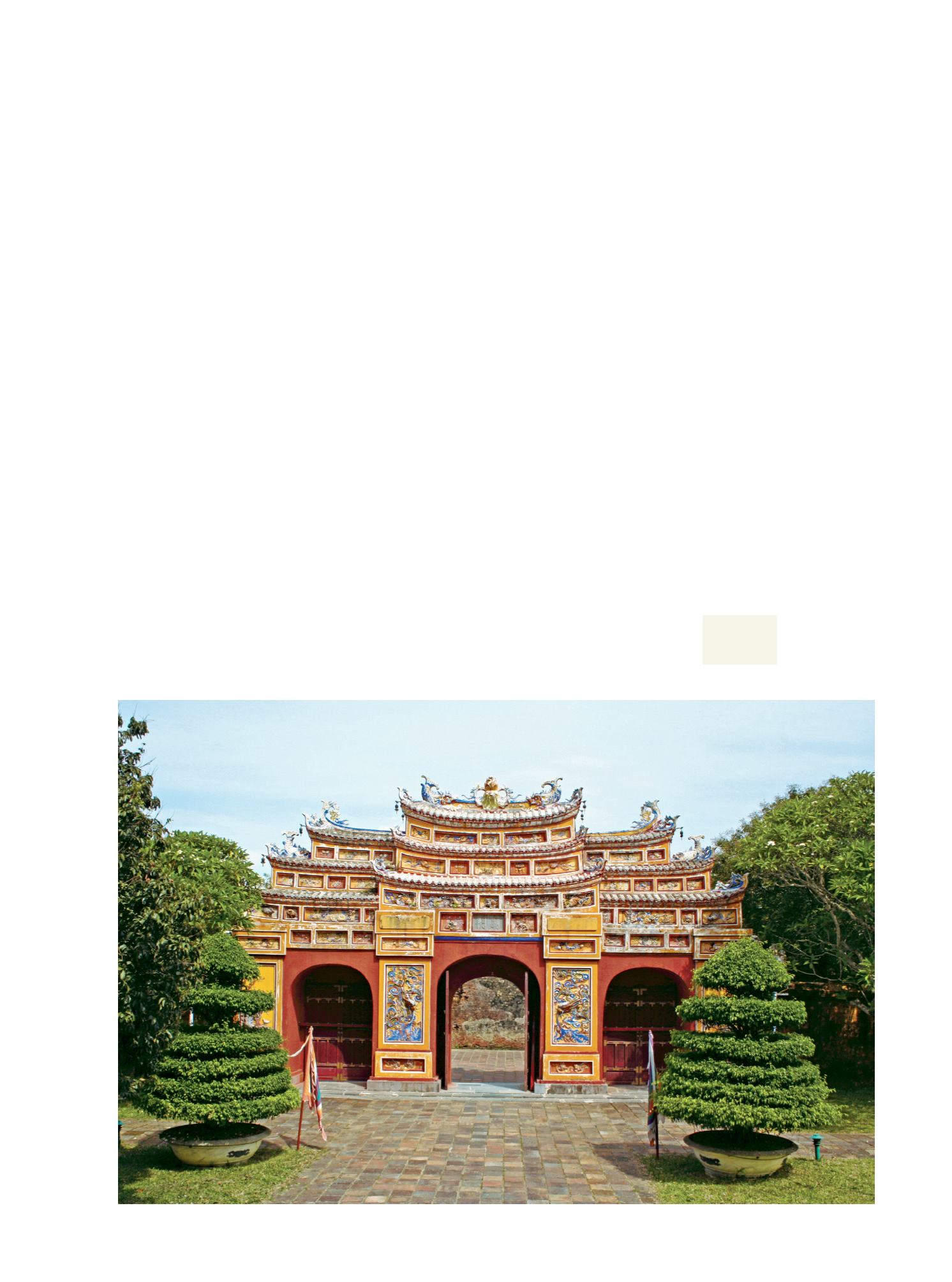
La magnífica ciudadela de la
ciudad de Hanoi
The magnificent Citadel
of Hanoi City


