·amura·
44
compás int • int compass
Euskadi, el Camino del Mar
Seguíamos la costa francesa con nuestro velero y de-
cidimos conocer ese famoso Camino de Santiago. Par-
te de nuestro equipo seguía por mar mientras la otra
parte recorría en coche los lugares relevantes, encon-
trándonos en los puntos más relevantes. Empezamos
en Hondarribia, un pequeño pueblo a la orilla del río
Bidasoa que separa España de Francia y donde el Pa-
lacio del Emperador Carlos V, hoy maravilloso Parador,
domina los empinados callejones del pueblo rodeado
por los restos de la muralla. La torre de la iglesia de
Nuestra Señora del Manzano se alzaba en el cielo azul,
el barrio de los antiguos marineros se llenaba de gente
que disfrutaban de los pintxos y las copas, atiborran-
do las calles sombreadas con sus conversaciones.
Es un pueblo de encanto donde aparecen las fle-
chas amarillas que marcan el camino del peregrino.
Mientras nuestro equipo de navegación seguía la cos-
ta con el velero, recorrimos en coche los pocos kiló-
metros que nos llevaron a San Sebastián-Donostia,
donde nos encontramos con ellos para descubrir jun-
tos una elegante ciudad que rodea la playa de la Con-
cha y la playa de la Zurriola, donde desemboca el río
Urumea. Los edificios del siglo XIX adornan las calles,
la catedral desafía las nubes y el sol. Desde el Monte
Igeldo, admiramos la bahía con la isla de Santa Clara
que bloquea la entrada y los restos del castillo de San-
ta Cruz de la Mota que coronan el monte al pie del cual
resplandece la elegancia de la ciudad. Vimos nuestro
velero que entraba en la bahía hasta amararse en el
pequeño y antiguo puerto al pie del castillo.
Euskadi, the Sea Route
We followed the French coast in our sailboat and de-
cided to meet the famous Camino to Santiago. Part of
our equipment was still at seawhile the rest of it trav-
elled by car through the relevant areas, and meeting
once again at our rendezvous point. We began at Hon-
darribia, a small town at the Edge of the Bidasoa river
that separates Spain fromFrance, as well as being the
place the Palace of the Emperor Charles V, now a mar-
vellous ‘Parador’, dominates the steep alleyways of
the town surrounded by a wall. The church tower of
Nuestra Señora del Manzano rose up to the blue sky,
the neighbourhood of the ancient sailors was filled
with people that enjoyed ‘pintxos’ and drinks, their
conversations roaring through the streets.
It is an enchanting town where the yellow ar-
rows appear, indicating where the pilgrims route
begins. While our navigating equipment was still at
the coast inside the sailboat, we travelled by car the
few kilometres that would take us to San Sebastian-
Donostia, where we would meet up again to discov-
er the elegant city that surrounds the Concha beach
and the Zurriola beach, where the Urumea river
flows out into the ocean. The 19th century buildings
adorn the streets, the cathedral defies the clouds
and sun. From the Igeldo Mount, we admired the
bay with the Santa Clara island that blocks the en-
trance and the remains of the Santa Cruz de la Mota
castle that crowns the mount. We observed our sail-
boat make its way into the bay until it docked itself
on the small and ancient dock of the castle.
1
2
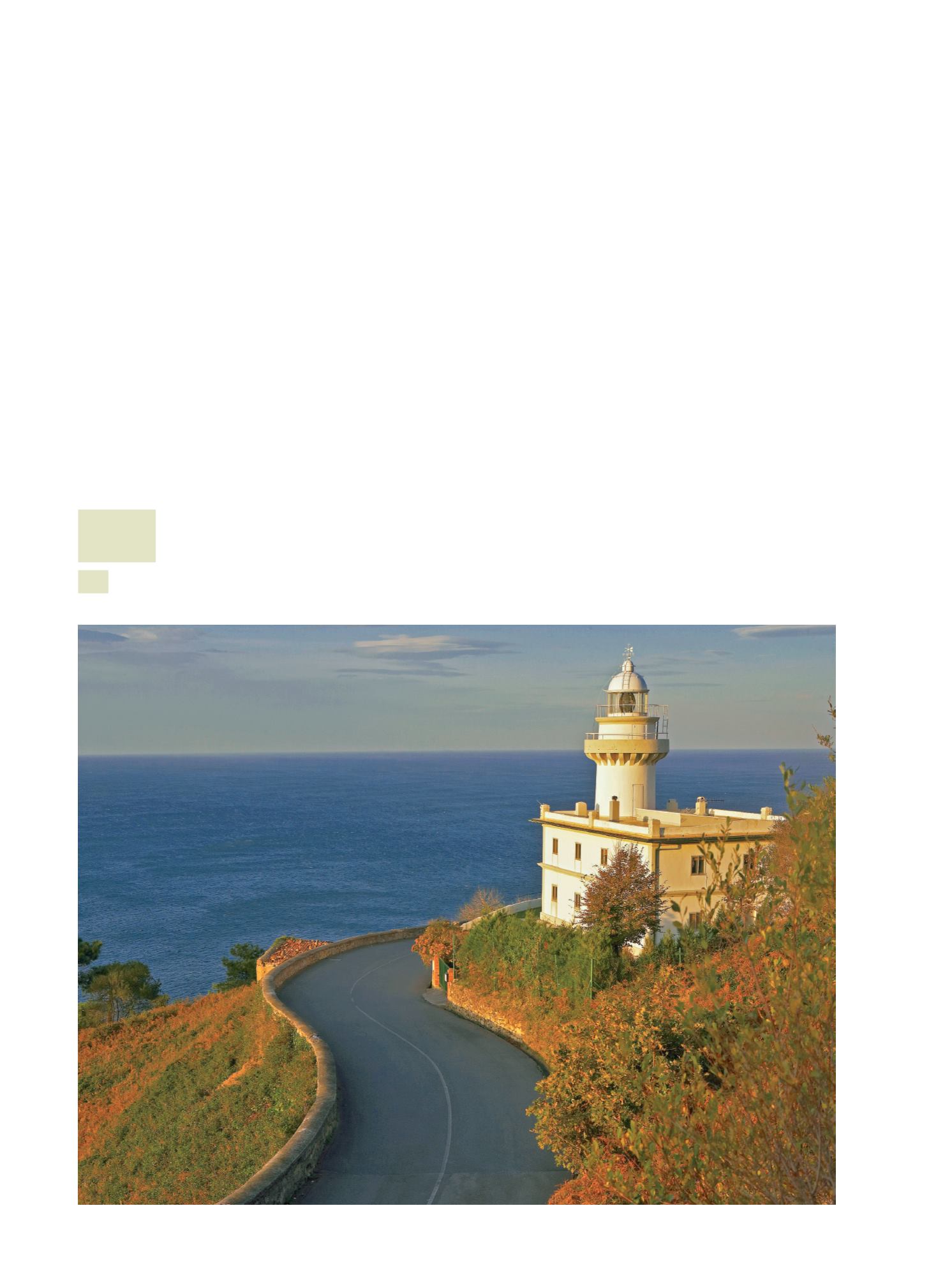
1. San Sebastián, Vista
Igueldo
2. San Sebastián, Faro
Igueldo.


