·amura·
54
compás int • int compass
desciende del cielo para recoger las almas puras. Es, sin
duda, una de las joyas del Camino de Santiago, fundada
en el siglo XII, cuando se instalaron los Caballeros de la
Orden Militar de Santiago, destinados a proteger a los
peregrinos. Visitamos el Castillo de Pambre escondido
dentro de una barranca, en medio del bosque de robles
y encinos, cuyas murallas desafían el tiempo y cuen-
tan historias de batallas. Construido en el siglo XIV por
Gonzalo Ozores de Ulloa, se alza sobre un peñón que
domina el río Pambre, cerca de Palas de Rei. Llegamos
a la capilla de San Roque en Melide para descubrir su
hermoso portal, cuyos arcos románicos perfectos se
coronan con intrigantes capiteles. En la placita medie-
val admiramos la iglesia parroquial de Sancti Spiritus
con su fastuoso retablo, junto a la capilla de San Anto-
nio y el Museo da Terra de Melide alojado en el antiguo
hospital de peregrinos. Melide es tierra de gaitas, aquí
nacieron y aquí se juntan el Camino Primitivo y el Cami-
no Francés. En las afueras del pueblo, la Iglesia de Santa
María, que data del siglo XII, nos invitó a unos momen-
tos de meditación frente a su portal románico puro y
su cruceiro. Remojamos los pies en el río que bordea el
albergue de peregrinos de Ribadiso, frente al puente ro-
mánico que ha visto pasar tantas sandalias.
Finalmente entramos en Santiago de Compostela,
dejamos el coche y paseamos caminando, alcanzando
14th century adorned the mural, the tombstones,
the remains of the Knights of Santiago. It is, without
a doubt, one of the jewels of the Camino de Santiago,
founded in the 12th century, when the Knights of
the Military Order of Santiago settled in that area,
destined to protect the pilgrims. We visited the Cas-
tle of Pambre, hidden inside a cliff, in the middle of
the forest, whose walls defy time and tell stories of
war and battles. Built in the 14th century by Gonza-
lo Ozores de Ulloa, it rises on a spot that dominates
the Pambre river, near Palas de Rei.We arrived at the
chapel of Saint Roque, in Melide, to discover a gor-
geous portal. In the medieval plaza we admired the
church of Sancti Spiritus, next to the chapel of Saint
Anthony and the Museum da Terra de Melide nes-
tled in the ancient pilgrim hospital. Melide is a land
of bagpipes, here they were born and here is where
the Primitive Route and the French Route merge. On
the outskirts of the town, the Church of SantaMaria,
built in the 12th century, invited us to meditate for
a few moments in front of the Romanic portal. We
bathed our feet in the river that borders the pilgrim
shelter of Ribadiso, in front of a Romanic bridge that
has seen a large number of sandals.
Finally, we entered Santiago de Compostela, leav-
ing the car behind and began to walk, reaching de
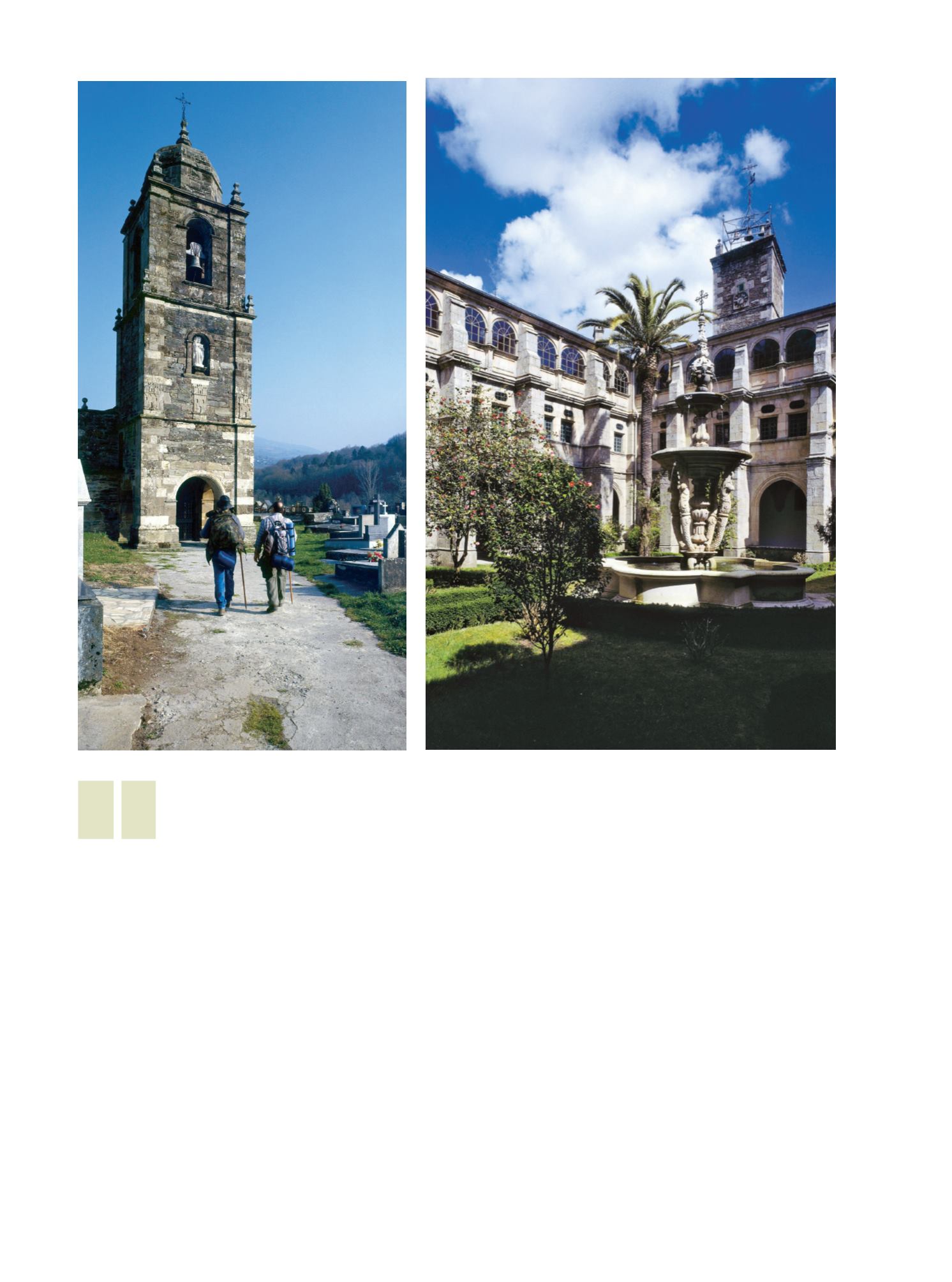
1. Triacastela Igrexa
de Santiago.Tono
Arias.
2. Samos Mosteiro
Claustro das Nerei-
das. TonoArias
1
2


