·amura·
42
compás int • int compass
Si bien la ciudad baja es un conjunto romántico
como surgido de una novela de Dostoievsky, Gornji Grad
(ciudad alta) es la memoria antigua de Zagreb. Origi-
nalmente eran dos pueblos medievales en dos colinas
contiguas: Kaptol, que era obispado fundado en el siglo
XI, y Gradec, ambos circundados por fuertes murallas,
separados por un arroyo que hoy en día es un agrada-
ble callejón peatonal donde se alojan los cafés, plenos
de gente. Las viejas casas de madera han sido reempla-
zadas por elegantes edificios barrocos... los restos de la
muralla y los callejones me transportan en el pasado. La
puerta de Piedra, antigua entrada de la muralla, se ha
vuelto una institución importante debido a un singular
hecho: en 1731 un incendio destruyó el portal de made-
ra, pero quedó intacta la pintura de la Virgen con el niño
pintada por un artista desconocido. Esto creó un mito,
una leyenda que le confiere a la puerta poderesmágicos.
Hundido en la penumbra de ese callejón cubierto,
observo cómo la gente prende velas, reza, haciendo
que la tal puerta parezca una iglesia y en su fachada
se entrona la estatua de Dora, heroína romanesca
del siglo XVIII. Me impregno de los olores del otoño,
el sol se esconde detrás de las primeras nubes, la luz
baja, los edificios como el Sabor (parlamento) o el
Banska Dvori (palacio presidencial) alzan su elegan-
cia, y las placitas me llevan a la torre Lotr
šč
ak, edi-
ficada en el siglo XIII para proteger la puerta sur. Me
dejo sorprender por una fuerte explosión: se ha dis-
parado el cañón, como cada día en punto de la media
noche. Zagreb retumba con ese fuerte cañonazo que
conmemora la batalla contra los turcos. La leyenda
dice que una munición disparada a esa misma hora,
mató de pasada a un gallo. Los turcos que sitiaban la
ciudad, viendo ese hecho, se desanimaron y renun-
ciaron a atacar la ciudad.
The lower town is a romantic setting. As if you
emerge from a novel by Dostoievsky, Gornji Grad (Up-
per Town) is the old memory of Zagreb. Originally,
it was two medieval villages on two adjoining hills.
The bishopric of Kaptol was founded in the eleventh
century. Kaptol and Gradec, both villages were sur-
rounded by strong walls and separated by a stream
that today is a pleasant pedestrianalleywhichhouses
cafes which are full of people. The old wooden houses
have been replaced by elegant baroque buildings but
remainsof thewall andalleys takemeback to thepast.
The Stone Gate, once themain entrance to the ancient
city has become an important institution because of a
singular fact. In1731afiredestroyed thewoodenpor-
tal, but thepaintingof theMadonna andChildpainted
by an unknown artist remained intact. This created a
myth and a legend that gives the doormagical powers
Within the confines of this dark alley, I observe
how people light candles, praying, making this door
look more like a church. Its façade is enthroned by a
statue of Dora, Romanesque heroin of the eighteenth
century. I amimpregnated by the smells of autumn as
the sunhidesbehind the lowclouds. The lowlight, the
buildings and the Sabor (parliament) or the Banska
Dvori (presidential palace) raise their elegance as the
square leadsme to the Lotr
šč
ak tower whichwas built
in the thirteenth century to protect the south gate.
I am extremely surprised by a loud explosion.
A cannon is fired. This happens every day at about
midnight, when Zagreb rumbles with a strong shot
that commemorates the battle against the Turks.
Legend says that munitions fired at this same hour,
killed a passing rooster. The Turks, who were be-
sieging the city, seeing this fact, became discour-
aged and gave up attacking the city.
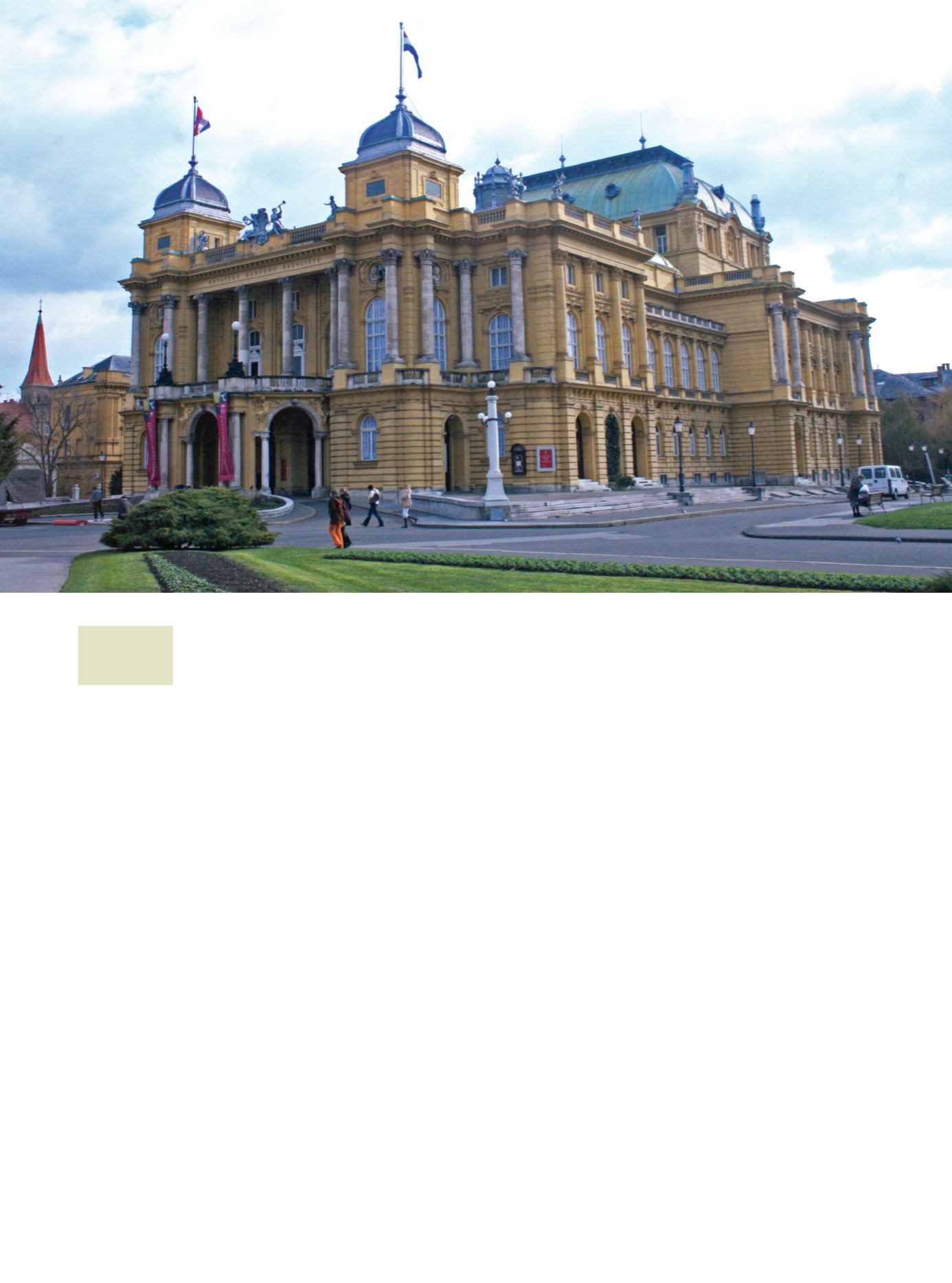
4 Teatro Nacional
de Croacia
/ Croatia
National Theatre
4


