·amura·
29
compás int • int compass
Un cambio de eventos
Peter Stuyvesant, el nuevo director general holandés,
tuvo que lidiar con la serie de problemas heredados por
sus antecesores: contrabando de bienes, la matanza
de familias nativas y el incumplimiento en el pago de
los impuestos, aunque sus esfuerzos rindieron frutos
con la construcción de un hospital y la primera lotería.
Para 1653, Nueva Ámsterdam gozaba de privilegios si-
milares a los de su patria. La construcción reciente de
la plantación de UN Tobacco y la vida comenzó a surgir
en un río donde las mujeres holandesas lavaban su ropa
(Maiden Lane), lugar que hoy ocupa Wall Street.
Sin embargo, un conflicto florecía en el horizonte. En
1652 Inglaterra le declaró la guerra a Holanda. Las colo-
nias inglesas estaban listas para iniciar la batalla contra
la Nueva Holanda, insistían en que los indios tramaban
una conspiración para recuperar Nueva Inglaterra. Stu-
yvesant construyó un muro fortificado (Wall Street) ha-
cia el este del Río Hudson, sin embargo la guerra se evitó
y la paz entre ambas naciones se restituyó.
Parecía que los ingleses y los holandeses compe-
tían por la tierra y las factorías en este nuevo mundo,
por ello, en 1664 el rey de Inglaterra, Charles II, obse-
quió a su hermano, el duque de York, James Stuart,
todo el territorio (incluyendo Nueva Holanda). En muy
poco tiempo varios barcos del duque llegaron a Coney
Island. La ciudad de Nueva Ámsterdam tenía 40 años
cuando se convirtió en Nueva York, en nombre del in-
glés duque de York.
A change of pace
Peter Stuyvesant, the new Dutch Director, had to
deal with a series of problems that he inherited
from his ancestors: fur contraband, the slaughter-
ing of native families, and tax evasion; although
some of his efforts paved the way for the construc-
tion of a hospital and the first lottery. By 1653, New
Amsterdam enjoyed privileges similar to the ones
found in the motherland. The recent construction
of a tobacco plantation near a river became a popu-
lar destination for women seeking to wash clothes.
This place is now known as Wall Street.
In spite of this, a conflict brewed on the horizon.
In 1652, England declaredwar on the Dutch. The Eng-
lish colonies were ready to initiate battle against N
ew Amsterdam, and insisted that the natives were
conspiring to capture NewEngland. Stuyvesant built
a fortified wall (Wall Street) to the east of the Hudson
River. The war was avoided, however, and peace be-
tween the two nations was reinstated.
It seemed like the English and the Dutch com-
peted for land and industry in this new world, and
for that, in 1664, Charles II, King of England, pre-
sented his brother, James Stuart, the Duke of York,
with the entire territory (including New Holland.) A
short time after, numerous ships under the Duke’s
command arrived at Coney Island. The city of New
Amsterdam was only 40 years old when it became
New York, in honor of Prince Charles’s brother.
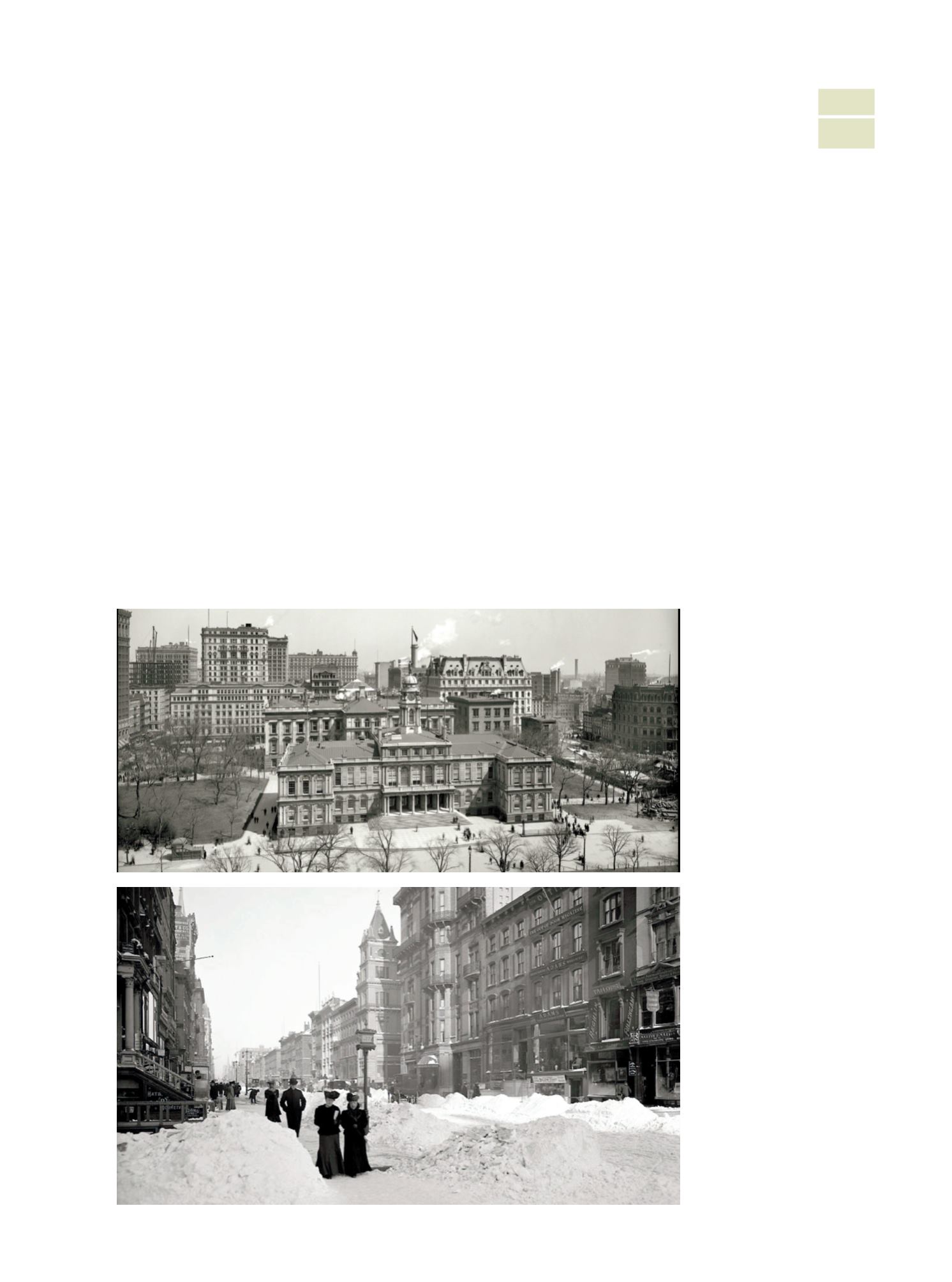
4. Ayuntamiento de
Nueva York Fotogra-
fias antiguas 1903.
/
New York City Hall,
New York Vintage
Photos 1903.
5. Quinta Avenida
y 27 tras una fuerte
nevada en 1905. Pa-
saje que hasta la fe-
cha es característico
de la granmanzana.
/
Fifth Avenue and
27th after a heavy
snowfall in 1905.
Passage so far is
characteristic of the
Big Apple.
5
4


