·amura·
49
compás int • int compass
Puntos de interés
•
Harlem.- En los años 20, Harlem fue el centro del
florecimiento de una cultura negra. En la actualidad
pasa por un nuevo renacimiento, transformándose en
un barrio seguro y atractivo. Importantes museos se
encuentran en esta parte de la ciudad, como el Museum
of the City of New York, el Museo del Barrio, Studio Mu-
seum in Harlem y la Morris-Jumel Mansion Museum.
•
NoLIta.- Fue parte de Little Italy. Perdió su carác-
ter italiano después de que la mayoría de los residen-
tes se mudaron, en su gran mayoría a Brooklyn. Los
años noventa estuvieron llenos de muchos cambios,
ya que boutiques, restaurantes y bares hicieron su
aparición, para hacer de renombre la zona.
•
SOHO.- Antiguamente zona de bodegas e indus-
trial, inició su transformación en los 70, cuando artis-
tas lo escogieron como estudio, situación que posi-
cionó a la zona dentro de la comunidad hasta llegar a
convertirse en un punto de referencia para la moda y
el estilo de vida de Nueva York.
•
Tribeca.- Su mayor atracción es el Festival de
Cine Tribeca, y es uno de los barrios que en la última
década cambió de un lugar lleno de almacenes hasta
convertirse en uno de los vecindarios con mayor de-
manda. Diseños, restaurantes, hoteles y galerías de
arte dibujan el paisaje de esta colonia.
•
Greenwich Village.- Barrio de gran historia, con
impresionante arquitectura de posguerra civil, que ha
sido por décadas el hogar de la élite intelectual y bo-
hemia. Con residentes famosos, como Nicole Kidman
hasta la famosa editora de Vogue, Anna Wintour, esta
zona ofrece callecitas llenas de historia, restaurantes
y boutiques de ultra lujo y algunas de las propiedades
más caras de Nueva York.
•
Chelsea.- Ubicados al margen del Río Hudson,
los barrios de Chelsea y Meat Packing District conser-
van su estética industrial, y un tanto dilapidada, pero
alojan a muchos de los hoteles, galerías de arte y bou-
tiques avant-garde del mundo. Se pueden recorrer a
pie, de norte a sur (y viceversa), vía The Highline, un
parque que se construyó sobre las vías de un tren ele-
vado que servía a una antigua fábrica de galletas y es
ahora el lugar más visitado de Nueva York.
44
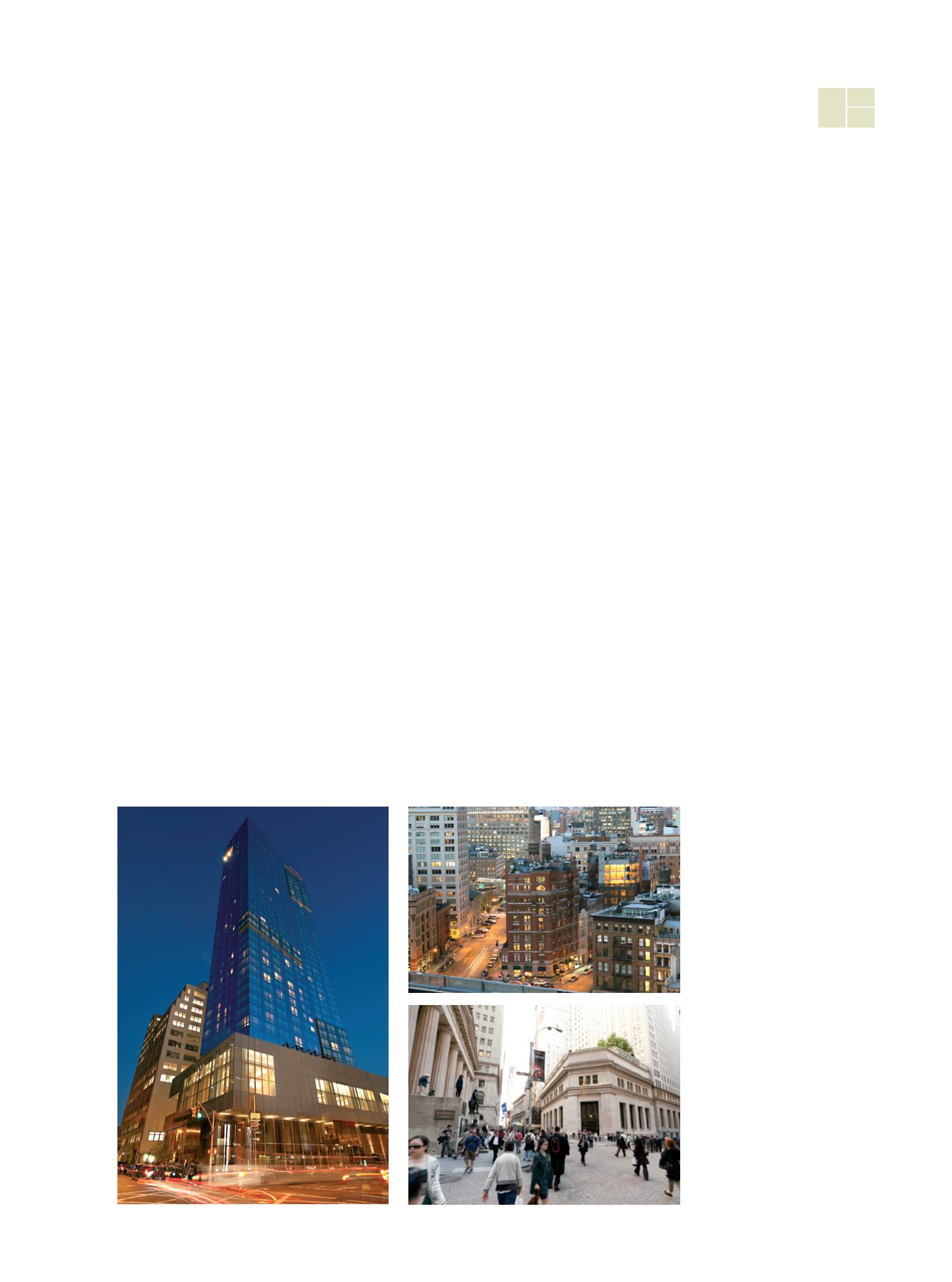
42. Soho (al sur de la
calle Houston) /
Soho
(South of Houston
Street)
43. Tribeca (Triángulo
bajo la calle Canal)
/
Tribeca (Triangle
Below Canal Street)
44.Wall Street es
considerado el
corazón histórico del
distrito financiero.
/ Wall Street is
considered the
historic heart of the
financial district.
Points of interest
• Harlem.- In the 1920s, Harlem was the focal
point of a flourishing black culture. Today, it is un-
dergoing a similar rebirth, transforming itself in a
safe and attractive neighborhood. There are many
important museums in this part of the city, such
as the Museum of the City of New York, the Studio
Museum, and the Morris-Jumel Mansion Museum.
• Nolita.- A part of Little Italy in the past, it
has lost some of its Italian character after a great
migration took most of its resident to Brooklyn.
In the 1990s, numerous boutiques, restaurants
and bars appeared, which brought some prestige
to the area.
• SOHO.- An industrial and storage area in the
past, it began to transform itself in the 1970s,
when artists reclaimed its spaces as studios, an
event that formed a bona fide community, and
thus became a center for fashion and lifestyles in
New York City.
• Tribeca.- Its greatest attraction is the Tribeca
Film Festival, and it’s one of the neighborhoods
that, in the last decade, changed itself from storage
area to become one of the most sought after places
in the city. Designs, restaurants, hotels, and art gal-
leries dot the landscape.
•GreenwichVillage.- Aneighborwitha longhis-
tory, with impressive post-Civil War architecture, it
has been for decades the home of the intellectual
and bohemian elite. With residents such as Nicole
Kidman, and the famous editor of Vogue, AnnaWin-
tour, this area also charms visitors with its narrows
streets, restaurants, luxury boutiques, and some of
the most expensive residences in the city.
•Chelsea.- Locatedat the foot of theHudsonRiver,
Chelsea and the Meatpacking District maintain their
industrial aesthetic, somewhat dilapidated, yet it is
the home ofmany a hotel, art gallery, and avant-garde
boutiques from across the globe. It can be explored
by foot, from North to South (and vice versa) via The
Highline, a park that was built onnow-defunct elevat-
ed railways which reached an old cookie factory, yet
which is nowone of themost visitedplaces in the city.
42 43


