Lamás famosa del Palacio Apostólico
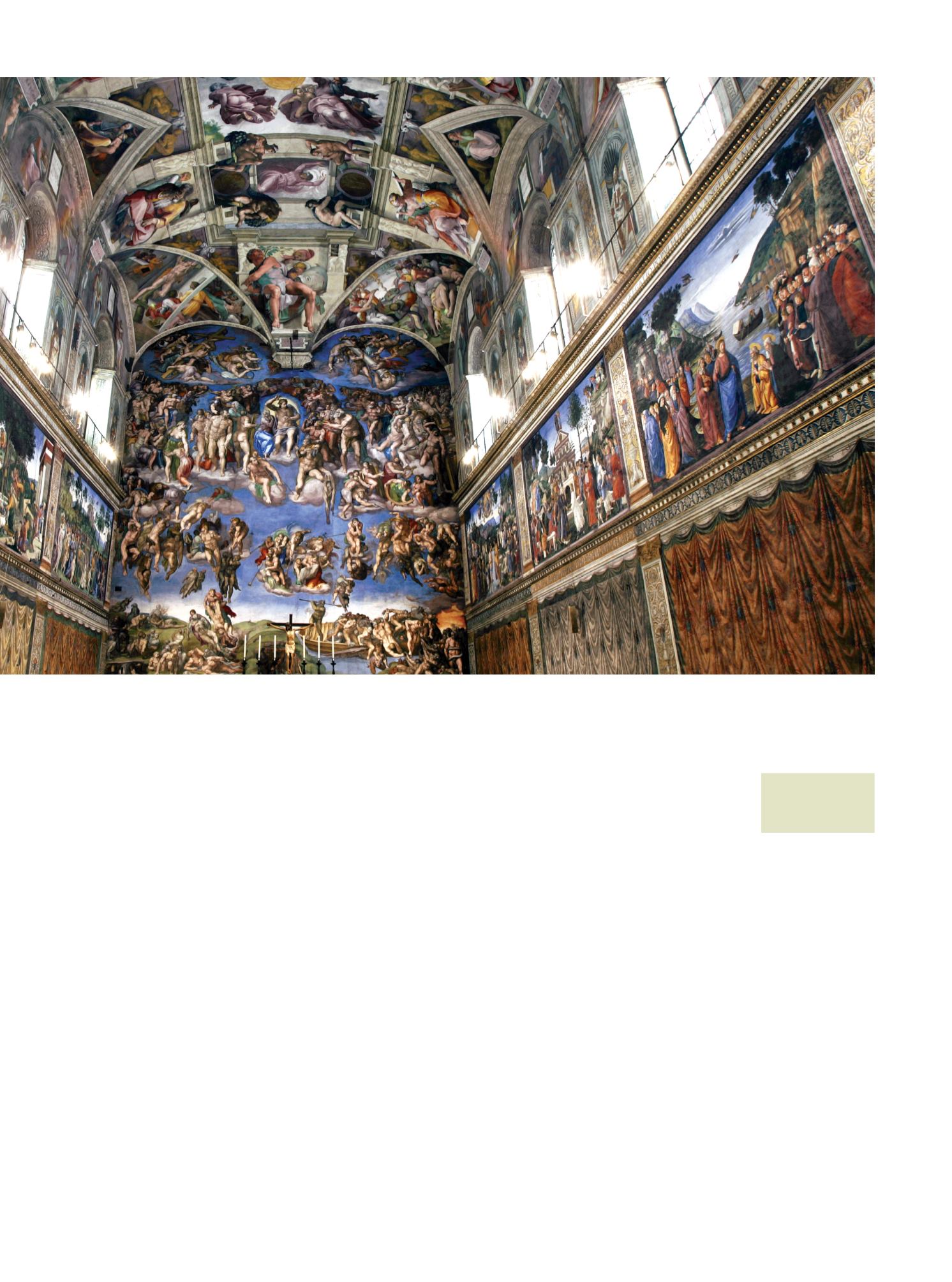
Esta magnífica obra, no obstante, recibió varias críticas.
En un principio, esta pared del altar contenía frescos de
Perugino que tuvieron que sacrificarse para que Miguel
Ángel pintara su obra; además, el hecho de que tantos
personajes aparecieran desnudos causó polémicas por
años, hasta que en 1564 en la Congregación del Concilio
de Trento decidieron contratar a Daniel de Volterra para
cubrir algunas de las figuras.
Asimismo, las paredes norte y sur contienenotras re-
presentaciones bíblicas que incluyen lavidadeCristoyde
Moisés. La serie de los Pontífices se extiende a todas las
paredes de la Capilla, se encuentran ubicados en parejas
dentrodenichos. En laparedde la entrada se ilustranel fi-
nal de las historias deCristoyMoises: por un lado laResu-
rrección de Cristo y por el otro la Disputa por el cuerpo de
Moisés. Los frescos originales eran obras de Ghirlandaio y
Signorelli, ambos fueron destruidos cuando se derrumbó
el arquitrabe de la puerta en 1522 y fueron remplazados
por pinturas de Hendrik van den Broeck y Mateos de Lec-
ce con el mismo tema.
5
5.Detallede laCapilla
Sixtina./
Detail of
the Sistine Chapel.
·amura·
131
los conquistadores •
the conquerors
ThemostfamousoftheApostolicPalace
This magnificent work, however, received sev-
eral criticisms. At the beginning, this altar wall con-
tained Perugino’s frescoes that had to sacrifice so
that Michelangelo painted his work. Furthermore,
the fact that many characters appear nude caused
controversy for years, until in 1564 the Congrega-
tion of the Council of Trent decided to hire Daniel of
Volterra to cover some of the figures.
Also, the north and south walls contain other
biblical scenes including the life of Christ andMoses.
The series of the Pontiffs extends to all the walls of
the Chapel, they are located in pairs within niches.
On the entrance wall the final of stories of Christ and
Moses are illustrated: on one side Resurrection of
Christ and on the other the Discussion over the body
of Moses. The original frescoes were work by Ghirlan-
daio and Signorelli, both were destroyed when the
architrave of the door collapsed in 1522 and were re-
placed by paintings by Hendrik van den Broeck and
Matteo da Lecce with the same subject.


