Fuentes y lagos artificiales
Los romanos han mostrado un aprecio incondicional
hacia las fuentes públicas, de ahí que en la capital
existan, de diferentes tiempos, decenas de éstas, que
van desde sencillos abrevaderos hasta monumenta-
les piezas del arte universal en las cuales, además, se
puede beber agua potable.
Se sabe que en la Roma imperial existieron más de
240 depósitos de agua y fuentes hechas con piedra,
arcilla, argamasa y hasta con madera.
Finalmente, otra importante forma de captación por
canalización de agua que se dio en la Roma antigua fue la
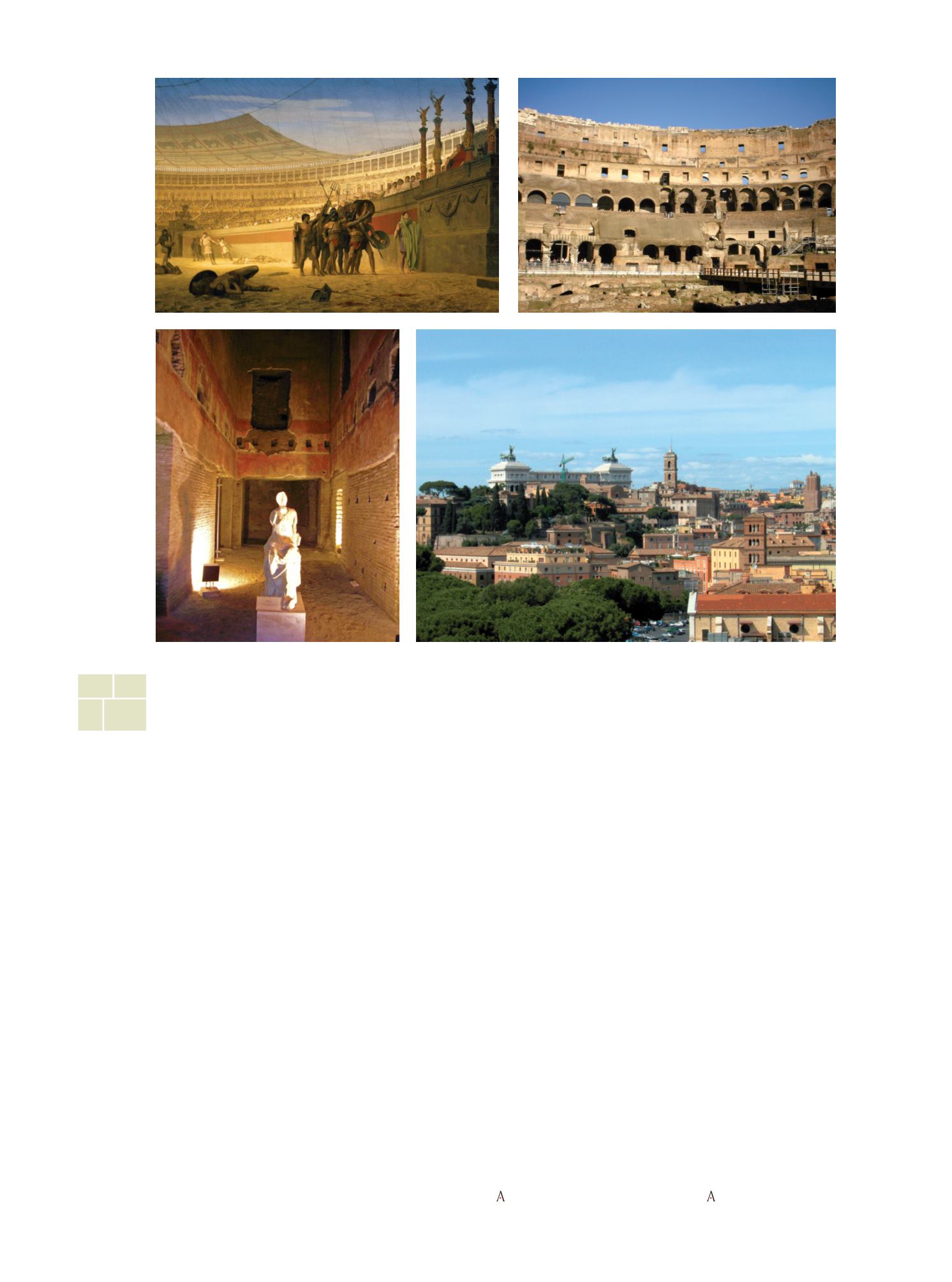
creación de lagos artificiales. Un ejemplo impresionante
fue el que existió en la Domus Aurea de Nerón; pero tam-
bién lo fue el que se generaba cada determinado tiem-
po al interior del Coliseo para celebrar el espectáculo
de las Naumaquias, que eran batallas navales donde
participaban cientos de personas escenificando algún
suceso bélico naval digno de ser recordado. Arqueó-
logos subacuáticos han encontrado bajo el Coliseo,
vestigios de los canales que lograban que el centro del
amplio escenario se llenara de agua.
“El agua es imprescindible para la vida, para satis-
facer necesidades placenteras y para el uso de cada
día”, escribió Vitruvio, ingeniero de Octavio Augusto,
en su libro
VIII De Architectura
.
El imperio siguió creciendo y como dice la obra
Roman Aqueducts & Water Supply
, “adondequiera que
llegaban los romanos, llegaban sus acueductos”.
Prueba de ello todavía se puede testificar en Asia
Menor, Francia, España y el norte de África.
O
16
17
18 19
·amura·
124
herencia cultural •
culture and heritage
16. La naumaquia en
el Coliseo de Roma.
/
The naumachia in
the Colosseum.
17. Canales que había
en el Coliseo. /
Canals
that were inside
the Colosseum.
18.Estatua en la
Domus Aurea. /
Statue at the
Domus Aurea.
19. Vista panorámica
del jardín Aranci. /
Panoramic view of
the orange garden.
Fountains and artificial lakes
The Romans have shown an unconditional esteem
for the public fountains, due to this there exist in
the capital, from different periods, dozens of these
fountains, that go from simple drinking troughs up
to monumental pieces of the universal art in which,
also, it is possible to have drinking water.
It is known that in the Imperial Rome there were
more than 240 water deposits and fountains made
with stone, clay, mortar and even wood.
Finally, another important form of catchments
by channeling of water that flourished in ancient
Rome was the creation of artificial lakes. An impres-
sive example was the one that existed in the Domus
AureaofNero; but alsowas theone that got generated
every so often inside the Colosseum to celebrate the
spectacle of the Naumachia, that were naval battles
where hundreds of persons portrayed some naval
war event worthy of being remembered. Sub-aquatic
archaeologists have found under the Colosseum, re-
mains of the channels that allowed that the center of
the wide stage to be filled up withwater.
“Water is essential for life, to satisfy plea-
sure needs and for everyday use”, Vitruvius, en-
gineer for Octavius Augustus, wrote in his book
VIII De Architectura
.
The empire kept growing and as the work
Roman
Aqueducts & Water Supply
says, “anywhere the Ro-
mans went, their aqueducts went with them”. Proof
of that can still be witnessed in Asia Minor, France,
Spain and North of Africa.


