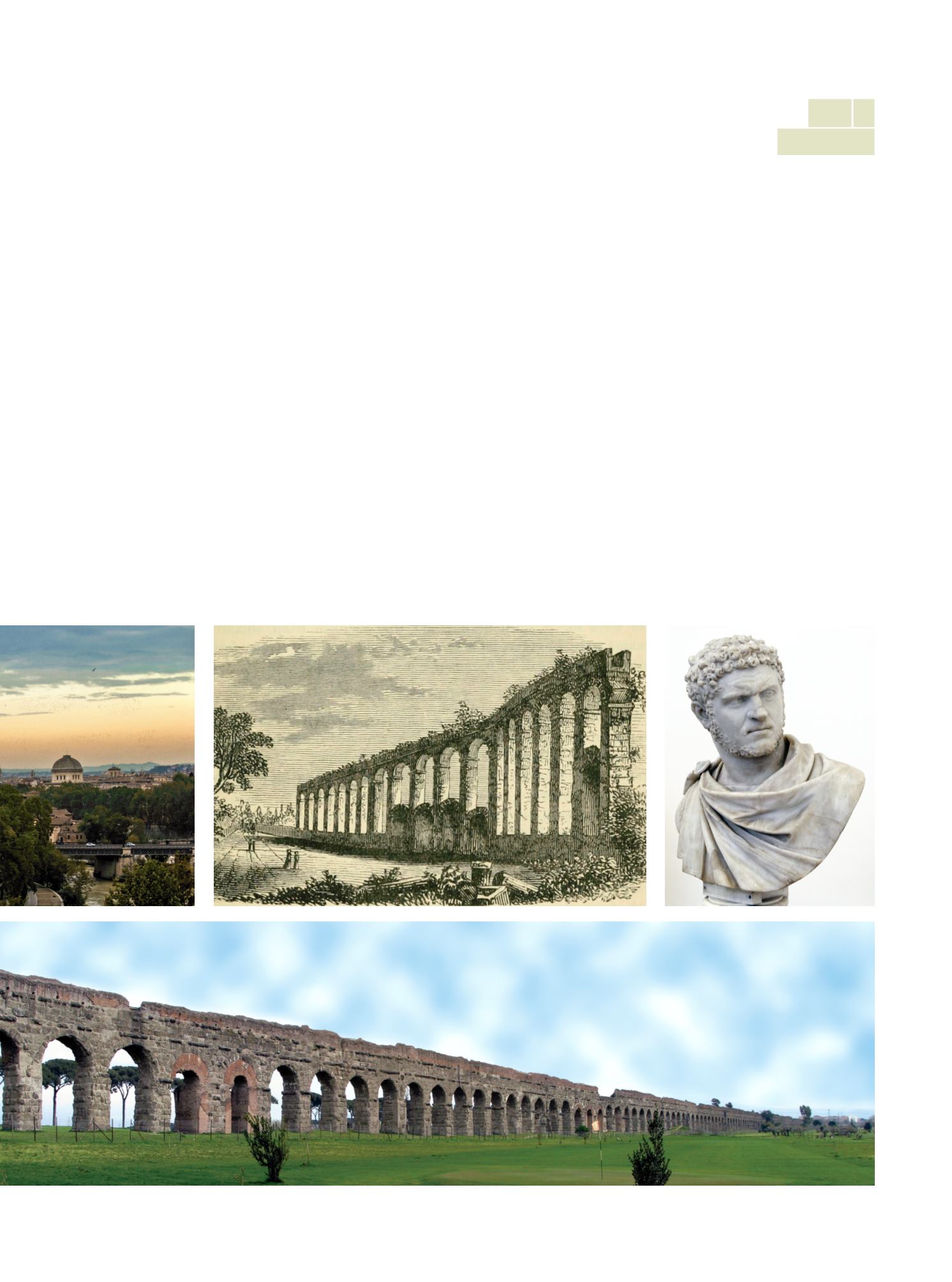
6. Para el siglo V
la ciudad tenía 11
acueductos. /
For the
5th century, the city
had 11 acueducts.
7. Busto del
emperador Caracalla.
/
Bust of Emperor
Caracalla.
8. Vista panorámica
del acueducto Aqua
Appia. /
Panoramic
view of the Aqua
Appia aqueduct.
Una sólida infraestructura
El primer acueducto que tuvo Roma fue el Aqua
Appia, construido en 312 a.C., prácticamente sub-
terráneo, exceptuado el tramo de la Porta Capena,
(de más de 16 km) que llevaban agua de los ma-
nantiales que estaban entre las millas VIII y IX de la
Vía Prenestina. Este acueducto entraba en a la ciu-
dad por el paraje llamado ad Spem Veterem, donde
hoy se alza la Puerta Mayor.
Para el 272 a.C. por iniciativa de Manio Curio
Dentato, quien siendo de origen plebeyo llegó al
grado de cónsul romano, se erigió el Anio Vetus, un
acueducto más largo que el anterior; comenzaba
en el río Aniene, entraba por Spes Vetus, atravesa-
ba el Esquilino por un canal subterráneo y termi-
naba en las cercanías de lo que actualmente es la
Estación Termini. Uno de los más importantes fue
el Aqua Marcia, el más largo de la Roma antigua,
construido en 144 a.C. y que llevaba agua desde la
parte alta de la cuenca del río Aniene, para llegar
también a lo que se conoce en la actualidad como
la terminal de tren más importante de la ciudad.
Con el tiempo se le hicieron adecuaciones; uno de
los registros indica que en tiempos del emperador
Marco Aurelio Antonino Basiano, Caracalla (186 -
217), ordenó la generación de un canal secundario
para cubrir las necesidades de unas termas que es-
taban en construcción.
6
7
8
·amura·
121
herencia cultural •
culture and heritage
A solid infrastructure
The first aqueduct that Rome had was the Aqua
Appia, built in 312 BC, mostly subterranean, ex-
cept for the section of la Porta Capena, (of more
than 16 km) and that took water from the springs
that were between the miles VIII and IX of the Via
Praenestina. This aqueduct entered the city by
the place called ad Spem Veterem, where La Porta
Maggiore raises today.
By 272 BC. by initiative of Manius Curius Den-
tatus, who despite being of commoner origin
attained the rank of Roman Consul, Anio Vetus
was erected, an aqueduct even longer than the
previous one; it started on the Aniene river, it
entered by Spes Vetus, went across Esquiline by
means of an underground channel and ended
nearby what is currently the train station Termi-
ni. One of the most important was the Aqua Mar-
cia, the longest one of ancient Rome, built in 144
BC and it used to take water from the high part
of the basin of the Aniene river, to reach what is
now known as the most important train station
in the city. Through time some adaptations where
made; one of the records indicates that in times of
the Emperor Marcus Aurelius Antoninus Basiano,
Caracalla (186 - 217), he ordered the creation of
a secondary channel to cover the needs of some
thermae that were under construction.


