Foto /
Photo
: IC / THE POCHTIMES / SPS / AO / FRANCE INFO / MA ANGELES / ROBERT M
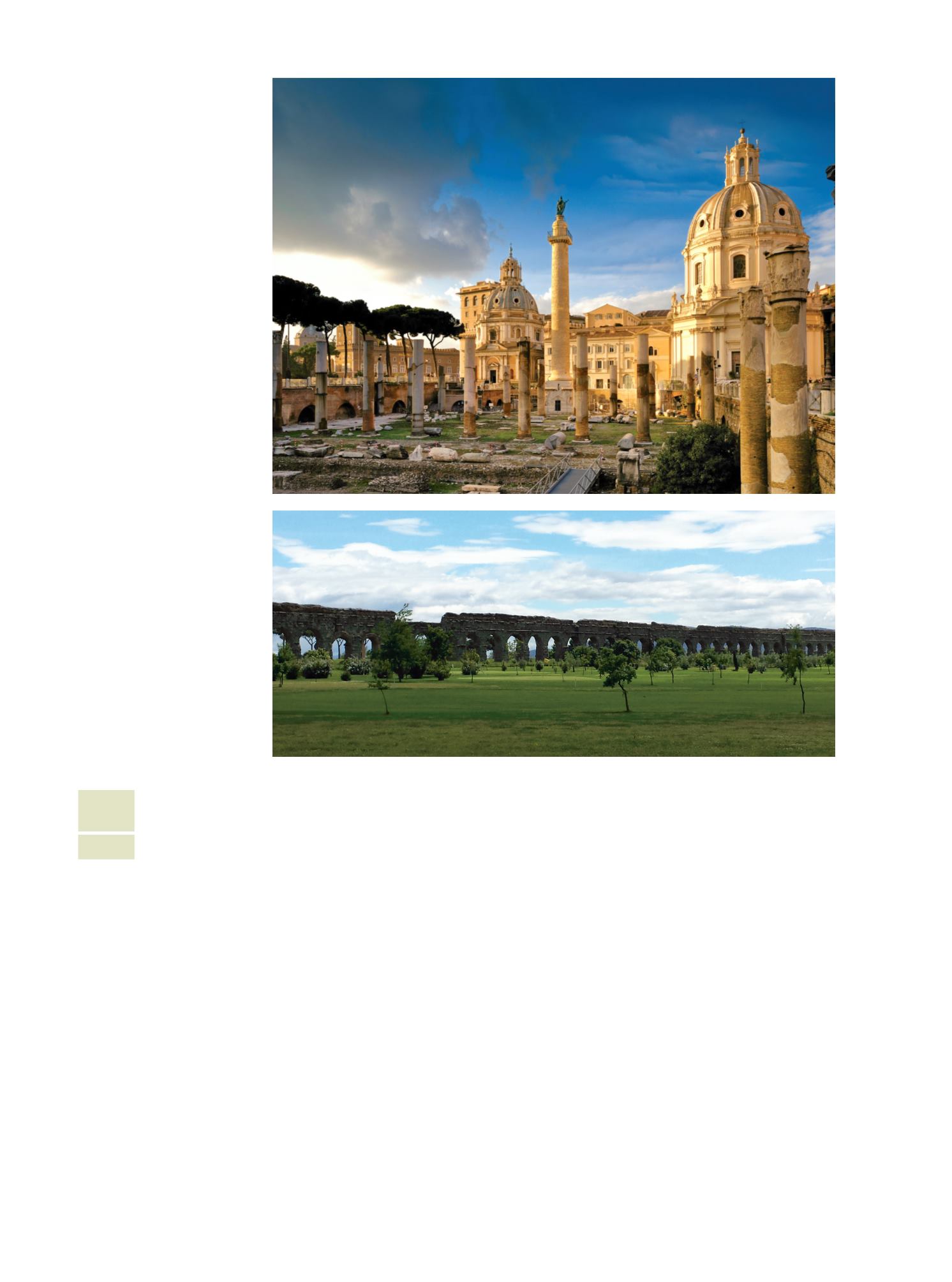
Por su parte, el Anio Novus traía el agua del río Su-
biaco, ubicado a 68 km de Roma, mientras que el Aqua
Claudia, el cual se construyó al mismo tiempo que el
anterior, llevaba el agua a la Domus aurea. Ambos fue-
ron iniciados por Calígula, sin embargo este último,
terminado por Claudio, es considerado la realización
más grandiosa de todas. Los arcos son visibles en las
cercanías del arco di Dolabella e Silano.
Algunos de estos acueductos y otros no menciona-
dos, como el Aqua Iulia, Aqua Alsietina y Aqua Traiana
fueron rescatados siglos después, para restaurarlos e
incrementar su caudal. Por ejemplo, en 1453, el céle-
bre arquitecto Leon Battista Alberti, bajo instrucción
del papa Nicolás V, fue el encargado de restauración de
las obras del Aqua Virgo, cuyo caudal terminaba donde
ahora se yergue majestuosa la Fontana di Trevi.
El Aqua Alexandriana es cronológicamente el últi-
mo de los acueductos romanos. El emperador Alejandro
Severo ordenó su construcción, la cual llegó a la ciudad
hacia el año 226; el agua provenía del pueblo de Colonna,
en Pantano Borghese, y llegaba a Roma sobre las típicas
arcadas revestidas de ladrillo, que siguen las Vías Pre-
nestina y Labicana y mueren en la Puerta Mayor. Entre
otras, abastecía las Termas Alejandrinas.
9
10
9.Domus Aurea de
Nerón. /
Domus
Aurea of Nero.
10. Restos del Aqua
Alsietina. /
Ruins of
Aqua Alsietina.
·amura·
122
herencia cultural •
culture and heritage
On the other hand, the Anio Novus brought wa-
ter from the Subiaco river,located at 68 km from
Rome, while the Aqua Claudia, that was built at the
same time as the previous one, tookwater to the Do-
mus aurea. Both were started by Caligula, however
the later one, concluded by Claudius, is regarded as
the greatest accomplishment of them all. The arcs
are visible nearby the arc di Dolabella e Silano.
Some of these aqueducts and others not men-
tioned, like the Aqua Iulia, Aqua Alsietina and Aqua
Traiana were rescued centuries later, to restore them
and increase their flow stream. For example, in 1453,
the famous architect Leon Battista Alberti, under or-
ders of the Pope Nicholas V, he was commissioned
with the restorationworks of the Aqua Virgo, its flow
end where la Fontana di Trevi now stands proud.
The Aqua Alexandriana chronologically is the last
one of the Roman aqueducts. The Emperor Alexander
Severus ordered its construction, that reached the city
towards the year 226; the water came from the town of
Colonna, in Pantano Borghese, and reached Rome atop
the typical arcades coated inbricks, that followtheVias
Praenestina y Labicana and die off in la PortaMaggiore.
Amongothers, it provided theAlexandrineThermae.


