·amura·
45
compás int • int compass
Las siete colinas de Roma
El centro de la ciudad estaba delimitado por siete
colinas: Palatino, Capitolino, Celio, Esquilino, Quirinal
y Viminal, actualmente también el Janículo, Vaticana
y el Pincio.
El monte Palatino se encuentra ubicado entre el
Circo Máximo y el Foro Romano. Luego de ser habita-
do por Rómulo, se convirtió en uno de los lugares más
atractivos y deseados para vivir y construir palacios
por muchos de los más importantes e influyentes ha-
bitantes de la antigua Roma, debido a que se encuen-
tra en el punto más céntrico de la ciudad.
En el Palatino todavía se encuentran los restos de la
civilización de Rómulo que data del siglo IX a. C., también
se pueden visitar las residencias de los emperadores
Augusto, la de su esposa Livia, Tiberio, Domiciano, el
templo de Apolo y los Jardines Farnese.
Otra de las colinas más importantes es el monte
Capitolino, donde se encuentra el templo de Júpiter,
el cual era el centro del mundo romano y el escenario
de las ceremonias políticas y religiosas más sagradas.
Simboliza la autoridad de Roma como
Caput Mundi
,
cabeza del mundo, por lo que este tipo de gobierno es
el modelo precedente de toda civilización capitalista.
El Ayuntamiento y Senado de Roma se encuentran
aquí, en un complejo de edificios del Renacimiento
diseñados por Miguel Ángel.
The Seven Hills of Rome
The center of the city was delimited by seven hills:
Palatine, Capitoline, Caelian, Esquiline, Quirinal and
Viminal, currently also the Janiculum, Vatican and
the Pincian.
The Palatine mount is located between the Cir-
cus Maximus and the Roman Forum. After being
inhabited by Romulus, it became one of the most
attractive and desired places to live and build pal-
aces by much of the most important and influential
inhabitants of ancient Rome due to being located on
the centermost place of the city.
In the Palatine, remains of Romulus’ civilization
are still found dating back to the IX century BC, also
the Residences of the Emperors Augustus, the one
of his wife Livia, Tiberius Domitian, the Temple of
Apollo and the Farnese Gardens can be visited.
Another of the most important hills is the Capi-
toline mount, where The Jupiter Temple is located,
it was the center of the Roman world and the stage
of the most sacred political and religious ceremo-
nies. It symbolizes the authority of Rome as Caput
Mundi, head of the world, by which this type of gov-
ernment is the precedent model for all capitalist
civilization. The City Hall and the Senate of Rome
are located here, in a complex of buildings from the
Renaissance designed by Michelangelo.
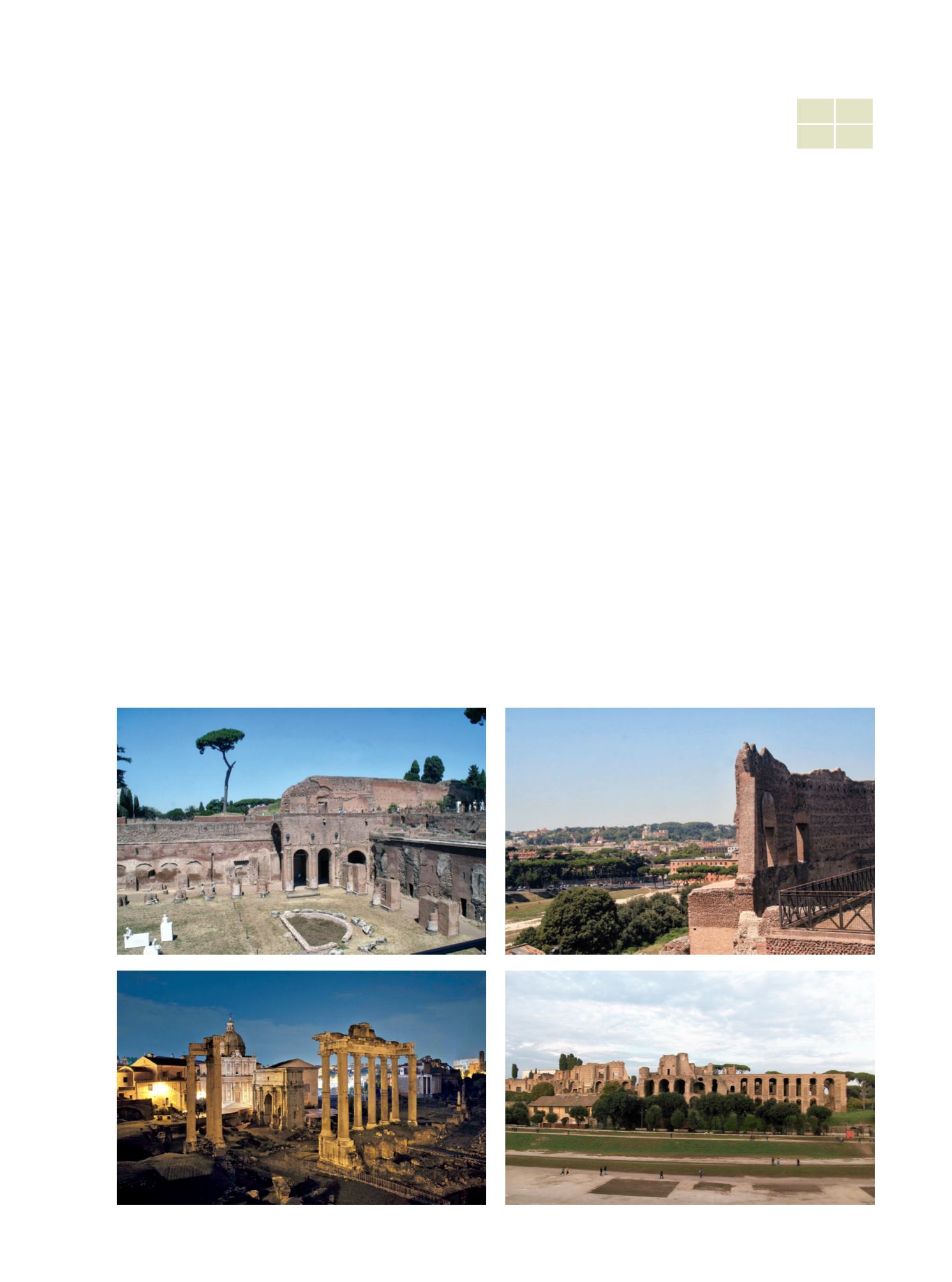
6.Tumbasde incineración
delMontedelPalatino,
dondeseencontraba la
cuevade la loba,Luperca,
dondeseamamantóa los
gemelosfundadoresde
Roma,RómuloyRemo.
/
Cremationtombsof
MountPalatine,where
thecaveofthewolf,
Lupercal,whichfedthe
twinfoundersofRome,
RomulusandRemus.
7.EnelPalatinoyel
Quirinalsepueden
ver infinidadderestos
de las imponentes
edificacionesquefueron
construidaspara laalta
sociedadromanaen la
Antigüedad.
/
InthePalatineand
Quirinalcansee
countlessremainsofthe
imposingbuildingswere
builthighinancient
Romansociety.
8.ElForoRomano,
construidoenterrenos
pantanosos,muestra las
ruinasde loquefueensu
épocaelcentroneurálgico
deRoma.
/
TheRomanForum
builtin
swamps ,
showstheruins
thanitwasin
itstimethecenter
ofnerve
Rome.
9.ElCircoMassimo(el
circomásgrande),fue
unestadioparacarreras
decarrosde laAntigua
Roma.
/
TheCircoMassimo(the
biggestcircus),wasa
stadiumforchariotraces
ofancientRome.
6
7
8
9


