·amura·
155
cinematografía •
Cinematography
La actuación moderna nació en Moscú
¿Qué sería el cine sin la actuación, sin una disciplina
que marcara las pautas de cómo preparar un persona-
je que es quien lleva el peso de la historia?
El actor es quien da vida a la historia, quien con su
sensibilidad nos cuenta una historia en el cine. Actuar
no es actuar, pues por paradójico que suene actuar no
es fingir una emoción.
Lo que el actor menos quiere al momento en el que
la película termina es que el público diga: “El papel de
ese actor se veía muy actuado.” Por el contrario, cuan-
do vamos al cine no queremos ver a actores actuando,
queremos ver a seres humanos de carne y hueso ex-
perimentando una vivencia real.
La persona que fundó las bases para el estudio de la
actuación como hoy la conocemos, el hombre que de-
dicó su vida a crear un método del cual se desprenden
gran parte (si no es que todas) de las teorías de actua-
ción en la actualidad, fue Constantin Stanislavski.
Stanislavski se destacó por fundar, administrar
y dirigir el Teatro de Arte de Moscú a principios del
siglo XX. Durante su rectoría elaboró su método
Stanislavski, el cual es un acercamiento al estu-
dio actoral, que como ya hemos dicho, es la base
de cualquier método actoral en la actualidad. Este
método se basa en la relajación, concentración y la
imaginación del actor como ejes principales para
preparar y ejecutar un personaje.
El legado de Stanislavski vive para siempre, pues
tanto para cualquier persona que se diga actor como
para cualquier director, es imposible no dominar los
fundamentos que este actor ruso postuló.
Modern acting was born inMoscow
What would be of filmwithout acting, without a dis-
cipline that marks the guidelines of how to prepare
a character who carries the weight of the story?
The actor is the one who brings the story to life,
whose sensibility tells a story on film. As paradoxi-
cal as it may sound, acting is not acting, it is not the
feigning of emotions.
What the actor least desires the moment a
film completes if for the public to say: “The role
played by this actor looked overwrought.” On the
contrary, when we go to the theater, we want
to see flesh-and-blood beings undergoing a
real experience.
The person who founded the bases for the act-
ing studio as we know it today, the man who dedi-
cated his life to create a method in which a great
deal, if not all, theories of acting are derived today,
was Constantin Stanislvaski.
Stanislavski distinguished himself by founding,
administrating, and directing the Moscow Art The-
ater in the beginning of the 20th century. During his
tenure, he crated the Stanislavski method, which is
an approach to the actor’s studio, which, as we have
mentioned, is the basis for andmodern actingmeth-
od. This method is based on relaxation, concentra-
tion, and the imagination of the actors as the main
vehicles to prepare and execute a character.
Stanislavski’s legacy lives forever, since it is im-
possible for any person who considers themselves
as an actor, or as a director, to not dominate the fun-
damentals that this actor brought forward.
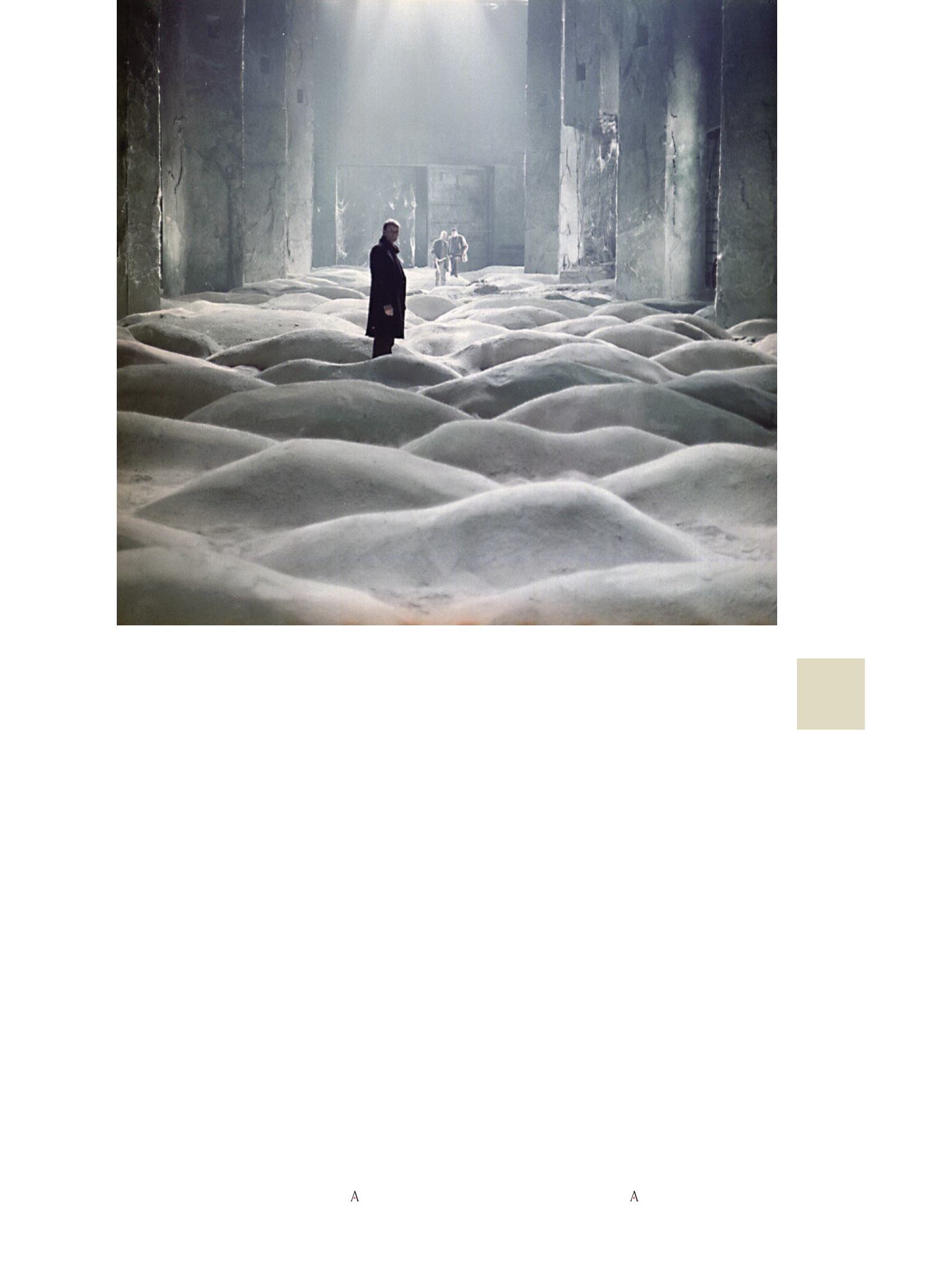
6. Andrei Tarkovsky
en el set de la
película Latercalled
Mirror 1973. /
Andrei
Tarkovskyontheset
ofthemovieLater-
calledMirror1973.
6


