·amura·
82
los conquistadores •
the conquerors
el momento en que la reina Ginebra traiciona al rey Ar-
turo y besa a Lancelot, Paolo y Francesca se funden en
un beso. Gianciotto los descubre, los arroja a un pozo
sin fondo y quedarán capturados en el segundo círculo
del infierno por el pecado de la lujuria. Una cuestión
atractiva es que no hay beso. Si el visitante se asoma,
ellos están a punto de rozar sus labios. Sin embargo,
hay una segunda versión de la obra, también realiza-
da en el mismo año, y una mala fundición hace que la
mano toque el muslo y aquí sí se funden los labios. De
las nueve versiones que Rodin hizo de
El beso
, las nue-
ve forman parte de la Fundación Carlos Slim, dos aquí
y las otras en el Soumaya de Plaza Loreto.
En contraste y cercano a los prerrafaelitas, se
encuentra
Amor secreto
, atribuido a Antonio Rosetti,
quien ha cubierto el rostro del hijo de Venus, la Afro-
dita griega. El dios del amor, tiene flechas de punta de
plomo y otras de oro; si las puntas de plomo se clavan
en el corazón de una persona, a la primera que viera
la odiaría para siempre; pero si las flechas de oro se
clavan en el corazón de una persona, de la primera que
viera caería irremediablemente enamorado.
Un día accidentalmente Eros se clavó una de sus
flechas de oro y quedó prendado de la bellísima y hu-
mana Psique; Rodin resignificará el mito en su mármol
Psique contemplando al amor
. Ella cobijada por el man-
to de la noche, descubre la identidad de su marido. En
la tercera posición del ballet clásico seduce a los visi-
tantes a romper el pacto para finalmente consentir el
matrimonio de Psique, y Eros.
El amor hasta la locura
de Jean Baptiste Carpeaux,
es una de las primeras maquetas para la fachada de
la Ópera de París. El amor que agita el corazón de los
hombres, lo mueve y lo trastoca, como ha trastocado
el amor de su madre con el mito de Adonis o con el
Amor fugitivo
, el amor que se escapa, o con las perver-
siones más sentidas de los versos de Charles Baude-
llaire aquí en
Mujeres malditas
o
Mujeres Condenadas
.
Para hablar de estas violencias del amor, tenemos
the Queen Guinevere betrays King Arthur and kiss-
es Lancelot, Paolo and Francesca are merged in a
kiss. Gianciotto discovers them, throws them into a
bottomless pit and they get captured on the second
circle of hell for the sin of lust. One attractive issue
is that there is no kiss. If the visitor appears, they
are about to brush her lips. However, there is a sec-
ond version of the work, also performed in the same
year, and a bad cast makes the hand touching the
thigh and there the lips get melted. From the nine
versions of
The Kiss
made by Rodin, the nine are part
of the Carlos SlimFoundation, two here and the oth-
ers in the Soumaya Plaza Loreto.
In contrast, and close to the Pre-Raphaelites, is
Secret Love
attributed to Antonio Rosetti, who has
covered the face of the son of Venus, the Greek Aph-
rodite. The god of love, has lead-tipped arrows and
some others of gold, if the lead tips stick in the heart
of a person, this person would hate forever the first
person this could see, but if the golden arrows stick
in the person’s heart, the person would fall hope-
lessly in love with the first person this could see.
One day Eros accidentally stuck one of his gold-
en arrows and fell in love with the beautiful and
human Psyche; Rodin will resignify the myth in his
marble;
Psyche contemplating love
. She sheltered by
the cloak of night, discovers the identity of her hus-
band. In the third position of the ballet she attracts
visitors in order to break the pact and finally con-
sent the marriage between Psyche and Eros.
Love to the folly
by Jean Baptiste Carpeaux, is one
of the first models for the facade of the Paris Opera.
The love that stirs the hearts of men, moves and
upsets them, as has shaken the love of his mother
with the myth of Adonis or with the
Fleeting Love
,
love that escapes, with Charles Baudelaire’s perver-
sions of the deepest verses here in
Cursed Women
or
Doomed Women
. To speak of this violence of love, we
also have in bronze andmarble
The Kiss of the Ghost
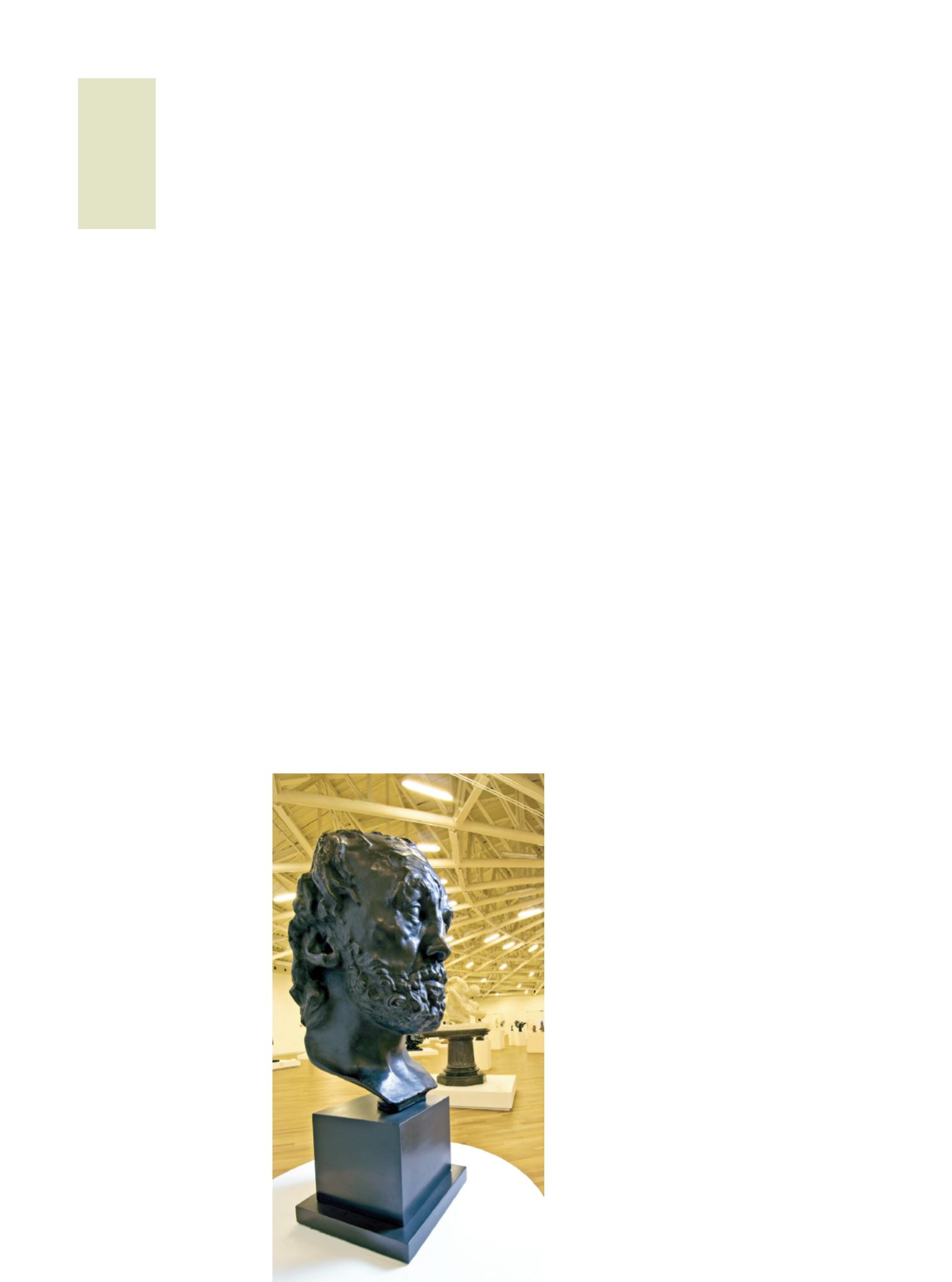
1. Auguste Rodin
(París, Francia,
1840 – Meudon,
Francia, 1917)
Máscara del hom-
bre de la nariz rota
1863 - 1864
Bronce con pátina
negra, café oscuro
y verde
31.2 x 19 x 16.3
cm; base 12.5 x
15.1 x 15.3 cm
2. Auguste Rodin
(París, Francia,
1840 – Meudon,
Francia, 1917)
Las tres sombras
1880
Bronce con pátina
café y negra
193 x 187.5 x
108.4 cm
El vulgo
–diría Rodin-
se imagina fácilmen-
te que lo que considera feo en la realidad no
constituye materia artística. Querría pro-
hibirnos representar lo que le disgusta y le
ofende de la Naturaleza.
The vulgar
-would say Rodin-
easily imagine
that what they considered ugly in reality is
not really art. It would like to forbid us repre-
sent what offends and upsets it about Nature.


