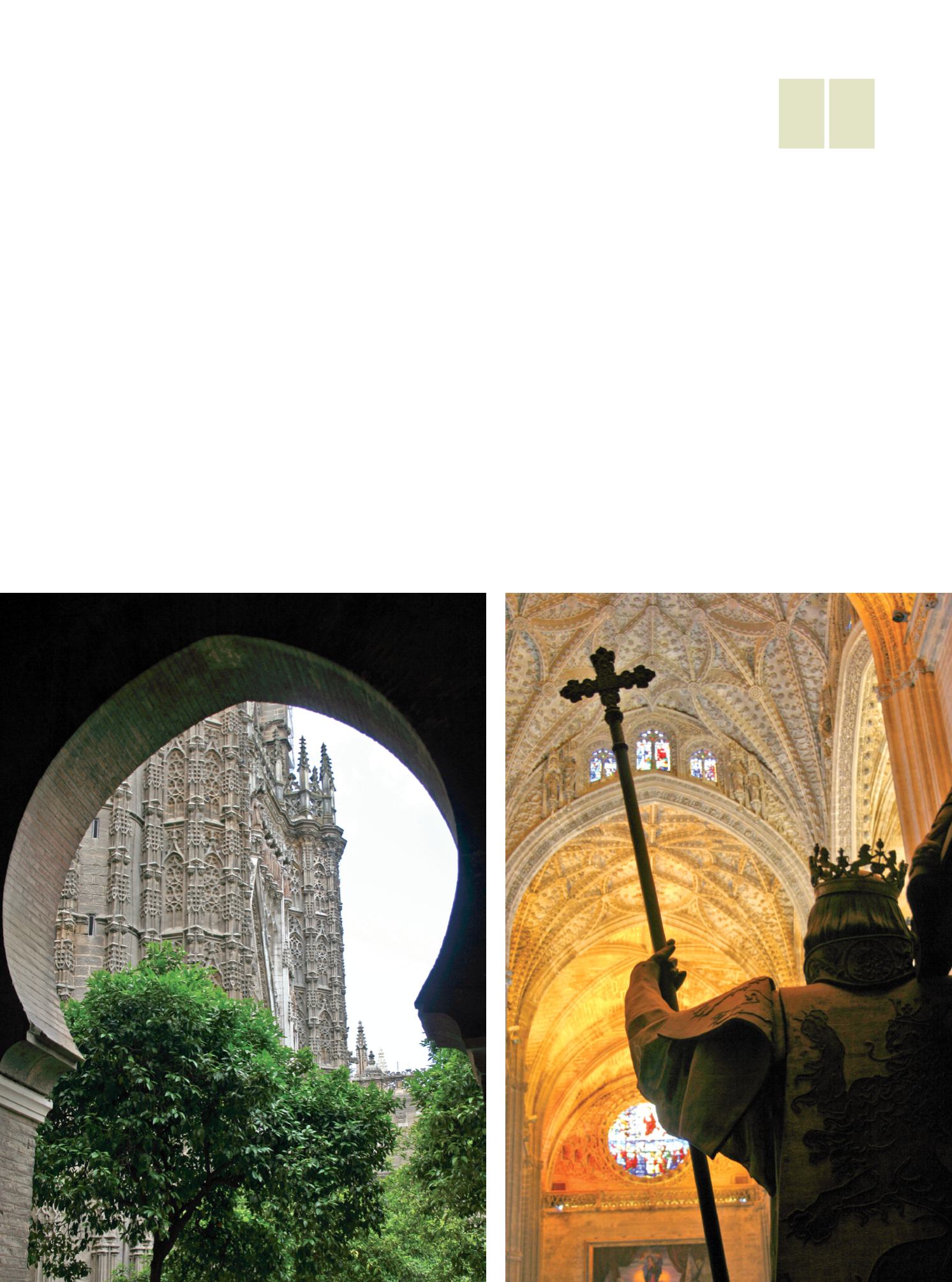
Reconquered by Ferdinand III in 1248, La Giralda
was transformed by Morish influence. It was built
in the twelfth century and now adorns the largest
Gothic cathedral in the world. It was built in 1401
and is still proud of its famous Patio de los Naran-
jos, whichwas part of themosque. Its architecture is
unusual for a cathedral and is somehow explained
by the influence of the mosques. It includes the
impressive Royal Chapel where the Kings San Fer-
nando, Alfonso X and Pedro I the Cruel lie.
The Alcazar is the Moorish fortress that became an
elegant Mozarabic palace for Catholic kings who very
much enjoyed their courtyards and sparkling foun-
tains surrounded byMoorish arches andwalls decorat-
ed with tiles and carved stucco. The alleys of the Barrio
de Santa Cruz, the old Jewish quarter, kept the atmo-
sphere of the so, where theMoorish atmosphere resur-
faceswithin theAndalusian. Its courtyards dazzlewith
mysteryandtheHouseofPilatecatchestheeyewithits
MoorishandRenaissance architecturalmix.
Churches are a beautiful haven of peace while
the bars invite us to get happy in Andalusian life,
enjoying the “pata negra” ham, a gazpacho and the
fried seafood. In Santa Cruz, we admired the court-
yards, and spent haunted evenings enchanted by
the “cante jondo” and flamenco. We admired the
Plaza de España” and its baroque twentieth centu-
ry architecture and just chilled out at the Parque
Maria Luisa. At night, we crossed the river to go
Reconquistada en 1248 por Fernando III, se fue
transformando sobre esas bases moras: la Giralda,
construida en el siglo XII, ahora adorna la Catedral
gótica más extensa del mundo, construida en 1401 y
todavía orgullosa de su afamado patio de los naranjos,
que era parte de la mezquita. Su arquitectura, atípica
para una catedral pero explicable por la influencia de
las mezquitas, incluye la impresionante Capilla Real
donde reposan los reyes San Fernando, Alfonso X y
Pedro I el Cruel.
El Alcázar, antigua fortaleza árabe, se volvió
un elegante palacio mozárabe para reyes católicos,
quienes disfrutaban mucho sus patios y el murmullo
de sus fuentes rodeadas por arcos árabes y muros
decorados de azulejos y estuco labrado. Los callejo-
nes del Barrio de Santa Cruz, antigua judería, conser-
van la atmósfera de zoco, donde el ambiente moro
resurge dentro del andaluz. Los patios deslumbran
de misterio y la Casa de Pilatos atrapa la vista con su
mezcla arquitectónica mudéjar y renacentista.
Las iglesias son un bello refugio de paz mientras
los bares invitan a imbricarnos en la vida andaluza,
gozando del jamón de pata negra, de un gazpacho o un
salmorejo, de la fritura de pescados y mariscos. En el
barrio de Santa Cruz admiramos los patios, pasamos
las veladas embrujados por el cante jondo y el flamen-
co, gozamos de la Plaza de España con su arquitectura
barroca del siglo XX y nos refrescamos en el parque
María Luisa. En la noche cruzábamos el río para ir a
compás int • int compass
·amura·
53
3. El pario de los
naranjos de la
Catedral de Sevilla
/
The orange pario
in the Sevilla
Cathedral.
4. Escultura
de Cristóbal
Colón, interior
de la Catedral de
Sevilla /
Cristóbal
Colón sculpture
inside the Sevilla
Cathedral.
4
3


