the market was installed at a time when the Muslim
culture was predominant. We visited the sumptuous
palaces strolling the courtyards enjoying the ham, the
olives and the lomo de caña . Carmona is seducing be-
cause of its candor, keeping its secrets, gets naked be-
hind the coldness of its high walls, as if it was dancing
to the rhythmof a romanticnovel.
Jerez de la frontera - Wines, Flamenco and Horses
We sailed along the river toward the sea, and
found on the banks of the Guadalquivir, Jerez de
la Frontera. The city is watching the fertile val-
ley where the vines brought by the Phoenicians in
1100 BC are grown. The town is filled with an aroma
of wine and of the famous sherry wine. From the
streets typically Andalusian, arise Arab vestiges
from times when the place was a Muslim peasant
village. We visited the Gonzalez Byass wineries,
whose emblem in their bottle is a red hat and jacket,
inhabits the city and the fields of Spain, as well as
the Domecq or Estévez. We admired the cathedral,
the churches and palaces, such as Domecq, the
Abrantes Duke, Bertemati and Riquelme.
Horses are part of the culture. For centuries the
Carthusianbred, developed and preserved the Carthu-
sian race which produces, at the foot of the Arab for-
tress, the beautiful white, elegant walking horses. Jer-
ez, according to legend, is the birthplace of flamenco.
It has producedmany of the greatest dancers like Jose
instalaba el mercado en tiempos en los que dominaba
la cultura musulmana; visitamos los palacios y reco-
rrimos sus suntuosos patios disfrutando del jamón,
de las aceitunas y del lomo de caña. Carmona seduce
por su candidez, conserva sus secretos, se desnuda
con ardor detrás de la frialdad de sus altos muros,
como bailando al compás de una novela romántica.
Jerez de la Frontera: vinos, flamenco y caballos
Navegamos siguiendo el afluente hacia el mar y
encontramos, en la margen del Guadalquivir, Jerez de
la Frontera, vigilando el fértil valle donde crecen las
vides traídas por los fenicios en 1100 a.C. El pueblo se
llena del olor a buen vino y al famoso Jerez. De las ca-
lles típicamente andaluzas surgen los vestigios árabes
de épocas en las que el lugar era aldea de campesinos
musulmanes. Visitamos las bodegas González-Byass,
cuyo emblema de la botella con sombrero y chaque-
tilla roja habita la ciudad y los campos de España, y
también las bodegas Domecq o Estévez. Admiramos
la catedral, las iglesias y sus palacios, como los de Do-
mecq, el Duque de Abrantes, Bertemati, Riquelme.
El caballo es parte de la cultura. Durante siglos los
cartujos criaron, desarrollaron y conservaron la raza
cartujana que produce hermosos equinos blancos de
elegante andar, al pie del Alcázar árabe. Jerez, según
la leyenda, es la cuna del flamenco actual y aquí han
nacido muchos de los grandes como Manuel Torre o
José Mercé. El flamenco es de origen gitano-morisco y
·amura·
55
compás int • int compass
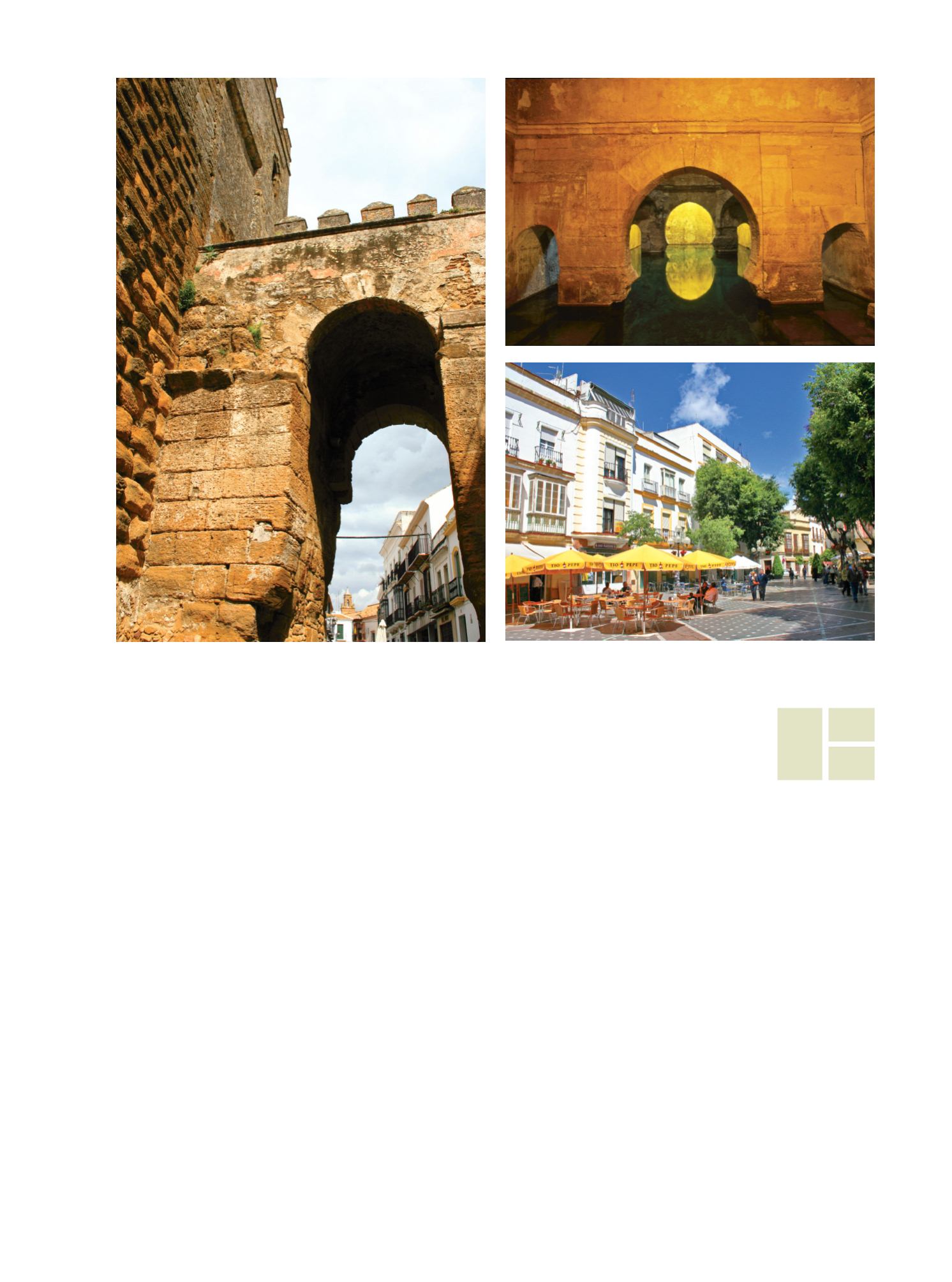
7. Andalucia /
Los
Baños de Doña
María de Padilla,
Seville, Spain.
8. Reflections
Rainwater tanks
reflection /
Los Ba-
ños de Doña María
de Padilla, Seville,
Spain.
9. Jerez de la
frontera /
Jerez de la
frontera.
7
8
9


