Desde lo alto del castillo de Gibralfaro construido
por Yusuf I en el siglo XIV, sentimos la presencia de
los acontecimientos moros del pasado, de las palabras
árabes que retumbaron sobre sus murallas; admira-
mos la ciudad desde lo alto de la fortaleza y pudimos
ubicar que, donde se alza la catedral, en otro tiempo
imperó la inmensa mezquita con su minarete. Ba-
jando el Gibralfaro entramos en la Alcazaba, palacio-
fortaleza de la época Nazarí, cuyos arcos moriscos se
asoman hacia el mar azul, y los jardines de la Puerta
oscura inundan con su olor a flor de azahar. Atrave-
samos el teatro romano, cruzamos la Alameda, visita-
mos los palacios y vagamos por esa ciudad que nos
acogió como si fuésemos el último moro después de
la reconquista.
From the top of the Gibralfaro castle built by
Yusuf I in the fourteenth century, we feel the pres-
ence of the Moors events of the past, of the Arabic
words that rang on their ramparts. We admired the
city from the top of the fort and we could appreci-
ate that, where the cathedral stands, once a huge
mosque reigned with its minaret. Going down the
Gibralfaro we entered the Alcazaba, the fortified
palace from the Nasrid era, whose Moorish arches
look out towards the blue sea and the gardens of
the Puerta Obscura (dark door) flooded with an or-
ange blossom aroma. We crossed the Roman theater
and the Alameda, visited the palaces and wander
through the city that welcomed us as if we were the
last Moor after the reconquista.
1
compás int • int compass
·amura·
60
15 16
17
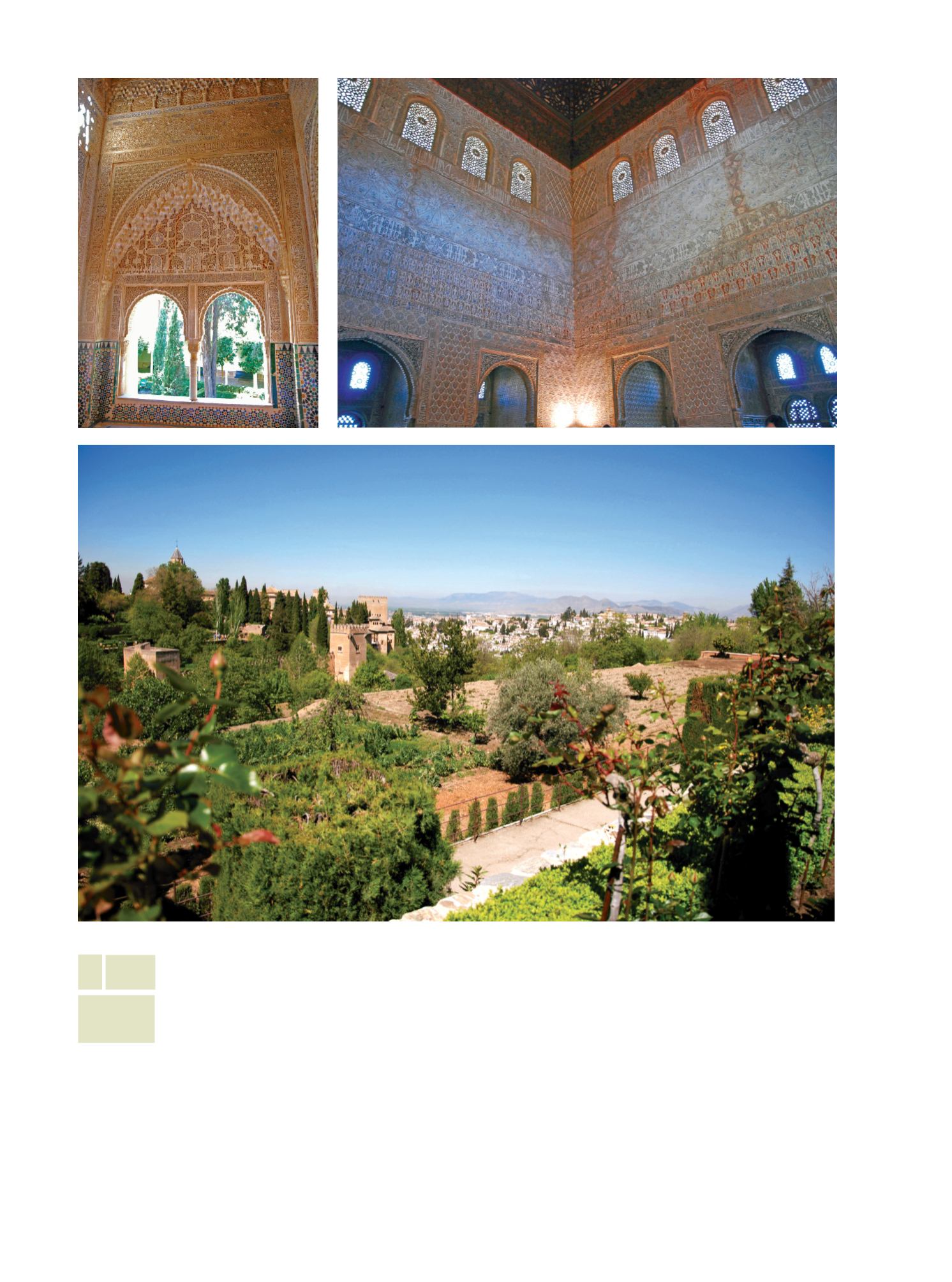
15. Sala de Dos
Hermanas /
The Hall
of the Two Sisters-
Alhambra, Granada,
Spain.
16. Sala de Emba-
jadores /
Hall of
the Ambassadors,
The Throne Room.
Alhambra, Granada,
Spain.
17. Jardines Nuevos
/
New Gardens,
Alhambra, Granada,
Spain.


