45
compás int •
compass int
·amura·
imposible y trágico. El arte mudéjar (tradición artís-
tica musulmana desarrollada en una sociedad cris-
tiana) adorna la pequeña gran ciudad donde el buen
comer es un arte típico aragonés que forma parte de
su encanto.
Las torres mudéjares de campanario que puntú-
an el casco antiguo fueron decoradas con cerámica y
motivos arabescos creados por ladrillos y la catedral
sorprende por su torre, el artesonado gótico-mudé-
jar y su retablo plateresco.
La Plaza del Torico seduce por sus portales y
casas modernistas, la Iglesia de San Pedro, antigua
mezquita, encanta por su bóveda ricamente decora-
da, el viaducto (siglo XVI) impresiona por su fuerza y
lo que más apasiona es el mausoleo de los famosos
amantes.
Albarracín, auténtica aldea-museo encerrada en
su muralla sobre el peñón del recoveco del río
Guadalaviar, sorprende por su belleza. El castillo de
origen árabe domina el pueblo, las casas cuelgan de
las rocas, y los callejones se transforman en escali-
natas para alcanzar rincones encantadores vigilados
por la muralla.
Su iglesia renacentista, el Palacio Episcopal que
alberga un fabuloso museo, las casonas y palacios, la
herrería de las ventanas, la acogedora Plaza Mayor y
los impresionantes aleros de los tejados hacen de
Albarracín un enclave con atmósfera medieval y
sabor árabe. Es considerado el pueblo más hermoso
de España.
La “Casa Santiago” es el mejor restaurante de la
región y se deben probar las almohábanas, un ejem-
plo de repostería árabe.
with the history of its impossible and tragic love.
TheMudejar art (Moslemartistic tradition developed
in a Christian society) decorates the small great
city where the fine dining is a typical Aragonese
art that is part of its charm.
The Mudejar towers of the belfry that mark the
old centre were decorated with ceramics and Arab
motifs created by bricks and the cathedral surprises
by its tower, the coffered ceiling gothic-Mudejar
and its plateresque altarpiece.
The Torico Square seduces by its main doors
and modern houses, the Church of Saint Pedro,
ancient mosque, enchants for its vault richly deco-
rated, the viaduct (XVI th century) impresses by its
strength and what passionate the most is the
mausoleum of the famous lovers.
Albarracin,
authentic
village-museum
enclosed in its wall over the rock of the nook of the
Guadalaviar River, surprises for its beauty. The cas-
tle of Arab origin dominates the village; the houses
hang from the rocks, and the alleys transform into
staircases to reach charming corners guarded by
the wall.
Its Renaissance church, the Episcopal Palace
that houses a fabulous museum, the large houses
and palaces, the windows forge, the cozy Major
Square and the impressive eaves of the roofs make
of Albarracin an enclave with medieval atmos-
phere and Arab flavor. It is considered the most
beautiful village of Spain.
The “Casa Santiago” is the best restaurant of
the region and you must try the almohábanas, an
example of the Arab confectionery.
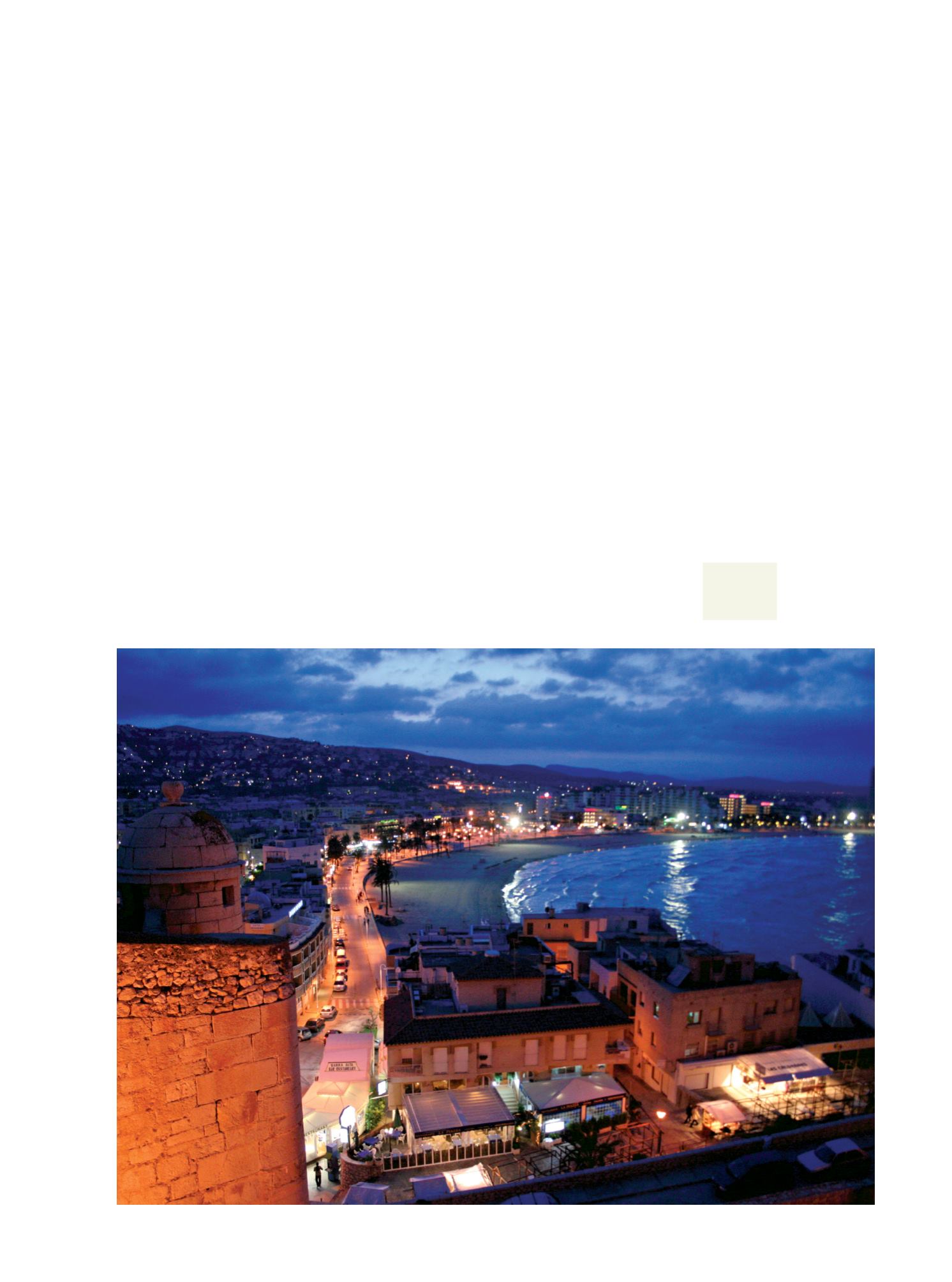
Peñíscola: desde lo alto de
su peñón, se observa su
pasado. Fue una importante
fortaleza árabe que se
volvió cristiana con la
reconquista y el Papa Luna,
Benedicto XIII, ocupó su
palacio como sede de su
extraño pontificado al
margen de la iglesia.
Peñíscola’s past can be
observed from the height
of its headland. It was an
important Moorish
fortress that became
Christian with the
re-conquest and Pope
Benedict XIII (Pedro de la
Luna) lived in its palace as
the seat of his strange
pontificate at the margin
of the church.


