compás int •
compass int
50
·amura·
restaurantes, el gentío y la hermosa marina donde
atracamos nuestro velero.
En nuestro regreso hacia Madrid visitamos las
montañas de esa región valenciana para descubrir el
hermoso Valle de Montaverner, donde comimos las
mejores cerezas, hasta llegar a Xátiva.
Aquí nacieron el pintor José Rivera “el Españolito”
y el papa Borja Alejandro VI. La ciudad conserva un
rico patrimonio artístico, como la colegiata renacen-
tista y el Hospital Real, al pie de su enorme castillo
con treinta torres, cuatro puertas fortificadas y su
muralla que desciende la montaña, fruto de la fusión
ibero-romana-árabe.
Seguimos a Bocairent que data de la época ibéri-
ca, conquistado por los romanos, y que conserva su
modelo urbanístico islámico. El puente Pont Nou per-
mite cruzar el acantilado y tener una vista fabulosa
del pueblo sobre un peñón. Visitamos su iglesia, sus
museos, sus calles empinadas.
Destacan su plaza de toros escavada en la roca en
1843 y los Covetes dels Moros (cincuenta y tres
oquedades excavadas artificialmente en el paredón
rocoso del Barranco de Fos), seguramente antiguas
viviendas trogloditas o sepulcros.
Cuenca
Ya en Castilla La Mancha visitamos esa importante
ciudad. Creada por los árabes, esa villa fortificada fue
restaurants, the crowd and the beautiful marina
where we tied up our sailboat.
In our way back to Madrid we visit the moun-
tains of that Valencian region to discover the beau-
tiful Valley of Montaverner, where we ate the best
cherries, until arriving to Xativa.
Here the painter José Rivera “the Españolito” and
the pope Borja Alejandro VI were born. The city pre-
serves a richartisticheritage, as theRenaissance col-
legiate church and the Royal Hospital, at the feet of
its huge castle with thirty towers, four fortified
doors and its wall that goes down the mountain,
fruit of the Spanish-Roman-Arab fusion.
We continue to Bocairent which dates from the
Iberic time, conquered by the Romans, and that pre-
serves its town-planning Islamic model. The Pont
Nou Bridge allows to cross the cliff and to have a
fabulous view of the village over a rock. We visit its
church, itsmuseums, and its steeped streets.
Its bull fight ring scratched in the rock in 1843
and the Covetes dels Moros (fifty-three cavities
artificially excavated in the rocky wall of the
Barranco de Fos) stand out, surely old troglodytic
houses or sepulchers.
Cuenca
Already in Castilla La Mancha we visit that impor-
tant city. Created by the Arabs, that fortified villa
1
2
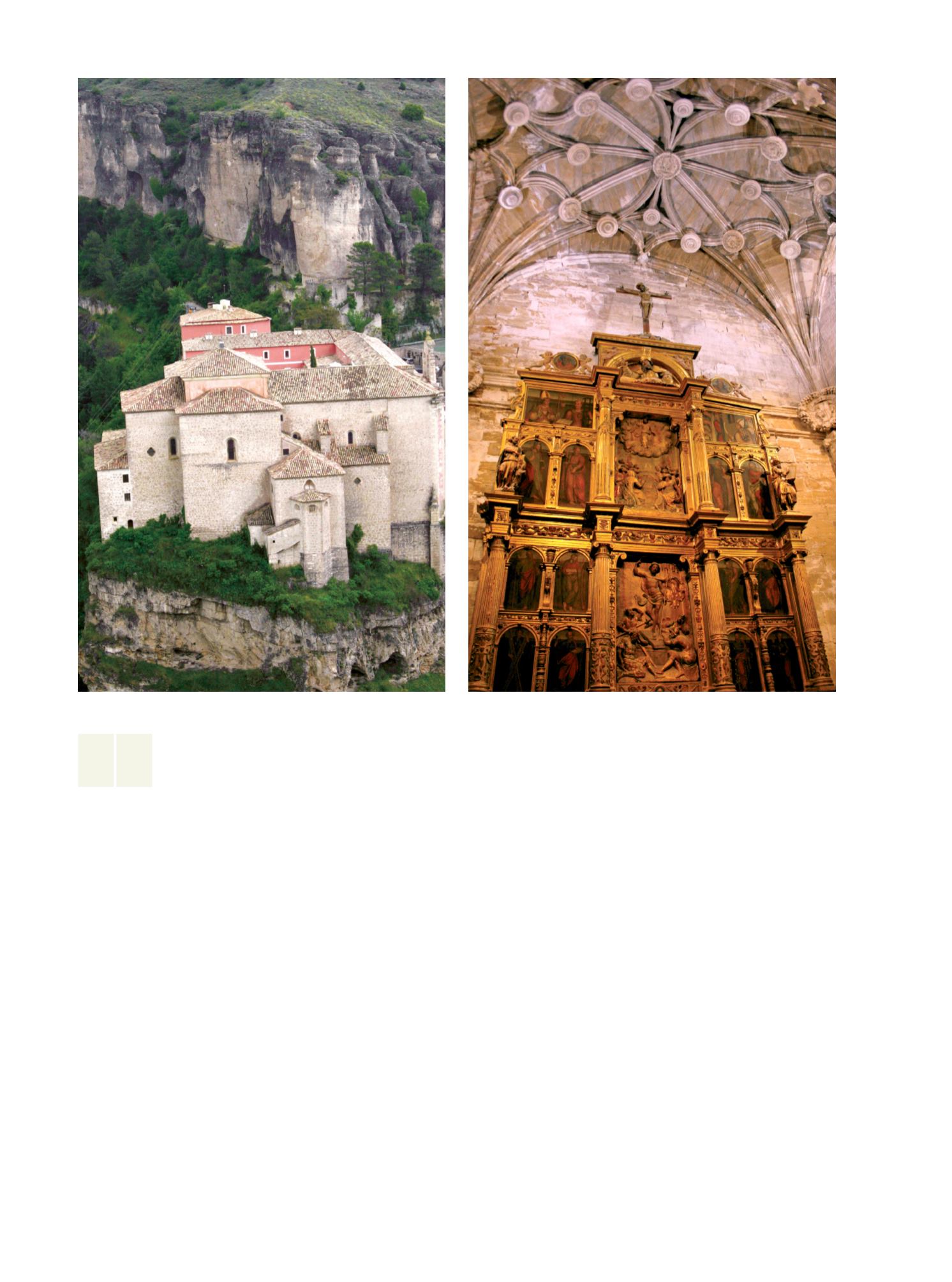
1. El convento de San Pablo (siglo
XVII) situado al pie de la ciudad
antigua de Cuenca es hoy un
mítico hotel de la cadena de los
Paradores.
The San Pablo convent (17th
century) situated at the foot
of the ancient city of Cuenca
is today a mythical hotel of
the Paradores chain.
2. La catedral de Cuenca,
construida a lo largo de los
años, encierra unos fastuosos
ejemplos de la arquitectura
española.
The Cathedral of Cuenca, built
over many years, housesmany
elaborate examples of Spanish
architecture.


