·amura·
105
los conquistadores •
the conquerors
L
a mal llamada colección Armella Spitalier no tendría
razón de ser si ésta no fuera compartida de mane-
ra universal. Hoy en día, estoy seguro, es todavía la
única muestra precolombina que es posible visitar desde
cualquier punto del planeta Tierra.
Inspirado un poco por mis padres y otro tanto por mi
tío, el arquitecto Mario Armella Maza, me introduje con
gran pasión en el arte, sus objetos y la historia que llevan
en su contexto. Pero no sólo eso me mantuvo siempre
cerca de lo precolombino: mi propia escuela, la Universi-
dad de las Américas, está situada en Cholula, Puebla, cuna
de la civilización mixteco-cholulteca, donde comencé mis
estudios en Administración ya con conocimientos adqui-
ridos en las cimentaciones que hiciera mi tío al construir
edificios por el rumbo de Tepepan; asimismo, fueron fruc-
tíferas para mi inclinación las visitas de fin de semana a
Teotihuacán o Xochicalco. De esta manera, el acervo con-
cesionado por el INAH comenzó a nutrirse.
EnMéxico,muchas personas poseenpiezas. Lamayo-
ría de la gente sólo sabeque sonviejas; ignoran su tempo-
ralidad y de repente les inventan un uso; se la atribuyen a
una cultura o grupo determinado y, muy amenudo, plati-
can anécdotas fantásticas sobre cómo llegó a sus manos.
Lamayoría de estas personas las han encontrado inciden-
talmente durante su vida, casi siempre en pequeños gru-
pos de piezas y también con frecuencia de lamisma fami-
lia cerámica. Sin embargo, también hay casos en los que
el acaparador ya es grande en edad y conocedor de la ley
promulgada por el presidente Luis Echeverría Álvarez. Tie-
ne las piezas legalmente, es decir, concesionadas formal-
mente por la autoridad competente, el INAH. En esos ca-
sos sucede lo siguiente: el hombre culto, quien conservó
su colección a salvo de accidentes, llega al tiempo en que
piensa en lamuerte y comienza a preocuparse por el buen
resguardo del acervo, en cuyo caso también es resultado
de anécdotas y aventuras vividas en la juventud, cuando
viajaba distancias enormes visitando los diversos sitios
arqueológicos en nuestramaravillosa republicamexicana.
T
he mistakenly called Armella Spitalier collec-
tionwould have no reason of existing if it was
not meant to be shared universally. Today I’m
sure it’s still the only pre-Columbian sample that
can be visited from every corner of the planet earth.
Inspired a little by my parents and a little more
by my uncle Mario Armella Maza, I became involved
with art with great passion, it’s objects and the his-
tory they carried in their context. But not only that
kept me close to the pre-Columbian, my own school,
the “AmericasUniversity”, locatedat CholulaPuebla,
cradle of the Mixteco-Cholulteca civilization, where
with already acquired knowledge on the founda-
tions laid nearby “Tepepan” my uncle built architec-
tonic works, and the weekend visits to Teotihuacan
or Xochicalco, which are located on the surrounding
area of Mexico city, were how the cultural heritage
authorized by INAH began to nourish.
In Mexico everyone has pieces, most of the people
onlyknowtheyareold, they ignore the timeperiodand
everynowandthenmakeupause,andtheyattributeit
to a culture or a certaingroup and very often talk about
fantastic anecdotes of howthepiece got to their hands.
Mostofthesepeoplehavefoundthemincidentallydur-
ing their lives. Almost always in small groups of pieces
and also frequently they are from the same ceramic
family. But there are times in which the gatherer is
old in age and knows of the law promulgated by Presi-
dent Luis Echeverria Alvarez; this person legally owns
the pieces, meaning that they are authorized formally
by the competent authority, INAH. It’s in those cases
that the following happens; the cult man that kept his
collection safe from accidents, who comes to think of
death and preoccupied with the good safekeeping of
the collectionwhich is also the result of anecdotes and
adventures lived when he was young and would travel
great distances, visiting various archaeological sites in
ourwonderfulMexicanRepublic.
1. Cantereros de
Teotihuacán
Víctor Daniel
Camacho Maldonado
Oleo sobre lienzo
150cm x 125 cm
2012
/
Teotihuacan
Quarrymen
Oil on canvas
150cm x 125 cm
2012
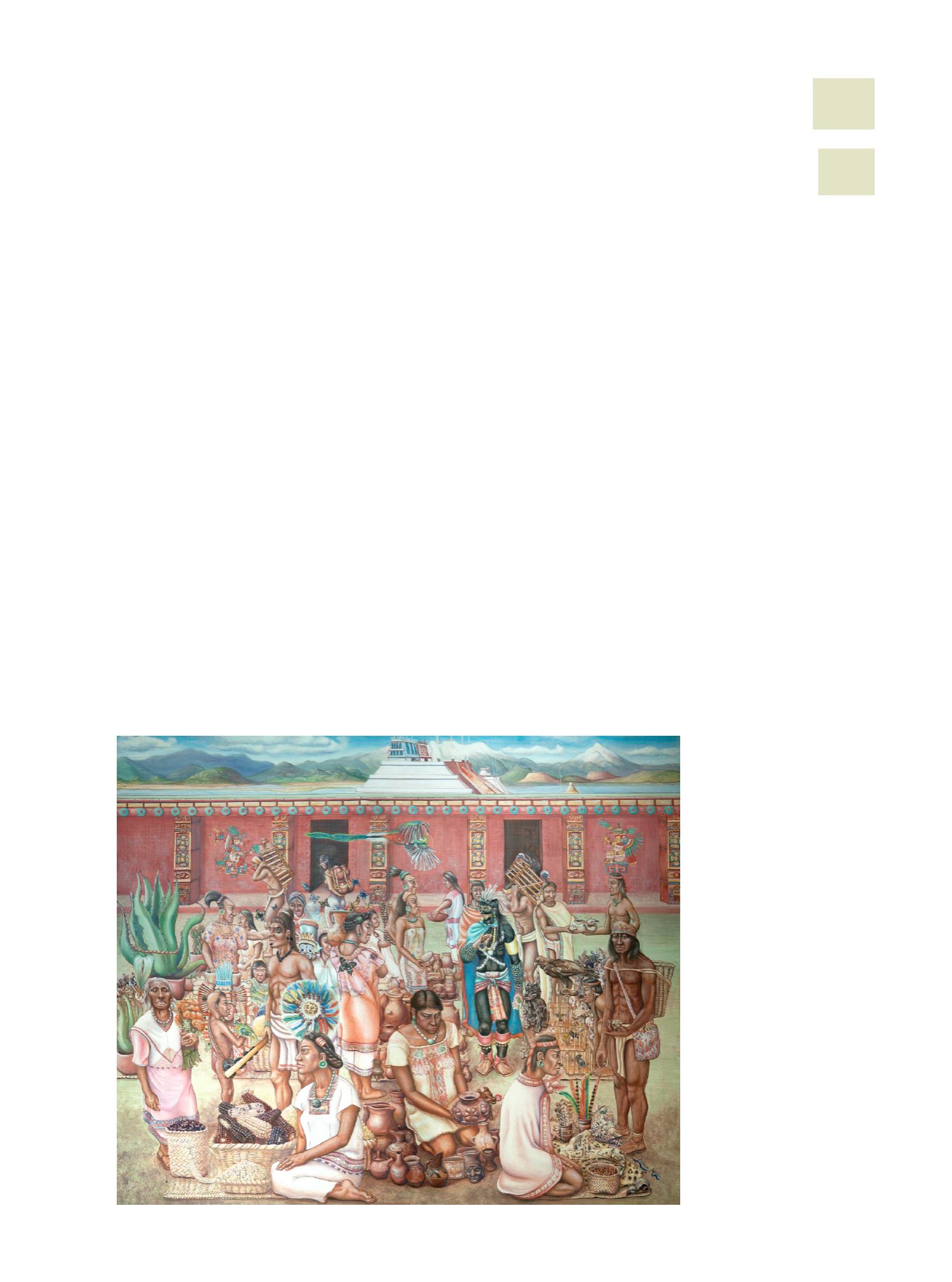
2. Tianguis en
Tlatelolco
Víctor Daniel
Maldonado
Oleo sobre lienzo
150cm x 125 cm
2011
/ Tianguis in
Tlatelolco
Oil on canvas
150cm x 125 cm
2011
1
2


