·amura·
29
compás int • int compass
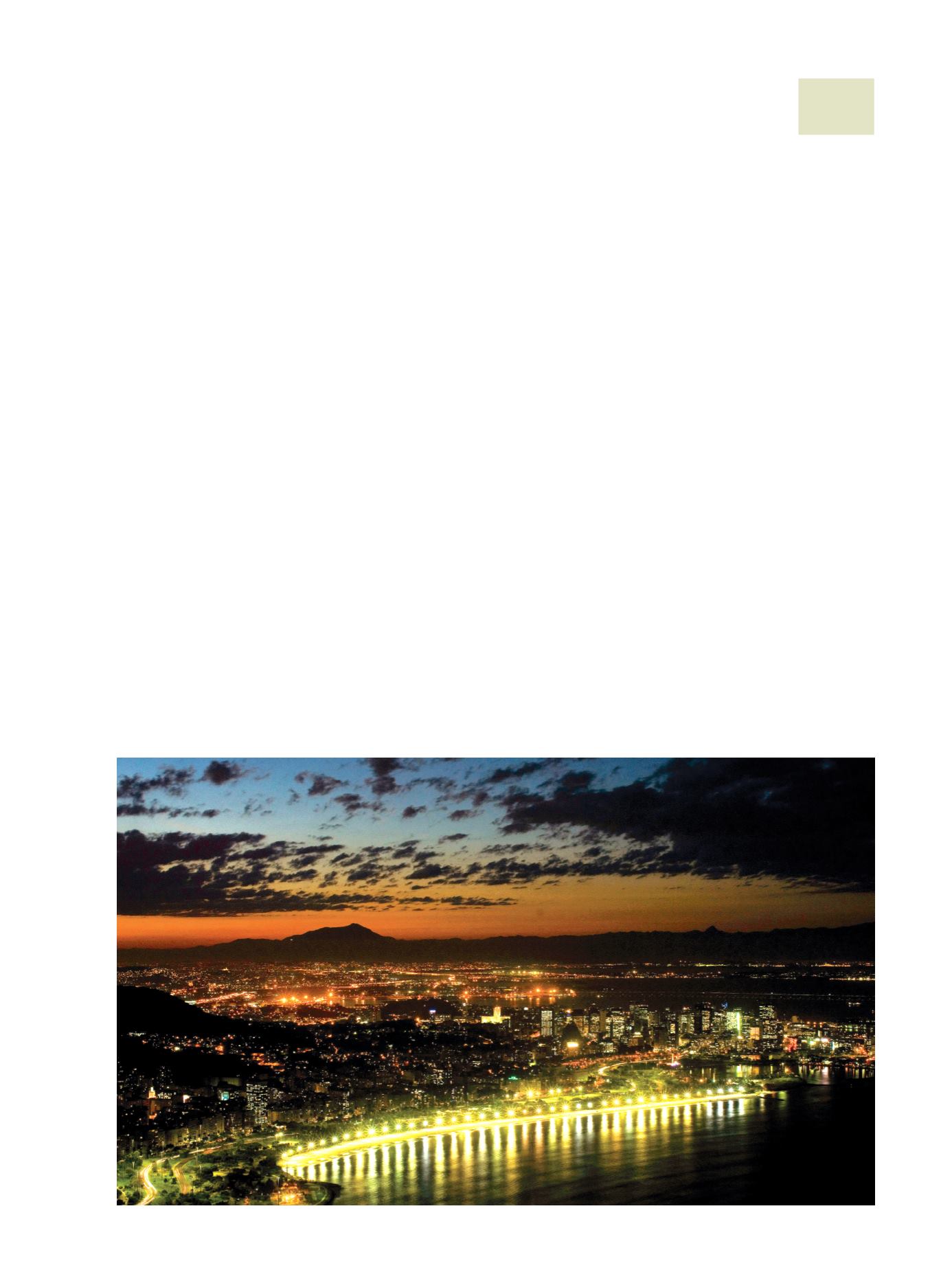
Cidade Maravilhosa
Los brasileños le llaman a Río “La ciudad maravillosa” y
es cierto que es uno de los espectáculos urbanos más
hermosos en el mundo. Concentrada en un estrecho
listón entre el mar y las montañas, es hogar de casi
siete millones de residentes. Son protegidos por el
punto de referencia más emblemático de Rìo, la esta-
tua del Cristo Redentor situada a 709 metros sobre el
nivel del mar. Caminar por las calles de Río es revivir
la historia de Brasil. Los edificios antiguos del centro
de la ciudad y alrededores guardan la memoria de los
momentos principales del país.
En enero de 1502, la segunda expedición portu-
guesa de exploración, que lideró Gaspar Lemos, llegó
a la bahía de Guanabara. Al avistar lo que pensó ser la
desembocadura de un río, le dio el nombre de Río de
Janeiro (Río de Enero) a la región. Pero solo en 1565
Estácio de Sá fundó el municipio, que bautizó con el
nombre de São Sebastião do Rio de Janeiro, en honor
de Don Sebastián, en aquel entonces Rey de Portugal.
Durante el Imperio, la región vivió de su potencial
portuario y de los ciclos de la caña de azúcar, del oro y
del café. En 1763, Río de Janeiro se convirtió en capital
del Imperio.
En 1889, el Mariscal Deodoro da Fonseca lideró un
grupo de militares del ejército que destituyó al empe-
rador de su cargo y asumió el poder en el país. Con la
Proclamación de la República, en 1889, la capital del
Imperio se convirtió en capital federal de Brasil.
A principios del siglo XX, las calles anchas y las cons-
trucciones imponentes surgen en la ciudad, la mayoría
en estilo fin-de-siècle francés. En 1920 se fundó la pri-
mera universidad del país en Río de Janeiro, que se deno-
minó URJ (Universidad Río de Janeiro). Después de este
período, se fundaronmuchas instituciones de educación
superior y centros de estudio sobre la cultura e historia
de Rio, con el objetivo de rescatar lamemoria y construir
una identidad para el pueblo del estado.
Cidade Maravilhosa
Brazilians call Rio “The marvelous city” and it
certainly is one of the most beautiful urban spec-
tacles in the world. Concentrated in a narrow strip
between the sea and the mountains, it is home
to nearly seven million residents. They are pro-
tected by the most iconic landmark of Rìo, Christ
the Redeemer, located 709 meters above sea level.
Walking the streets of Rio is to revive the histo-
ry of Brazil. The old buildings of the city located
downtown and other areas are the memories of
the country’s best moments.
In January 1502, the second Portuguese expe-
dition of exploration, led by Gaspar Lemos arrived
in Guanabara Bay. He devised what he thought to
be the mouth of a river, giving it the name of Rio
de Janeiro (River of January) to the region. But only
in 1565 Estacio de Sá founded the town, which he
named São Sebastião do Rio de Janeiro, in honor of
Sebastian, at that time King of Portugal.
During the Empire, the region experienced po-
tential cycles and began to export sugar cane, gold
and coffee. In 1763, Rio de Janeiro became the capi-
tal of the Empire.
In 1889, Marshal Deodoro da Fonseca led a group
of army officers that overthrew the Emperor from
office and took the power of the country. With the
proclamation of the Republic in 1889, the capital of
the Empire became the federal capital of Brazil.
In the early twentieth century, the wide streets
and imposing buildings emerged in the city, most-
ly in fin-de-siècle French style. In 1920 he founded
the country’s first university in Rio de Janeiro,
which was named URJ (University Rio de Janeiro).
After this period, many colleges and schools were
founded regarding the culture and history of Rio,
in order to save the memory and build an identity
for the people of the state.
5. Río de Janeiro
/
Rio de Janeiro.
5


