·amura·
31
compás int • int compass
Las calles de Copacabana son excelentes para paseos
nocturnos en bicicleta y, a fin de tarde, la orilla del mar es
perfecta para partidos de voleibol de playa o de futvóley
que tiene características del fútbol—el jugador puede to-
car la pelota con cualquier parte del cuerpo, antebrazos y
manos—y del voleibol. Otro ejemplo es la práctica de kite
surf en la Laguna Rodrigo de Freitas, con vista privilegiada
del CristoRedentor, ycomoescenariode fondo lasmonta-
ñas de la Floresta da Tijuca y de la Pedra da Gávea.
Conocida por la piedra de mismo nombre que in-
vade el mar, la pequeña playa de Arpoador tiene cer-
ca de 500 metros de longitud y está ubicada entre
el fuerte de Copacabana y la playa de Ipanema, este
lugar ofrece una de las vistas más deslumbrantes de
Río: la puesta de sol detrás del monte Dois Irmãos,
con las playas de Ipanema y Leblon como escenario.
Tal momento inolvidable forma parte de lo cotidiano
de todos los que frecuentan la zona sur. De octubre
a febrero, es habitual ver cariocas salir del trabajo e
ir directamente a la playa, simplemente para aplaudir
este espectáculo de la naturaleza.
Gran parte de la historia de Brasil permanece viva
en Río de Janeiro. Bellos edificios de los siglos XIX y XX
abrigan museos, iglesias y centros culturales que re-
componen la historia de la ciudad y la cultura del país.
Hay gran variedad de espacios que ofrecen exposicio-
nes temporales, muestras de cine, presentaciones de
música, teatro y danza.
The streets of Copacabana are great for cycling
at night or late afternoons. The beach is perfect for
volleyball matches or futvoley, which has football
features-the player may touch the ball with any
part of the body, forearms and hands-. Another ex-
ample is the practice of kite surfing in the Rodrigo
de Freitas Lagoon, with a privileged view of Christ
the Redeemer, the back ground is the mountains of
the Floresta da Tijuca and Pedra da Gávea.
Known for stone of the same name we find the
small Arpoador beach, which is about 500 meters
long and is located between Copacabana Fort and
the beach of Ipanema, it offers one of the most
stunning views of Rio: the sun set behind the
mountain of Dois Irmãos, with the beaches of Ip-
anema and Leblon as a setting. Such an unforget-
table moment is an everyday thing for all of those
who frequent the south. From October to Febru-
ary, it is common to see Cariocas leave work and
go straight to the beach, just to applaud this show
of nature.
Much of the history of Brazil remains alive in
Rio de Janeiro. Beautiful buildings of the nine-
teenth and twentieth harbor museums, churches
and cultural centers recompose the city’s history
and culture. A variety of spaces offer temporary ex-
hibitions, film screenings as well as presentations
of music, theater and dance.
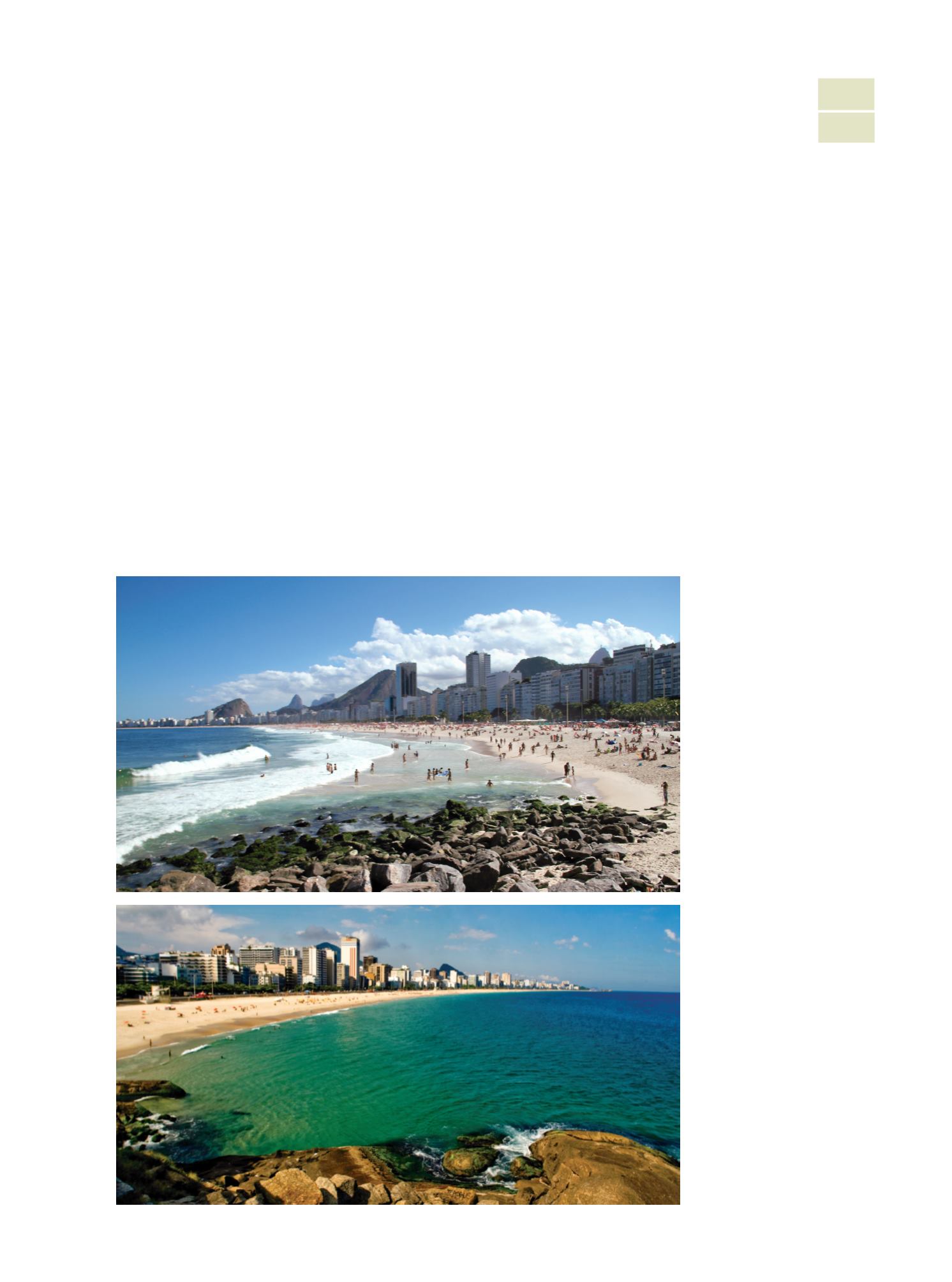
7. Copacabana.
/
Copacabana.
8.Praia do Leblon.
/
Praia do Leblon.
7
8


