·amura·
34
São Paulo
Esta rica ciudad es conocida mundialmente como la
capital del turismo de negocios de Brasil, llegando a
concentrarse hasta el 70% del movimiento nacional
en este segmento. Sin embargo, su estructura gigan-
te no es sólo por el aspecto económico, porque eso sí,
alcanzó el título de la zona comercial y financiera más
importante de América Latina. Sao Paulo es lamayor in-
fraestructura de Brasil en la política y la cultura. Nueve
millones de visitantes asisten cada año a ferias, con-
gresos, exposiciones, generando ingresos de hasta 5
millones de dólares a la ciudad. Para tener una idea, São
Paulo, es responsable de la celebración de las feriasmás
importantes que se celebran en el país.
Muchos de sus monumentos tienen una enorme
influencia en la historia de este país, por el Memorial
de América Latina, el Jardín Botánico, el Parque de
Ibirapuera y el Museo de Arte de São Paulo. El Teatro
Municipal de São Paulo organizó nada menos que la
Semana de Arte Moderno de 1922, un evento que dio
una nueva dirección para las artes en Brasil, cuando
se abriría la puerta a la modernidad. Hoy es sede de
eventos como la Bienal Internacional de Arte, el Gran
Premio de Fórmula 1 y de la Sao Paulo Fashion Week.
La Tierra de llovizna es considerada por muchos la
mejor vida nocturna en el país con todo tipo de di-
versión y entretenimiento. En 1997, recibió el título
de “Capital Mundial de la Gastronomía, compitió en-
tre los 43 países en el 10
º
Congreso Internacional de
Gastronomía, Hotelería y Turismo. La historia de São
Paulo comienza con la capitanía de São Vicente, el re-
sultado de una donación hecha el 28 de septiembre
de 1532 por el rey de Portugal, D. Juan III.
São Paulo
This rich city is known worldwide as the capital of
business tourism in Brazil, reaching up to concen-
trate 70% of the national movement in this seg-
ment. However, its giant structure is not only in
the economic aspect, it reached the title of the most
important commercial and financial area in Latin
America. São Paulo is Brazil’s largest infrastructure
in politics and culture. There are nine million visi-
tors each year to attend trade shows, conferences
and exhibitions, generating revenues of up to 5mil-
lion dollars to the city. To get an idea, São Paulo, is
responsible for the celebration of the most impor-
tant fairs held in the country.
Many of its monuments have an enormous in-
fluence on the history of the country, as the Latin
American Memorial, the Botanical Garden, the Ibi-
rapuera Park and the Art Museum of São Paulo. The
Municipal Theatre of São Paulo organized no less
than the Modern Art Week in 1922, an event that
gave a new direction for art in Brazil; it would open
the door to modernity. Today it houses events such
as the International Art Biennial, the Formula 1
Grand Prix and São Paulo Fashion Week. This land
of drizzle is considered by many the best night-
life in the country, with all kinds of fun and enter-
tainment. In 1997, it received the title of “Gourmet
Capital of the World, among the 43 countries that
competed in the 10th International Congress of
Gastronomy, Hospitality and Tourism. The history
of São Paulo begins with the captaincy of São Vicen-
te, which was the result of a donation made on Sep-
tember 28, 1532 by the King of Portugal, D. João III.
compás int • int compass
13
14 15
16
17
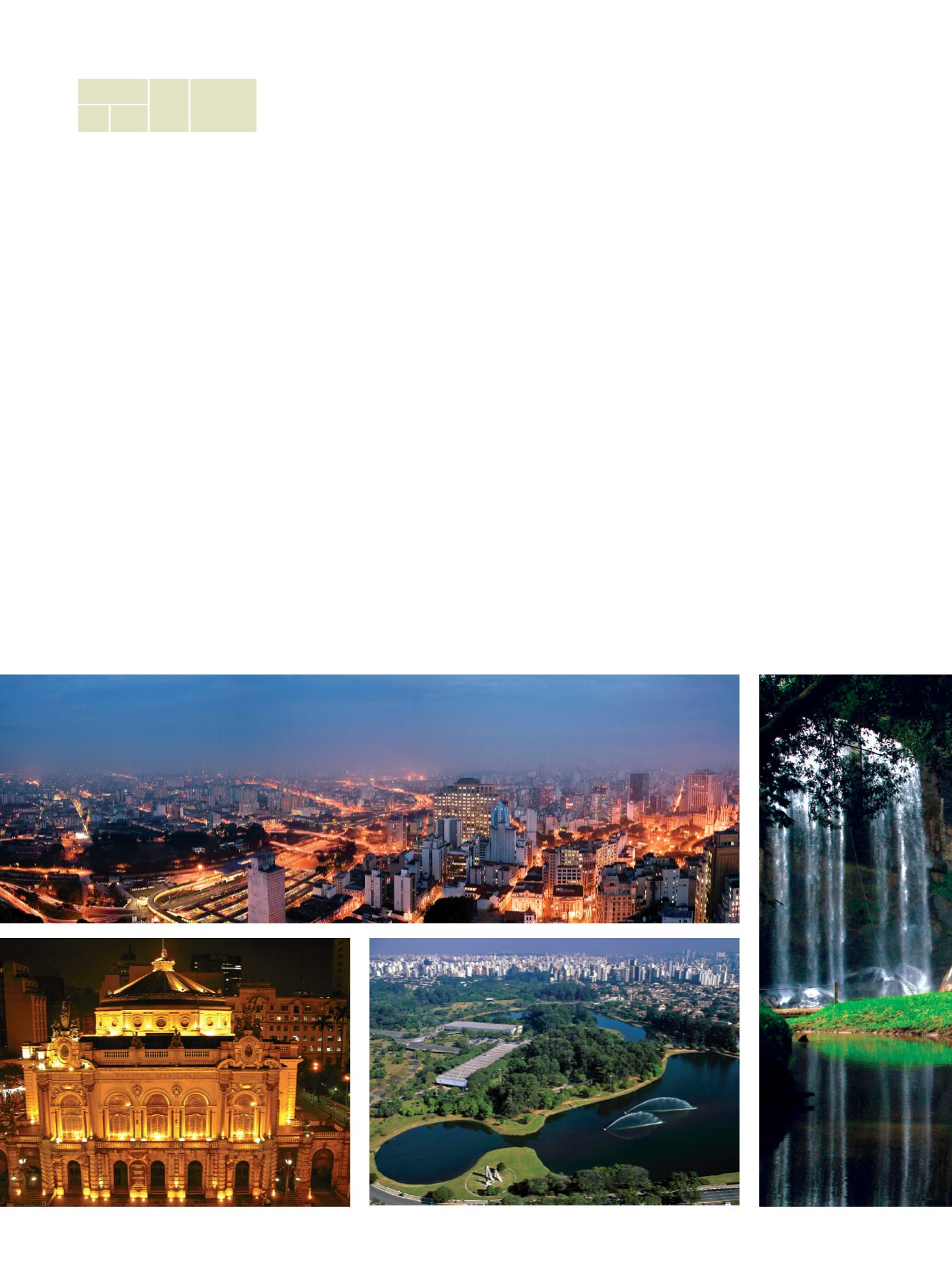
13. São Paulo.
/
S
ã
o Paulo.
14. Teatro Municipal
de São Paulo.
/
Municipal theater of
S
ã
o Paulo.
15. Parque do
Ibirapuera, São
Paulo.
/ S
ã
o Paulo,
Ibirapuera Park.
16 y 17. São Paulo
/
S
ã
o Paulo.


