·amura·
67
compás int • int compass
San Marón, 300 A.C.
San Marón nace como un santo en Aleppo (Siria),
siendo un ermitaño. Su trabajo consistía en predicar
la buena fe y dar a conocer un punto de vista comple-
tamente fresco a aquel otro predominante en aquellos
tiempos; aunado a estas pláticas y predicciones había
una gran congregación de personas, logrando así un
importante número de devotos. En esta época, inicia
un cambio importante en la iglesia del Medio Oriente.
La idea de San Marón, contraria a aquella de los monofi-
sitas, predica que Jesús era Dios y humano, que sintió el
dolor, el mal y la enfermedad. Por esta razón, la creencia
de San Marón era compartida por una importante con-
gregación, dándole el nombre de “maronitas”.
Los inicios de los maronitas se dan a conocer en
las montañas, conducidos por Juan Marón, esto con el
propósito de proteger a sus seres más cercanos de las
ideologías de otras comunidades. Sus características
principales son: grupo familiar y de oración, viven cerca
de su iglesia. La devoción es uno de los emblemas más
fuertes de esta religión. La educación es también im-
portante para ellos, iniciándose en el campo, así como
la espiritualidad, que se traduce en la oración.
Saint Maron, 300 B.C.
St. Maron how was born in Aleppo (Syria) chose
the life of a hermit. His job was to preach the good
faith and provide a completely fresh perspective to
that used in these times, along with these talks and
predictions a large congregation of people was add-
ed, thus a large number of devotees. At this time, a
major shift in the church of the Middle East began
to take place. The idea of St. Maron, contrary to that
of the Monophysites, preached that Jesus was God
and man , he felt the pain , evil and disease. For this
reason St. Maron’s belief was sympathetic to this
important congregation, giving them the name of
Maronites.
The beginnings of the Maronites are disclosed
in the mountains, brought there by John Maron,
this happened in order for themto be able to care for
their families and ideologies from other religious
groups. Their characteristics are those of family
and prayer. They live near their church. Devotion is
one of the strongest emblems of this religion. Edu-
cation is also important to them, which translates
into prayer.
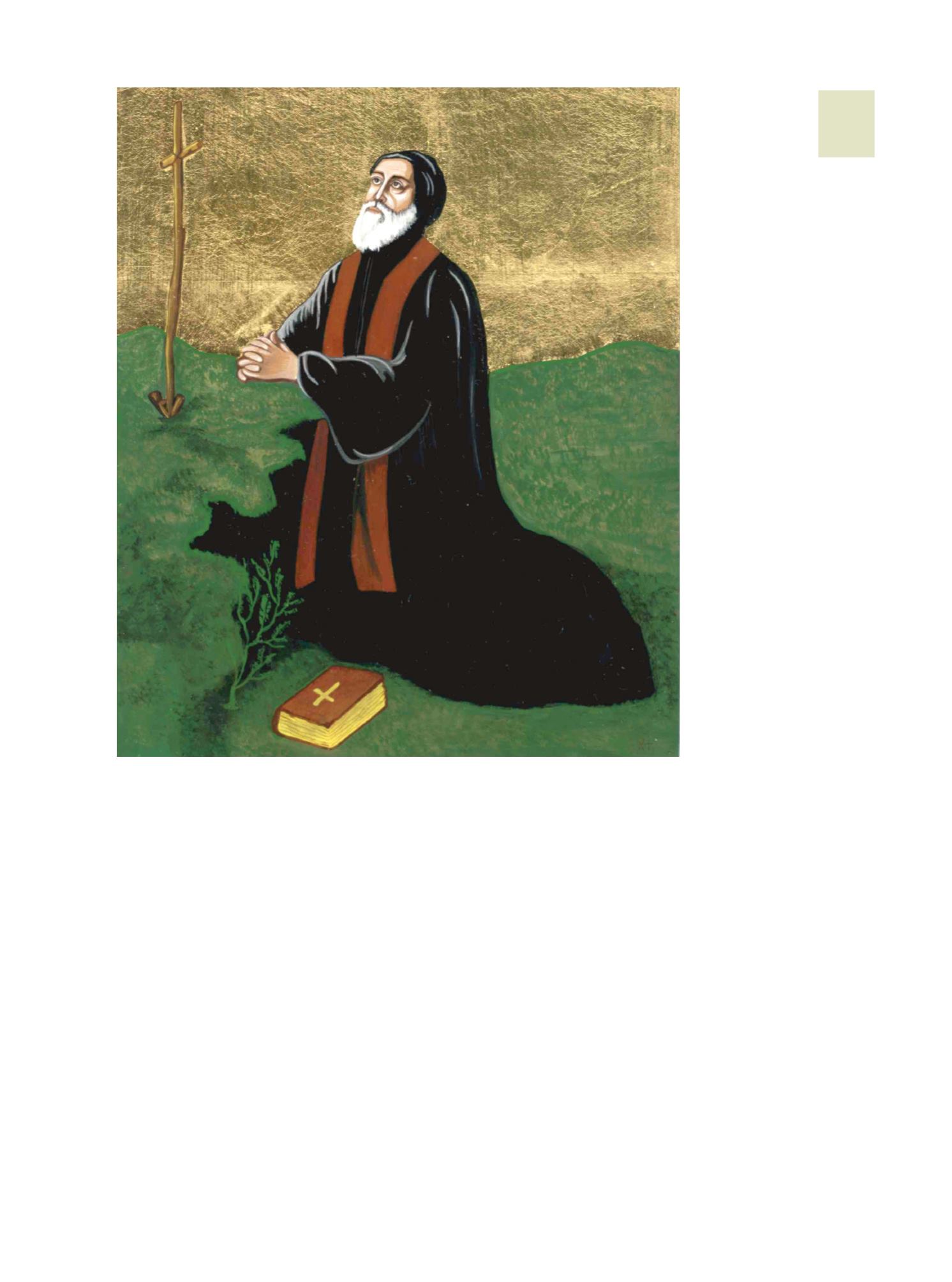
2.Representación
pictórica de San
Charbel en oración
/
Painting of Saint
Charbel praying.
2


