·amura·
68
compás int • int compass
Unmonjemilagroso
San Charbel inicia su incursión como monje maro-
nita en el año de 1851, a la edad de 20 años. Uno de
los mensajes más importantes que nos transmite es
aquella de la historia de los libaneses. Desde pequeño,
él cuidaba una cueva con la imagen de la virgen María
(ampliamente adorada por este pueblo). Vivió en una
escuela de fe, con conceptos claros dentro de su reli-
gión, obedeciendo siempre a sus superiores y decidien-
do ser ermitaño. Esta elección por parte de San Charbel
lo lleva a un régimen estricto. Su vida se basaba en ho-
rarios específicos de oración, siendo así que sus plega-
rias tomaban lugar a las 3:00 AM, 7:00 AM, 1:00 PM, etc.
Se alimentaba de vegetales únicamente cultivados por
él, y no mencionaba palabra salvo en misa.
Los hechos más fantásticos de este santo son sus
milagros. Muchas personas han sido testigos de ellos.
El más destacado fue que, pese a la fecha simbólica de
su muerte (25 de Diciembre), el cuerpo de San Charbel
se ha mantenido incorrupto. Días después de su falle-
cimiento, varios monjes comenzaron a notar que un
aceite sanguinolento empezó a emanar de su tumba;
una vez abierta la cripta, descubrieron a este hombre
suspendido en esta agua. El cuerpo fue limpiado y tras-
ladado; sin embargo, este hecho se volvió a repetir.
Uno de los milagros más conocidos de este monje
es aquel de Nohad El Chami, una mujer libanesa parali-
zada por hemiplejia. Contaba con 55 años y padecía una
enfermedad incurable. Una noche de enero de 1993,
tuvo un sueño en el que dos monjes se acercaron a su
cama, uno de ellos era San Charbel, el cual caminó has-
ta ella y puso sus dedos sobre su garganta, indicándole
que venía a operarla, a lo que ella respondió: “No es ne-
cesario, pues los doctores ya me han dicho que no hay
nada que se pueda hacer”. Aun así se dice que San Char-
bel procedió con esta operación, y, una vez terminada,
la mujer pudo caminar. Esta visita por parte de San Ma-
rón y San Charbel ha quedado grabada en la memoria
de esta mujer, pues tenía los dedos marcados sobre el
cuello, donde se dice que este santo la tocó.
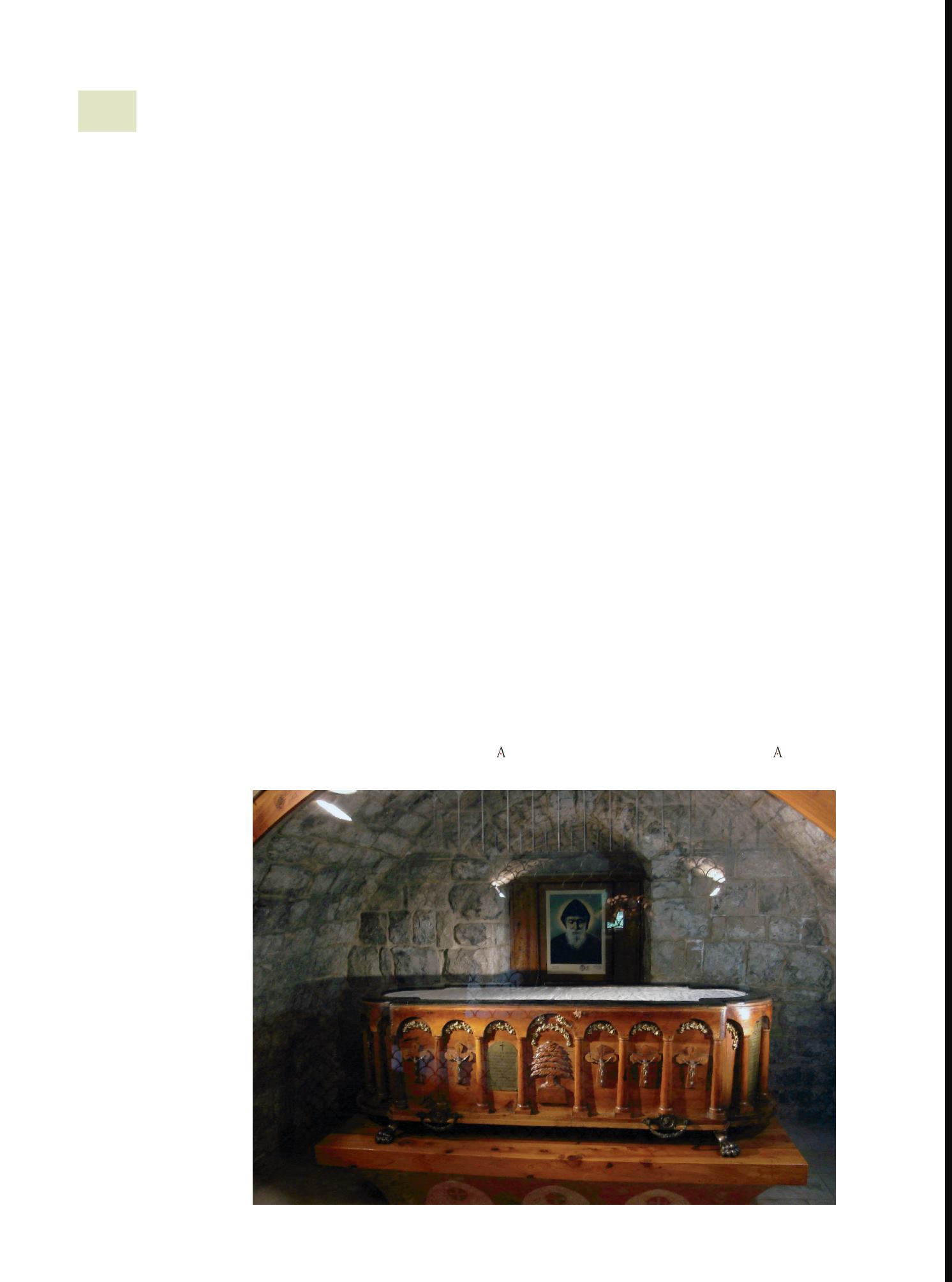
3. Tumba de San
Charbel con el icono
del cedro /
Tomb of
San Charbel with
cedar icon.
3
Amiraculous monk
St. Charbel begins his stint as a Maronite monk
in the year 1851, at the age of 20. One of the most
important messages it conveys, is that of the his-
tory of the Lebanese. Since childhood he kept a
cave with an image of the Virgin Mary (widely
worshiped by these people). He lived in a school
of faith, with clear concepts within their religion,
always obeying his superiors and deciding to be a
hermit. This choice by San Charbel introduces him
to a strict regime, his life was based on specific
times of prayer, whereas prayers took place at 3:00
am, 7:00 am, 1:00 pm, etc., being able to eat only
vegetables grown by him and not to mention word
except in mass.
One of the most fantastic of this Saint, are
miracles. Many people have seen them. The first
was that despite the symbolic date of his death
(December 25) St. Charbel ‘s body has remained
incorrupt. Days after his passing, several monks
began to notice that bloody oil began to flow from
the grave, once opened, they discovered this man
suspended in the water. The body was cleaned
and taken elsewhere, however, this fact was re-
peated. One of the best known miracles of this
monk is the one of Nohad El Chami, a Lebanese
woman paralyzed by hemiplegia. At 55 years she
had suffered from an incurable disease. One night
in January 1993 she had a dream in which two
monks came to her room, one of them was Saint
Charbel he walked towards her and put his fingers
on her throat, indicating that he came to operate,
she answered: “No need, as doctors have already
told me that there is nothing to be done”. Yet it
is said that St. Charbel proceeded with this opera-
tion, once this was over, the woman could walk.
This visit by Saint Maron and Saint Charbel has
been marked in the memory of this woman, be-
cause his fingers are marked on the throat, where
the saint is said to have touched her.


