·amura·
64
compás int • int compass
En el Líbano hay más de trece museos históricos,
únicos en su tipo. De acuerdo a los investigadores, un
país rico en ruinas también debe ser rico en museos.
En realidad, los libaneses han descubierto ruinas en
varias oportunidades durante trabajos de excavación
para construir infraestructura. Todos los días leemos
en los diarios el descubrimiento de nuevas ruinas que
dificultan las tareas de reconstrucción de Beirut y del
sur del Líbano luego de las guerras que atravesó el país.
Quizás Beirut sea la segunda ciudad, después de Roma,
en donde hay muchos espacios públicos con ruinas his-
tóricas en el centro comercial de la ciudad.
Aunque hablamos del pasado, esto no significa que
el Líbano, en su historia moderna, no haya dejado ningún
rastro. Es suficiente visitar el Palacio de Moussa en Deir
Al Kamar, situado a 40 km de la capital. Asimismo, la ar-
quitectura libanesa, que utiliza piedra en su construcción,
está reflejada enmiles debellas residencias con rojos teja-
dos en lasmontañas del Líbano.
Quizás al turista le aburra el pasado o se canse de
los paseos, y desee pasar una velada agradable. En el
Líbano hay muchos teatros, bares y programas noctur-
nos. Los jóvenes tienen su vida propia que empieza a
medianoche, en alguna discoteca, y termina con el de-
sayuno, en algún local, en las primeras horas de la ma-
ñana, ya que la salida nocturna no se completa sin el
típico desayuno libanés: manakish de zaatar, o knafe, y
hasta huevos revueltos con carne.
Para cada turista existe una propuesta en cuanto
a comida, música, salidas y festivales. Hay veladas de
bailes orientales y occidentales, música de jazz y clási-
ca y hasta milongas, en donde se baila el tango. Todas
estas atracciones se pueden encontrar en una sola ca-
lle, y así el turista puede ir conociendo uno y otro lugar
hasta encontrar lo que desea. O de ciudad en ciudad,
pues todas están próximas.
In Lebanon there are over thirteen historic mu-
seums, each unique in its kind. According to inves-
tigators, a country rich in ruins should also be rich
in museums. In reality, the Lebanese have discov-
ered ruins on several occasions during excavation
work to build infrastructures. Every day we read in
the papers the discovery of new ruins that hinder
the reconstruction of Beirut and southern Lebanon
after the wars that spanned the country. Perhaps
Beirut is the second city, after Rome, where there
are many public spaces with historic ruins in the
city’s commercial center.
Althoughwe speakof thepast, thisdoesnotmean
that Lebanon, in its modern history, has left no trace.
It is sufficient to visit the Palace of Moussa in Deir Al
Kamar, located 40 km from the capital. Also, in Leba-
nese architecture, stone is used in its construction,
which is reflected in thousands of beautiful houses
with red roofs in themountains of Lebanon.
Perhaps the tourist is bored with the past or
gets not tired of the tracks, and would rather spend
a pleasant evening. In Lebanon there are many the-
aters, bars and eveningprograms. Youngpeople have
their own life that begins atmidnight, in a nightclub,
and ends with breakfast on any premises in the early
hours of the morning, as night out is not complete
without the typical Lebanese breakfast: manakish
zaatar or knafe, even scrambled eggs withmeat.
For every tourist there is a proposal in terms of
food, music, outings and festivals. There are East-
ern evenings and western dances, jazz and classi-
cal music; even milongas, where tango is danced.
All these attractions can be found in one street, and
tourists can get to knowone and another place until
they find what they want. Or from city to city, due to
the fact that everything is close.
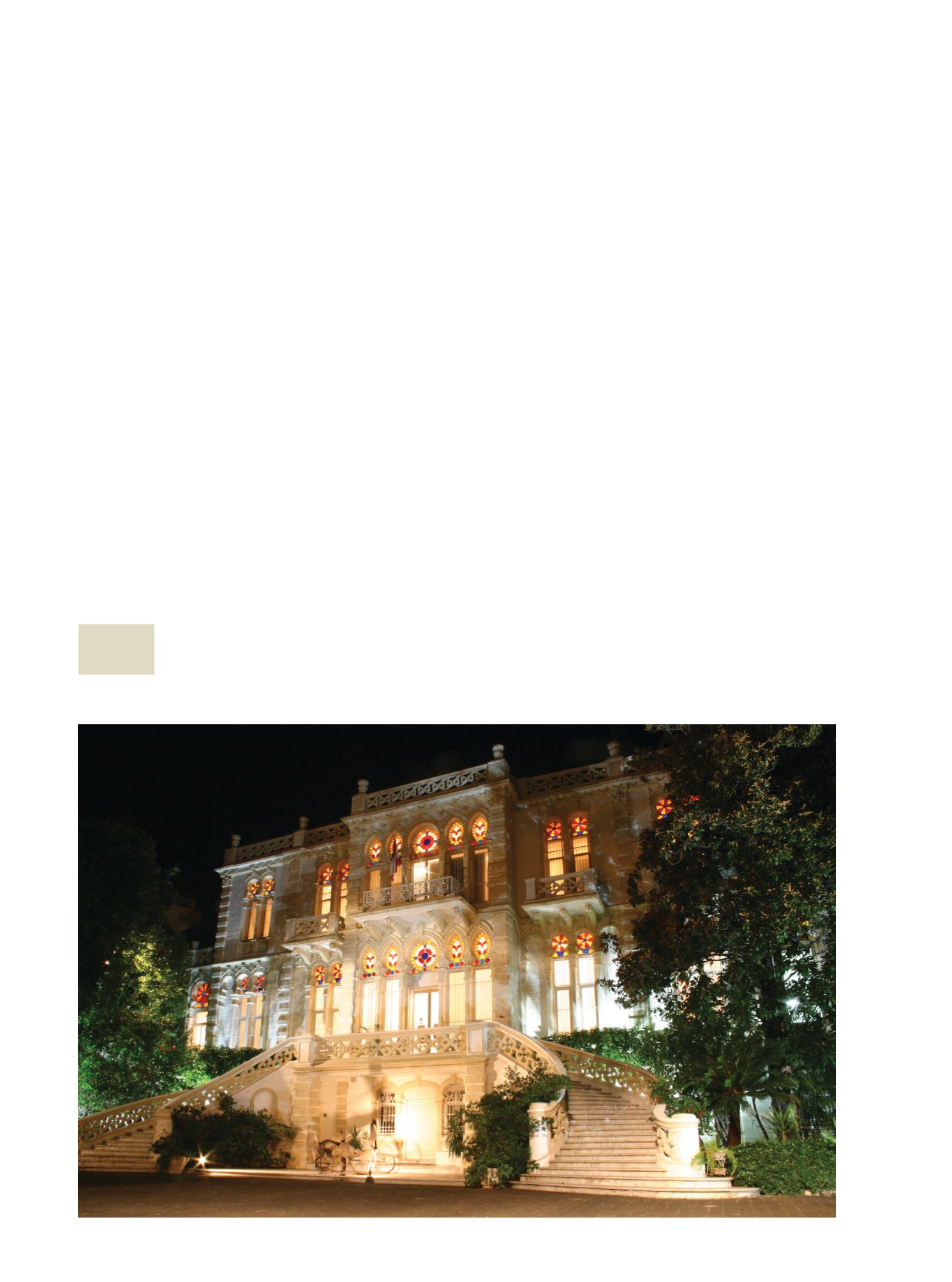
10. Entrada al Museo
Nicolas Sursock
. /
Entrance of Nicolas
SursockMuseum.
10


