·amura·
63
compás int • int compass
También está la Escuela de Derecho romana en Beirut
y los palacios Beiteddine y Deir Al Kamar, que reflejan un
período de auto gobierno durante el dominio otomano.
También se encuentran las ruinas de Trípoli, que represen-
tan la era de losmamelucos y los fatimitas.
Todo esto permite al visitante conocer -etapa tras
etapa- el desarrollo de la historia y comprender que
una gran parte de la civilización humana surgió en este
lugar del mundo.
Las ruinas del Líbano no son sólo palacios, templos
y pistas deportivas sino también mezquitas, conven-
tos e iglesias. El Líbano es parte de Tierra Santa. En
Qana, en el sur, tuvo lugar el primer milagro de Cristo,
en las bodas de Qana, donde transformó el agua en
vino. En su territorio habitaron, desde hace cientos de
años, judíos, cristianos y musulmanes que crearon un
patrimonio histórico en conjunto. Una de las paredes
de una mezquita en Beirut es también una de las pare-
des de una iglesia maronita, y a cuatrocientos metros
está la sinagoga, en el valle Abu Yamil.
El tañer de las campanas se abraza con los cantosmu-
sulmanes que invitan a rezar, creando una música espiri-
tual que sólo existe en el Líbano.
En la pequeña superficie del Líbano no hay manera
de aislarse, entonces se debe vivir en conjunto. Por eso,
la fiesta religiosa musulmana Al Adha o la Navidad cris-
tiana son fiestas para todos los libaneses de distintas
religiones. En el Líbano, las religiones mostraron que se
puede convivir en paz y se puede crecer y progresar den-
tro del respeto mutuo hacia todos los credos. La iglesia
católica ha santificado a varios santos de este pequeño
país, incluido al famoso San Charbel. Quizás el nuevo
santo, su santidad Juan Pablo II, fue un mensajero de
Dios que alivió las penas de los libaneses luego de tanto
sufrimiento, diciéndoles que su patria era más que un
país, era unmensaje.
Also Roman Law School and palaces in Beirut Be-
iteddine and Deir Al Kamar, reflecting a period of self-
government during Ottoman rule. There are also the
ruins of Tripoli, representing the age of the Mamluks
and the Fatimids.
This allows the visitor to-stage by stage, the
development of the story and understand that a
large part of human civilization arose in this place
of the world.
The ruins of Lebanon are not only palaces,
and temples but also mosques, monasteries
and churches. Lebanon is part of the Holy Land.
In Qana, to the south, Christ’s first miracle took
place at the wedding of Qana, where he turned
water into wine. In its territory inhabited, since
hundreds of years, Jews, Christians and Muslims
created a heritage together. A wall of a mosque
in Beirut is also one of the Maronite church
walls, and four meters away is the synagogue, in
the valley Abu Jamil.
The ringing of bells is embraced with the songs
that inviteMuslims to pray, creating a spiritual mu-
sic that only exists in Lebanon.
In the small area of this country there is no way
to isolate, reason why people have learned to live to-
gether. Therefore, the religious Muslim festival of Al
Adha or the Christian Christmas are festivities for all
the Lebanese of distinct religions. In Lebanon, reli-
gions showed the coexistence in peace, we can grow
and progress in mutual respect toward every creed.
The Catholic church has sanctified various saints of
this small country even the famous San Charbel. Per-
haps the new saint, His Holiness John Paul II, was a
messenger of God who eased the pains of the Leba-
nese after much suffering, saying that this country
was a not only country, it was amessage.
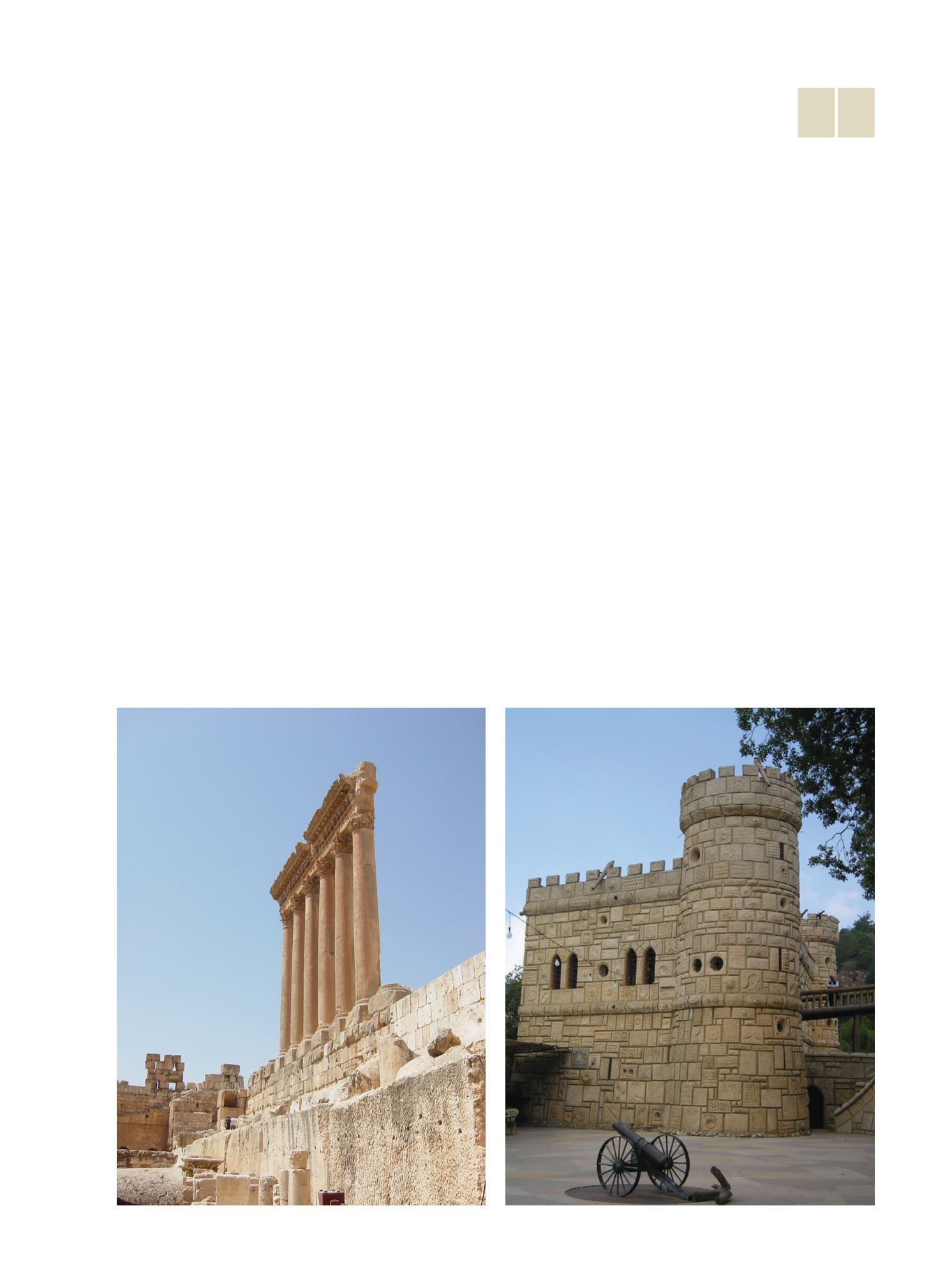
8. Antigua Heliópolis
romana en Baalbek.
/
Antique roman
Heliopolis in
Baalbek.
9. Castillo Moussar
se ubica a 50 km de
Beirut, entre Deir el
Qamar y Beit ed-Dine
/ Moussar Castle
is 50 km to Beirut,
between Deir el
Qamar and Beit ed-
Dine in Lebanon.
8
9


