·amura·
62
compás int • int compass
El visitante puede imaginar una ópera musical a la
vera de este río, pues allí se realizan esos espectáculos; no
hay nada similar en otro lugar del mundo.
En el Líbano se puede esquiar y nadar en el mismo
día. Se puede pasar el día, hasta las tres de la tarde, en las
montañas; luego, ir a la costa y nadar en las aguas tibias
del Mediterráneo. Además, el viaje es muy entretenido
pues se asciende y se desciende constantemente por
valles, colinas y montañas. Las cadenas montañosas del
Líbano tienen colinas y valles por donde atraviesan ríos y
durante todo el camino se percibe el aroma a flores silves-
tres, de las cuales se conocenmás de doscientos cuarenta
tipos; también es sorprendente observar las formas de las
rocas en lasmontañas.
Hay muchas seducciones en este pequeño país, hay
cuatro reservas naturales en sus montañas, pero el ser
humano es lo más completo que esta maravillosa natu-
raleza le brindó al Líbano. El hombre construyó grandes
atractivos turísticos, como hoteles, countries y restau-
rantes. Para descansar -luego de nadar, esquiar o pasear-
el turista puede elegir entre variados restaurantes que
satisfacen todos los gustos. Se puede optar por la cocina
libanesa, encontrándose con unos treinta y dos platos di-
ferentes antes que llegue el plato principal, que puede ser
una carneasadaoalgúnotroexquisitoplato libanés; luego
llegan los dulces y el turista no sabrá cuál elegir.
El Líbano también es un libro del desarrollo de las
civilizaciones desde la Edad de Piedra hasta la actua-
lidad. En este pequeño país se encuentran ruinas de
todas las épocas: de Adonis y Astaroth, griegos, feni-
cios y cananeos; la época de Assur, babilónica, persa,
romana, bizantina, árabe, otomana; luego, la época
francesa, que terminó con la Independencia de este
país en 1943.
En el Líbano hay unos cien sitios históricos, los más
importantes son: Tiro, en el sur; Biblos, en las montañas
(época fenicia3.000a.c.); Baalbek, enel Bekaa (era romana
1.000 a.c.); Anjar (época árabe, siglo XXII); Saida, en el sur
(época de la cruzadas).
The visitor can imagine a musical opera on the
banks of this river, reason why several shows are held
there,thereisnothinglikeitanywhereelseintheworld.
In Lebanon you can ski and swim in the same day.
You spend the day, until three in the afternoon, in the
mountains, just to go to the coast and swim in the
warmwaters of theMediterranean. In addition, travel-
ing inside thecountry isveryentertainingbecause the
trials ascends and descends steadily through valleys,
hills andmountains. Themountain ranges of Lebanon
have hills and valleys where rivers cross all the way,
youcanperceivethescentofwildflowers,ofwhichtwo
hundred forty types are known, it is also surprising to
see the shapes of the rocks in themountains.
There are many temptations in this small coun-
try, there are four nature reserves in the mountains,
but the human being is as complete as this wonder-
ful nature given to him by Lebanon. Man built great
tourist attractions such as hotels, country clubs and
restaurants. To rest, after swimming, skiing or walk-
ing, tourists can choose froma variety of restaurants
to suit all tastes. You can choose Lebanese cuisine,
meeting with about thirty-two different dishes be-
fore themain course arrives, it can be a roast or some
other delicious traditional dish, then the sweets ar-
rive and tourist do not knowwhich one to choose!
Lebanon is also a book of development of civili-
zations, from the Stone Age to the present. In this
small country ruins of all ages can be found: from
Adonis and Astaroth, Greeks, to Phoenicians and
Canaanites, the time of the Assyrian, Babylonians,
Persians, Romans, Byzantines, Arabs, and Otto-
mans, to arrive to the French period, which ended
with the Independence of this country in 1943.
In Lebanon there are a hundred historic sites, the
most important are: Tyre in the south; Byblos in the
mountains (3000 BC Phoenician times) Baalbek in the
Bekaa (Roman era 1,000 BC); Anjar (Arabic era, century
XXII), Saida, south (timeof the crusades).
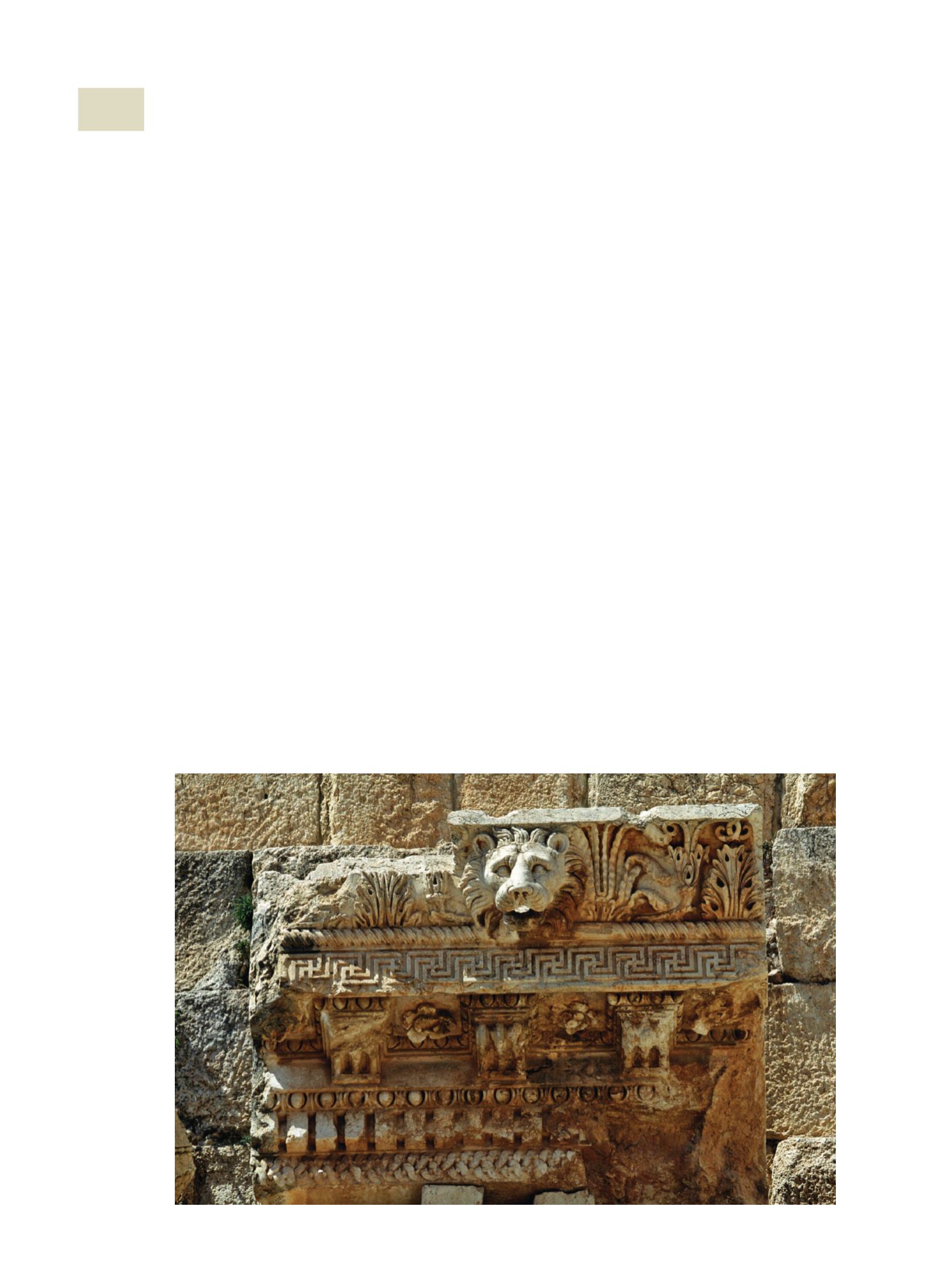
7. Antiguo friso
romano en Baalbek,
Líbano.
/ Antique
roman frieze in
Baalbek, Lebanon.
7


