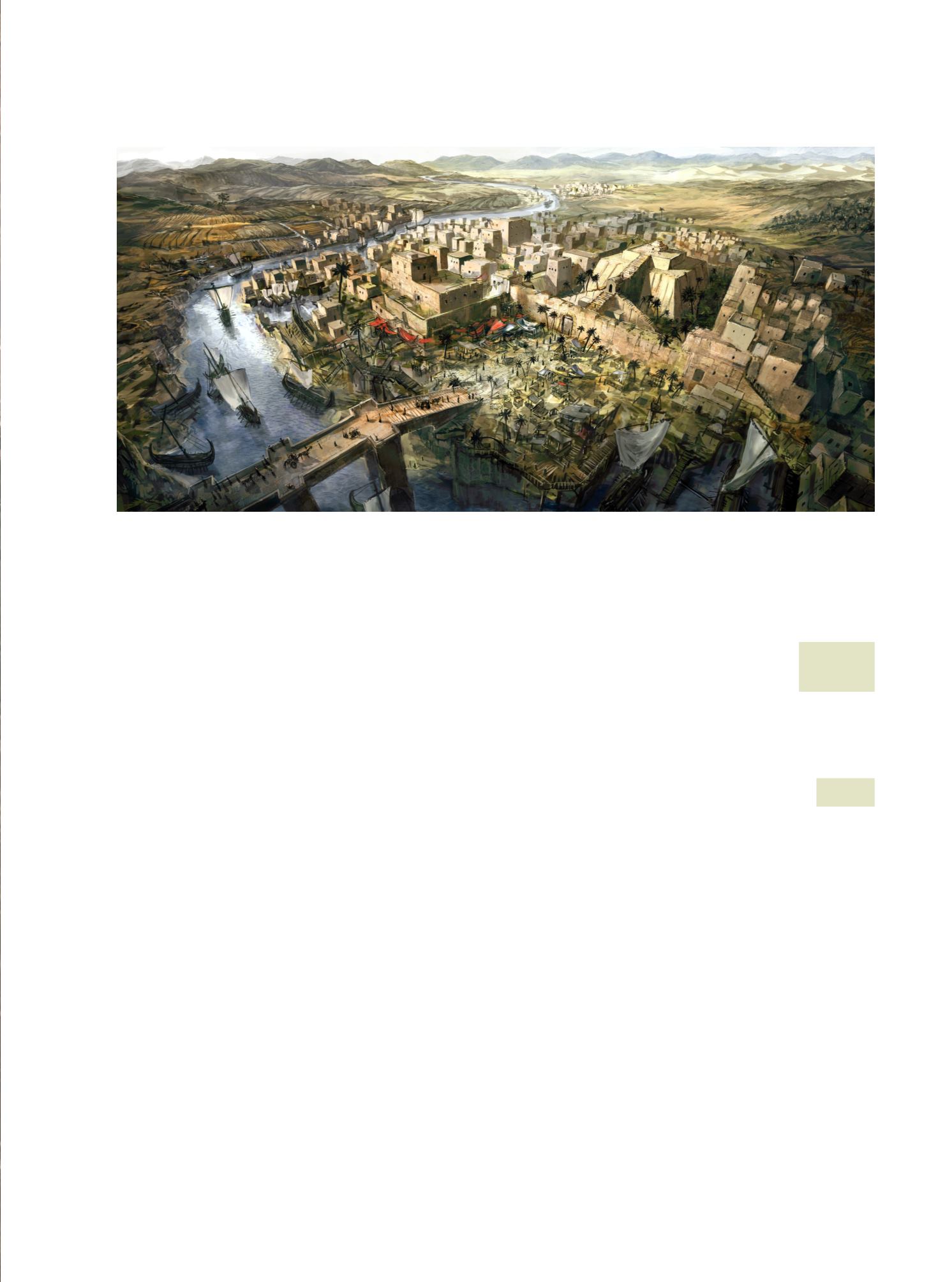
2. En Mesopotamia
ya existían sistemas
para llevar agua
a las ciudades. /
InMesopotamia
already existed
systems to bring
water to the cities.
1. Restos de un
antiguo acueducto
romano. /
Remains
of an ancient
Roman aqueduct.
L
a capacidad ingenieril que existe en la ac-
tualidad para transportar agua, entre un
lugar y otro, es una herencia romana por
excelencia. Acueductos, baños públicos,
termas privadas, fuentes y lagos artificia-
les; así como las diversas canalizaciones y contene-
dores de agua, son las estructuras más notables de la
Roma antigua que persisten hasta nuestros días.
Aún cuando en la antigua Mesopotamia y Gre-
cia existían sistemas de canalización para dotar
del líquido a los conglomerados urbanos, fueron
los romanos quienes potencializaron sus medios
de conducción, dándoles un grado de sofisticación
hasta ese entonces inexistente.
En el libro
Roman Aqueducts & Water Supply
(Los
acueductos romanos y el suministro de agua), Sexto
Julio Frontino (35 -ca.103), administrador del sumi-
nistro de agua de Roma, sentencia: “A los beneficios
tan numerosos y tan necesarios de tantos acueduc-
tos, van pues a comparar las pirámides que no sirven
obviamente para nada o también las obras de los grie-
gos, inútiles, pero celebradas por todas partes”.
Cabe decir que los romanos tuvieron otra manera
de contar con agua y era a través de la captación de
ésta en los
impluvium
, espejos o estanques de agua
hechos de piedra o mármol, por lo general colocados
en la zona del atrium de una casa, el cual, además,
servía como elemento decorativo. En ese lugar, el
agua reposaba hasta que las impurezas se quedaban
asentadas; de alguna manera el
impluvium
es el an-
tecedente de las cisternas y los tinacos.
2
·amura·
119
herencia cultural •
culture and heritage
T
he engineering capability existent to-
day to move water, from one place to
another, is a Roman heritage by excel-
lence. Aqueducts, public baths, private
thermae, fountains and artificial lakes;
as were also the diverse channelings and contain-
ers of water, are the most notable structures of the
Ancient Rome that still persist up to our days.
Even when in ancient Mesopotamia and
Greece there were channeling systems to provide
the fluid to the urban conglomerates, the Romans
where who empowered its means of distribution,
providing themwith a level of sophistication that
did not exist until then.
In the book Roman Aqueducts & Water Sup-
ply, Sextus Julius Frontinus (c 35 -103 AD), ad-
ministrator of the water supply of Rome, states:
“To the benefits so great in number and so nec-
essary of so many aqueducts, may there be com-
parison with the Great Pyramids that are obvi-
ously useless, or to the great works of the Greeks,
useless but so celebrated everywhere”.
It is fit to say that the Romans had a different
way to have water and this was done through the
catchment of the same in the impluvium, mirrors
or pools of water made of stone or marble, gener-
ally placed in the zone of the atrium of a house,
which also served as a decorative element. In that
place, the water rested until impurities precipi-
tated to the bottom; in a way the impluvium is the
precedent of modern tanks and cisterns.
1


