Foto /
Photo
: JEFF BROWN / WPS / IMAGE SJACK / som / DLS / NATIONAL GEOGRAPH
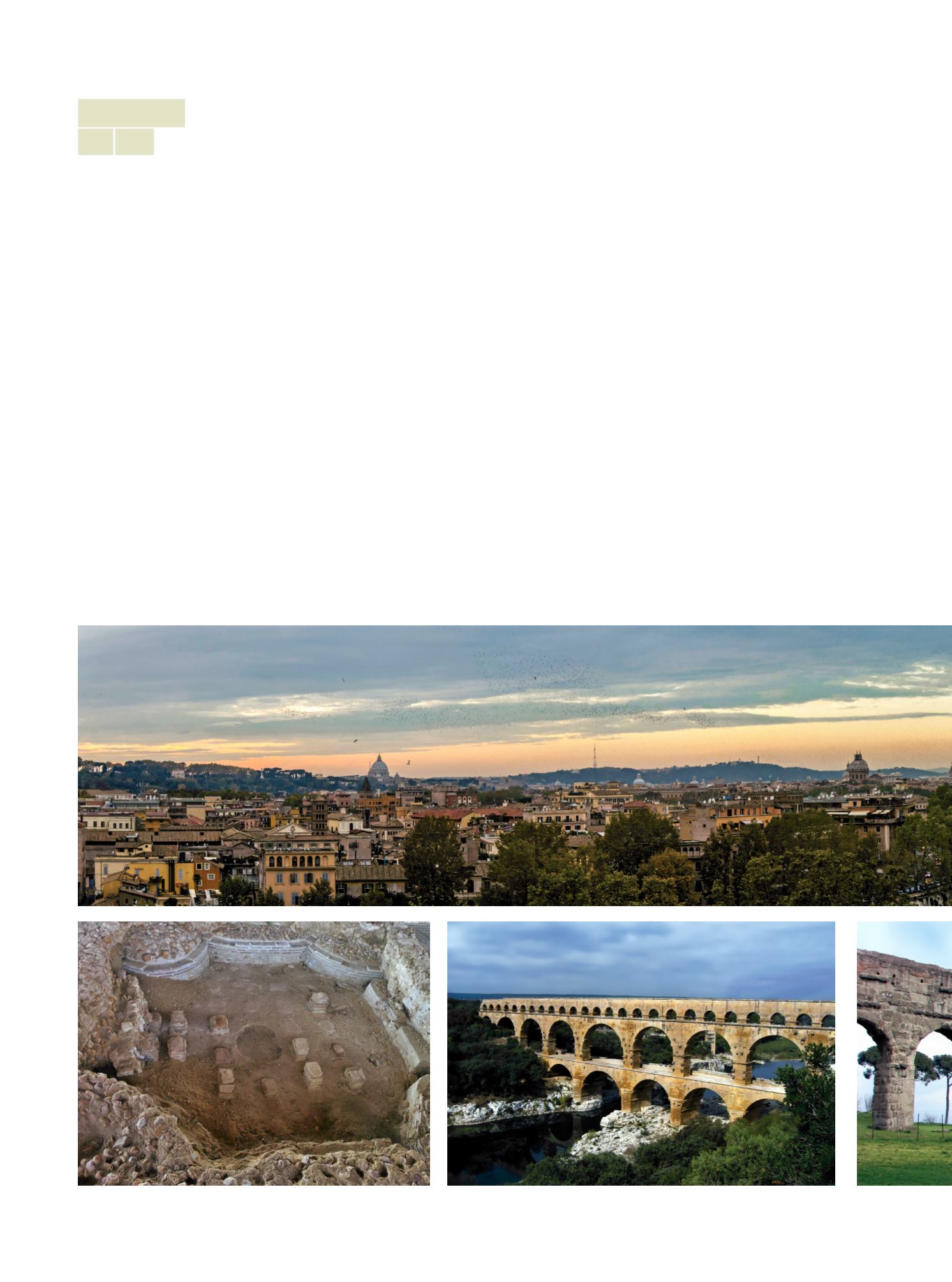
3. La construcción de
acueductos requería
de un cuidadoso
estudio del terreno
y las pendientes
que pudieran
encontrarse en él. /
Theconstructionof
aqueductsrequired
acarefulstudyofthe
terrainandslopes
thatmightbe in it.
4. Restos de
las termas que
utilizaban el sistema
hipocastum. /
Ruins
ofthebathsthat
usedthehipocastum
system.
5.Elsistemade
acueductosromano
seextendióportodo
elImperio,como
éste,ubicadoen
Provenza,Francia.
/
Thesystemof
Romanaqueducts
spreadthroughout
theEmpire, likethis
located inProvence,
France.
Acueductos grandeza de la ciudad
Hacia mediados del siglo V, la capital imperial conta-
ba con 11 acueductos, los cuales dotaban del agua
necesaria para el consumo de sus siete colonias,
con cerca de 1,212 fuentes, 937 baños públicos y 11
termas imperiales; cuyo consumo diario era de unos
160 millones de litros. Algunas de estas construccio-
nes tuvieron derivaciones para que el agua llegara a
las casas de las personas de alto estrato social. Cabe
señalar que antes de canalizarse, el líquido llegaba a
una piscina limaria, donde se decantaba para tratar
de que llegara lo más pura posible.
El levantamiento de estas estructuras exigía un
cuidadoso estudio del terreno, además de conocimien-
tos sobre presión hidráulica, ya que se trataba de llevar
el líquido desde unmanantial hasta su destino final, por
medio de la ley de la gravedad, por lo cual se generaban
pendientes sostenidas. En la parte superior de estas
obras, estructuradas con un sistema de arquerías, ha-
bía canales abiertos o riui. También, en ciertas partes,
contaba con canales soterrados que eran excavados
directamente en la roca. En la ciudad, se sabe que hubo
430 km de canales de conducción de agua.
La importancia de Roma era proporcional al volu-
men de agua que entraba en ella, por ello Vitges, rey de
los ostrogodos, mandó cortar el suministro de agua de
los acueductos, en el año 537, cuando la ciudad cayó
ante el asedio de los bárbaros.
3
4
5
·amura·
120
herencia cultural •
culture and heritage
Aqueducts, greatness of the city
Towards the mid V century, the imperial capi-
tal counted with 11 aqueducts that provided the
needed water for the consumption by its seven
districts, with about 1,212 fountains, 937 public
baths and 11 imperial thermae; that had a daily use
of some 160 million of liters. Some of these con-
structions had derivations tomake water available
in the homes of highly ranked persons. It should
be mentioned that before channeling, the liquid
arrived to a piscina limaria, where it was poured to
try to provide it as pure as possible.
The raise of these structures demanded a care-
ful study of the terrain, besides of knowledge about
hydraulic pressure, as the objective was to take
the liquid from a spring to its final destination, by
use of the law of gravity, thusly generating sus-
tained slopes. On the top portion of these works,
structured with an arcade system, there were open
channels or riui. Also, at some points, it had under-
ground channels that were craved directly into the
rock. In the city, it is known that there were 430 km
of channels for water conduction.
The importance of Rome was proportional to
the volume of water entering in her, therefore when
Vitiges, king of the Ostrogoths, orders to cut the wa-
ter supply from the aqueducts, in the year 537, the
city falls under the siege of the barbarians.


