·amura·
153
cinematografía •
Cinematography
S
in duda el cine es un reflejo de la cultura de
cualquier país, y Rusia no es la excepción,
pues estamos hablando de uno de los paí-
ses con grandes virajes en cuanto a política y so-
ciedad se refiere.
Haciendo un breve recuento histórico, Rusia vivió
la monarquía durante el imperio de los zares a partir
de 1721 hasta que en 1917 se convirtió en el primer
país socialista con la Revolución de Octubre y se con-
vierte en la Unión de Repúblicas Socialistas Soviéti-
cas, hasta que obtiene su reestructuración con la Pe-
restroika. En 1991 se convierte en la Federación Rusa.
Estos cambios políticos son contrastantes: pasar
del imperio de los zares, a una república socialista al-
tamente centralizada en Moscú, a una federación se-
mipresidencialista, en el país más grande del mundo
territorialmente hablando, no es poca cosa.
Y el cine no es la excepción. Todos estos cambios
han moldeado la forma en que distintos directores y
actores rusos han entendido, ejecutado y compartido
su visión artística que se refleja en la pantalla grande.
El cine ruso empezó un poco antes de 1910, con el
fotógrafo Alexandr Drankov, pero no fue hasta 1925
cuando paró los reflectores del mundo de la mano del
cineasta Sergei Eisenstein con El Acorazado Potemkin,
en el cual Sergei utilizó la técnica de montaje impues-
ta por Gardin en 1919.
W
ithout a doubt, film is a reflection of the
culture of any given country, and Russia
is no exception, for we are talking about a
country with one of the largest ups-and-downs as far
as politics and society are concerned.
Making a brief recap, Russia lived through a
monarchy during the empire of the tsars from1721,
up until 1917, when it became the first socialist
country after the October Revolution, which in turn
became the United Socialist Soviet Republic, until a
restructuration is achieved by way of the Perestroi-
ka. In 1991, it becomes the Russian Federation.
These political changes are contrasting: to pass
through the empire of the tsars, to a socialist repub-
lic highly concentrated in Moscow, to a semi-presi-
dential federation in the largest country on our ter-
restrial landmasses, it no small feat.
And film is no exception. All these changes have
molded the form in which Russian filmmakers and
actors have understood, executed, and shared their
artistic vision, one that is reflected up on the screen.
Russian cinema began shortly before 1910, with
the photographer Alexandr Drankov, but it wasn’t
until 1925 when it stopped the world’s spotlights
by the hand of the filmmaker Sergei Eisensteinwith
“Battleship Potemkin,” in which Sergei used the
montage technique imposed by Gardin in 1919.
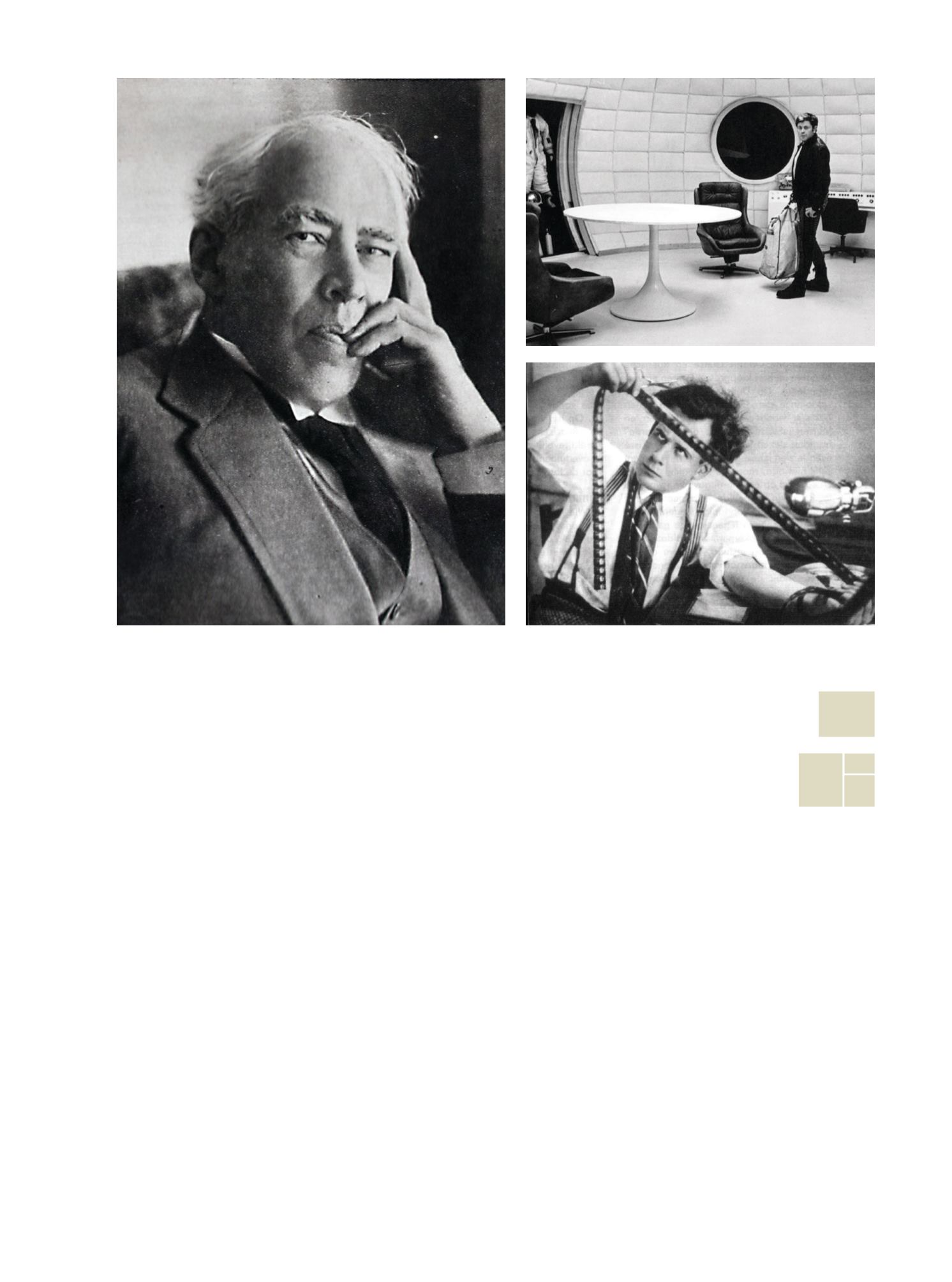
1. Interior,en1903,del
teatrodeartedeMoscú.
/
InsideofMoscowArt
Theaterinteriorsin1903.
2.KonstantinStanislavski
fueactor,director
escénicoypedagogo
teatral.Creadordesu
propiateoría,quepodría
denominarserealismo
psicológico./
Konstantin
Stanislavskiwasan
actor,stagemanager
andtheaterpedagogue.
Creatorofhisown
theory,whichcouldbe
calledpsychological
realism.
3.Escenade lapelícula
Solaris,de1972,dirigida
porAndreiTarkovsky,
yextraídade lanovela
homónimadeStanislaw
Lem./
SceneofSolaris
movieof1972,directed
byAndreiTarkovsky,
andtakenfromthe
homonymousnovelby
StanislawLem.
4.SergeiEisenstein,en la
edicióndeElacorazado
Potemkin./
Sergei
Eisenstein,intheedition
ofBattleshipPotemkin.
1
2
3
4


