tierra para crear a Adán y donde Abraham se apres-
taba a sacrificar a su hijo Isaac por orden de Dios,
que quería comprobar su fe y el niño fue reempla-
zado por un borrego al último momento.
Salomón construyó el primer templo en más de
siete años y lo consagró al colocar el Arca de la Alianza
en él. Destruido por Nabucodonozor en 586 a.C., se re-
construyó en 515 a.C. y el rey Herodes elevó el muro
para rellenar y crear la plaza nivelada. Los romanos lo
destruyeron y edificaron el templo dedicado a Zeus,
luego transformado en iglesia.
El profeta Mahoma anunció a sus discípulos
que en una noche había visitado el Monte para
rezar y al día siguiente ocurrió la Miraj (la Asun-
ción al paraíso para unirse con Alá). Entonces el
templo se volvió el tercer lugar sagrado para los
musulmanes, después de La Meca y Medina, y se
edificó el Domo de la Roca con su cúpula dorada en
688 d.C., para cubrir la famosa roca.
En ese recinto se alzan la mezquita Al Aqsa, el
Domo de la Cadena con sus hermosos mosaicos,
el Domo de la Asunción, donde Mahoma rezó antes
de ascender, un hermoso Minbar o púlpito de pie-
dra y las puertas monumentales. El viento con olor a
ciprés envuelve el misticismo que surge de cada piedra,
arco o muro mientras el Domo Dorado brilla como un
faro religioso. Las leyendas se mezclan con los hechos
históricos, los vestigios no saben a quién pertenecen y
los hombres respetan el silencio.
Jerusalén es también una invitación a descubrir los
callejones del Barrio Musulmán, las escondidas iglesias
rusas, armenias, el Monasterio etiope, la iglesia de San
Juan Bautista (lamás antigua de la ciudad), los restos de
los edificios mamelucos, El Soco, las sinagogas. En cada
rincón se saborea el tiempo perdido en el pasado.
Rumbo a Galilea
Nos dirigimos hacia el norte, pasando por Jericó,
cuya muralla fue destruida por el sonido de las trom-
petas según la Biblia. Bajando las verdes colinas que se
vuelven áridas y amarillas, llegamos a ese valle donde
corre el Jordán antes de desembocar en el Mar Muerto.
Moriah where there was a rock where Jehovah or-
dered Abraham to sacrifice his son Isaac because he
wanted to check his faith and the boy was replaced
by a lamb in the last moment.
Salomón built the first temple around seven
years and he consecrated it when he placed the
Ark of the Alliance on it. The temple was destroyed
by Nabucodonozor (586 B.C.), it was reconstructed
(515 B.C.) and the Herodes King elevated the wall for
stuffing and creating the even square. The Romans
destroyed it and they built the temple dedicated
Zeus then it became into a church.
The prophet Mohammed announced to his pupils
that he had visited the Mount for praying in one night
and the following day the Miraj happened (the Ascen-
sionto theparadise tounitewithAllah). Thenthe temple
became the third sacred place for the Muslims after The
MecaandMedinaandtheDomeoftheRockwasbuiltwith
itsgoldendome(688A.C.)tocoverthefamousrock.
The mosque Al Aqsa rises on that enclosure , the
DomeoftheChainwiththeirbeautifulmosaics,theDome
of the Ascention, where Mahoma prayed before ascend-
ing, a beautiful Minbar or stone pulpit and the monu-
mental doors. The wind with scent of cypress wraps the
mysticism that arises of each stone, arch or wall while
the Golden Dome shines as a religious lighthouse. The
legends mix with the historical facts, the vestiges don’t
belongnobodyandthemenconcernthesilence.
Jerusalemis alsoan invitation todiscover the alleys
of the Muslim neighborhood, the hidden Russian chur-
ches,armenians,theEthiopianMonastery,SaintJohnthe
Baptist church (the oldest in the city), the remains of the
Mameluke buildings, The Soco, the synagogues. In each
cornerthetimeissavoredlostinthepast.
Heading for Galilee
We go toward the north, going by Jericho, whose
wall was destroyed by the sound of the trumpets
according to the Bible. Lowering the green hills that
become arid and yellow, we arrive to that valley
where the Jordan runs before ending in the Dead Sea.
When the Israeli control closes the way to the lowest
1
·amura·
35
compás int • compass int
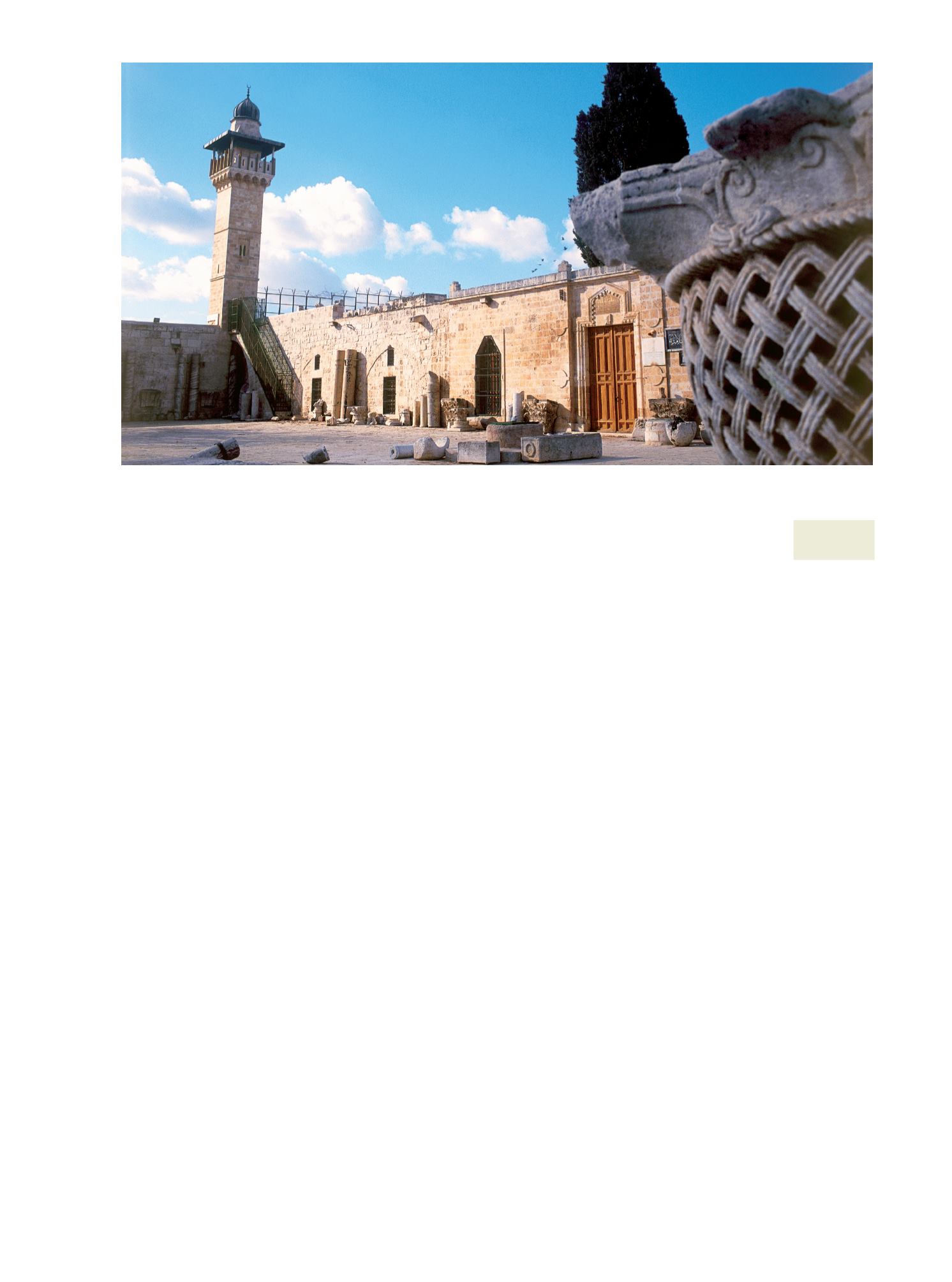
1. Haram Ash-Sharif
es el recinto sagrado
para los musulmanes,
donde admira-
mos los restos de
antiguas columnas
que adornaban los
templos romanos o
las mezquitas. Es un
lugar de profunda
meditación, testigo
de tantos aconte-
cimientos históricos./
HaramAsh-Sharif
is the sacred temple
of the Muslims,
where the remains
of ancient columns
used to decorate
roman temples and
mesquites can be ad-
mired. It’s a place for
deep meditation and
a witness of many
historic events


