·amura·
57
compás int •
compass int
NO
NE
SO
SE
N
S
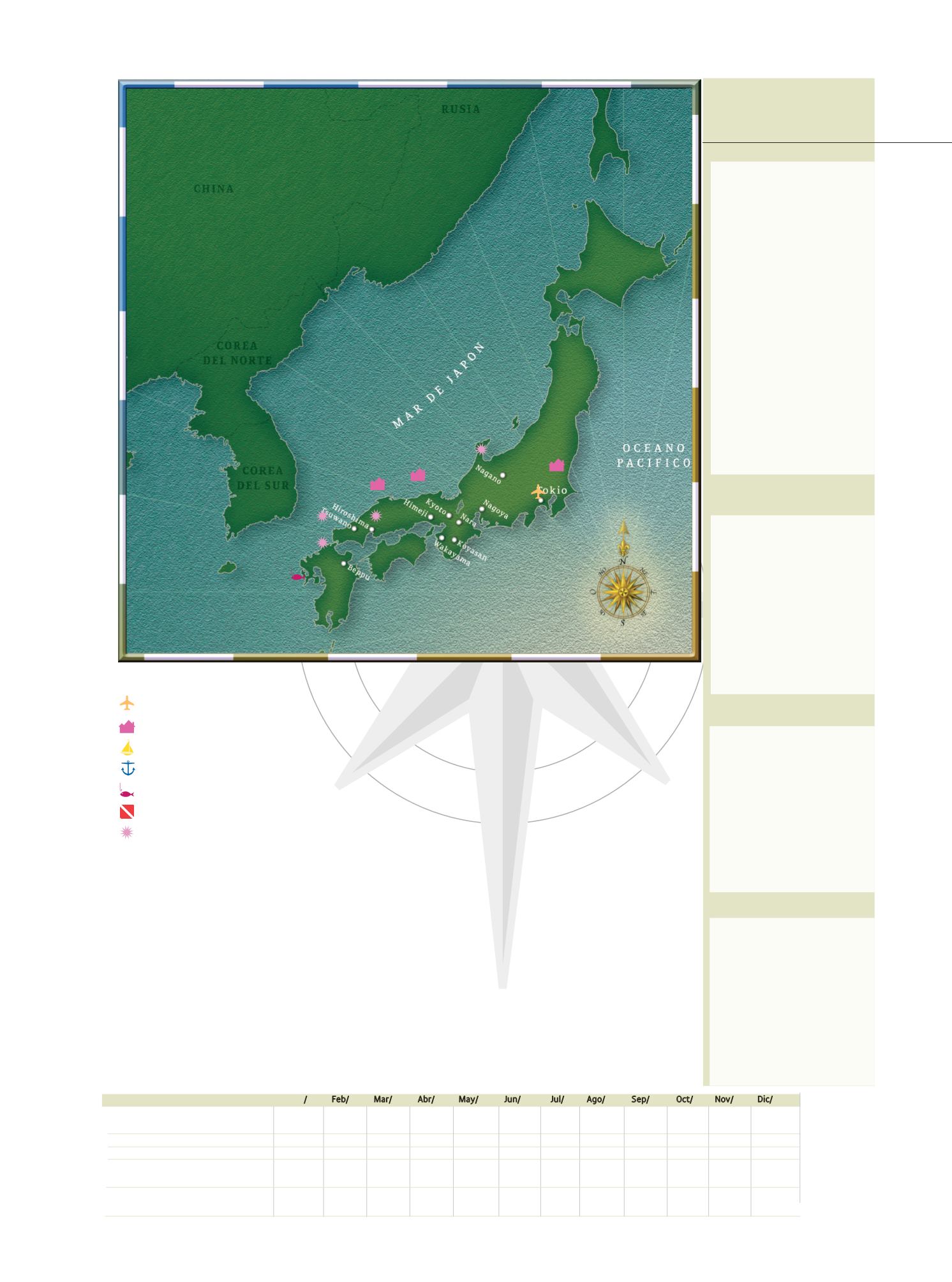
Aeropuerto /
Airport
Hotel
Marina /
Nautical Club
Punto de anclaje /
Anchoring
Zona de pesca /
Fishing
Zona de snorkeling /
Diving
Sitio de interés /
Attraction
Temperaturas promedio en Japón /
Average temperatures in Japan
(°C/°F )
Mes /
Month
Ene
/
Jan
Feb/
Feb
Mar/
Mar
Abr/
Apr
May/
May
Jun/
Jun
Jul/
Jul
Ago/
Aug
Sep/
Sep
Oct/
Oct
Nov/
Nov
Dic/
Dec
Temperatura Media
/
Average Temperature
6/43 6/43 8/48 15/59 19/67 21/71 26/80 23/82 23/75 18/66 13/56 8/47
Máxima /
Maximum
10/50 10/50 12/55 18/66 22/73 25/78 30/87 27/89 27/81 22/72 16/62 12/54
Mínima /
Minimum
35
36
41
51
60
65
74
76
69
60
48
40
Días con precipitación /
Average precipitation Days
5
5
10
10
10
12
10
9
11
9
7
3
Días con precipitación de nieve /
Snow Precipitation Days
1
1
0
0
0
0
0
0
0
0
0
0
Recomendaciones
náuticas
Sailing Tips
Clima /
Weather
El norte de Japón es frío, mientras
que el sur está en el cinturón de
los monzones. El verano se carac-
teriza por los vientos del sureste
y las lluvias en junio y julio. Los
tifones son más frecuentes
desde mediados de julio hasta
octubre, pero pueden ocurrir en
cualquier momento, aunque se
les pronostica de cinco a diez días
de anticipación y el meteorológi-
co es siempre confiable./
The
north of Japan is cold, while the
south is in the belt of the mon-
soons. The summer is charac-
terized for the southwest winds
and the June and July rains. The
typhoons are more frequent
from the middle of July till
October, but can occur at any
time, although they are fore-
casted from five to ten days in
advance and the weather report
is always reliable.
Precipitaciones /
Precipitations
Las precipitaciones en Japón son
elevadas, siempre por encima de
los 1.000 mm anuales. En las
regiones más altas, y en las del
sur, próximas a los climas tropi-
cales, se superan los 2.000 mm.
/
The precipitations in Japan are
elevated, always above 1.000
mm annually.
In the highest regions, and in
the southern ones, next to the
tropical weathers, are above
2.000 mm.
Corrientes Marinas/
Sea Currents
El otro factor es la presencia de la
corriente oceánica cálida de Kuro-
shivo, que templa el clima de la
mitad sur del país, y la corriente
fría de Oya-shivo, que enfría la
mitad norte.
/ The other aspect is
the presence of the warm ocean
current of Kuro-shivo, that tem-
plate the weather of the south-
ern half of the country, and the
cold Oya-shivo current that
cools the northern half.
Temperatura promedio/
Average Temperature
Lamediadeundíadejulioesdeunos
28°C(83°F)entornoalasislasdelsur
y sólo 23 °C (73 °F) cerca de
Hokkaido. El invierno es frío en la
mayorpartedelpaís,exceptuandoel
surdeKyushuyOkinawa.
/ Theaver-
age temperatureonaday in July is
about 28°C (83 °F) around the
southernislandsandonly23°C(73
°F)nearHokkaido. Thewinteriscold
onmost part of the country, except
inthesouthofKyushuyOkinawa.


