·amura·
49
compás int • int compass
The area of access to the sacred place, is formed in
Propylaea, then a large courtyard dedicated to sacri-
fices, with noticeable changes after the discovery of
the great altar. Of the 128 titanic columns of granite
brought from Egypt, reinstalled in its original posi-
tion to build the colossal Temple of Jupiter, in the
centuries II and III. BC, only six remain. One of the
mysteries that subsist, is the way the great stone of
thousands of tons was placed which is on top.
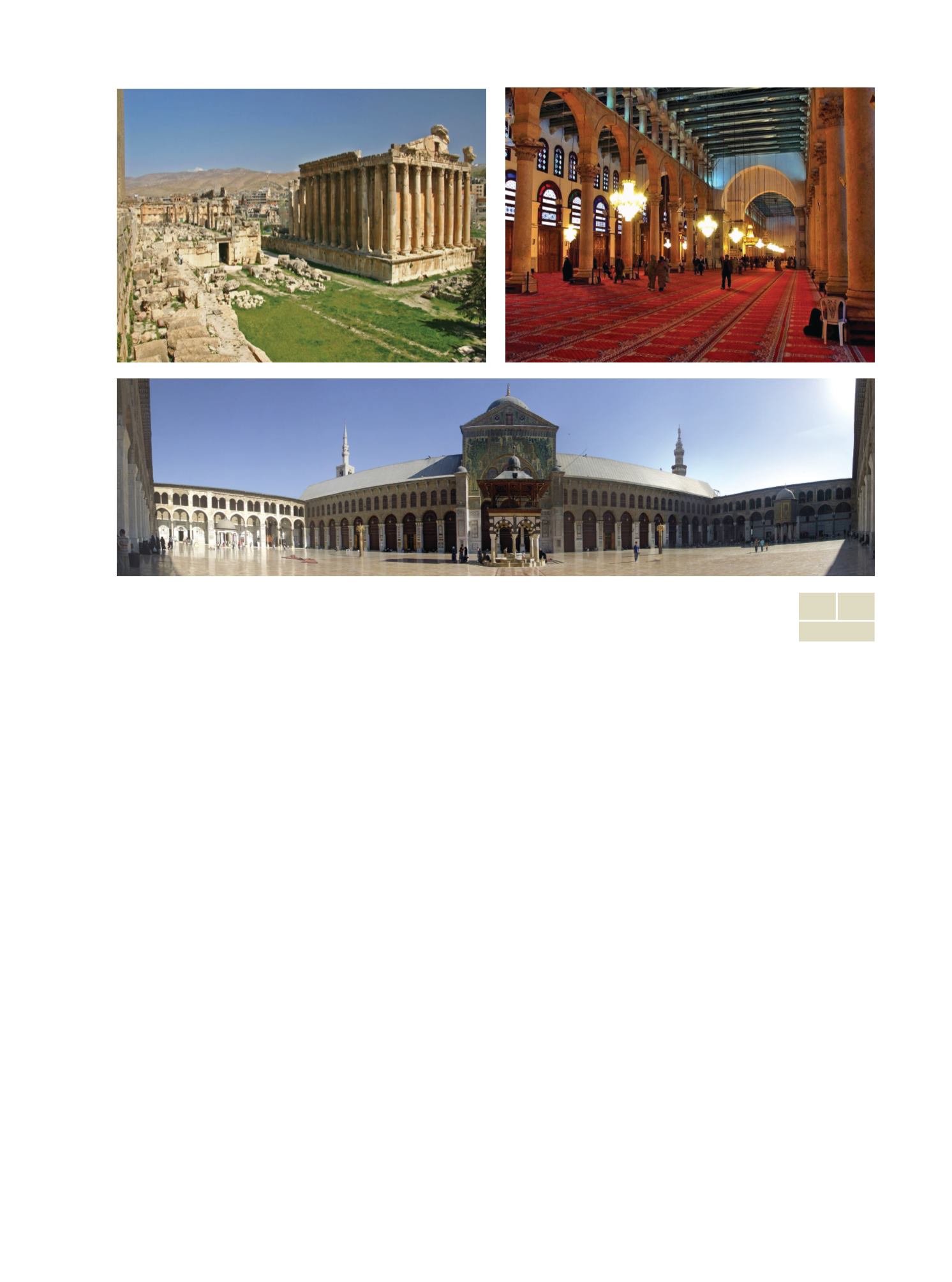
The formidable temple dedicated to the worship
of Bacchus also survives, the Roman god of wine,
which is located to the south of the six columns. It
is the best preserved and it is considered as a mas-
terpiece of the Roman architecture. The interior is
beautifully decorated and is divided into two parts:
the nave and the sanctuary. Both sides of the stair-
case lead to the shrine,which shows two socket
niches inwhich sculptural sketches are found along
a Greek cross, which shows that the temple was con-
verted into a church.
The hexagonal courtyard represents the Eastern
Star of Venus and has a diameter of 60 meters. The
Temple of Venus, goddess of Love, Beauty and Fertil-
ity, was built on a mass of vegetables and watered
by a stream. Its form reproduced the drawing of a
star or a seashell, river symbol of the deity.
This place retains other important monu-
ments such as the Umayyad Mosque and other
Mamluk era. On this scenario the Baalbek Interna-
tional Festival has been conducted, which pres-
ents the Lebanese world known stars of music,
ballet, theater and singing.
At the end of the visit of such an unforgettable
site , is a museum, which shows how it used to be a
long time ago; where all the temples were standing
in all its splendor, as well as pieces that have been
found throughout the excavations.
El área de ingreso al sagrado lugar se forma de pro-
pileos; luego un gran patio dedicado a los sacrificios, con
cambios notables tras el descubrimiento del gran altar. De
las 128 titánicas columnas de granito traídas de Egipto,
reinstaladas en su postura original para construir el colo-
sal templo de Júpiter, en los siglos II y III a.C., sólo quedan
seis. Uno de los misterios que subsisten es la forma en
que fue colocada sobre ellas la gran piedra demiles de to-
neladas que se encuentra en la parte superior.
Sobrevive también el formidable templo consa-
grado al culto de Baco, dios romano del vino, que
se ubica al sur de las seis columnas. Es el mejor
conservado y es calificado como obra maestra de
la arquitectura romana. El interior está bellamente
decorado y es dividido en dos partes: la nave y el
santuario. A ambos lados de la escalera que sube
al santuario, se aprecian dos zócalos de nichos en
los que se encuentran bosquejos escultóricos y una
cruz griega, que muestran que el templo fue con-
vertido en iglesia.
El patio hexagonal representa a la estrella oriental de
Venus y tiene un diámetro de 60 metros. El templo de
Venus, diosa del amor, la belleza y la fertilidad, fue edi-
ficado sobre una fosa de verduras y regado por un curso
de agua. Su forma reproducía el dibujo de una estrella o
el de una concha marina, símbolo fluvial de la deidad.
El conjunto conserva otros monumentos impor-
tantes como una mezquita omeya y otras de la era
mameluca. Sobre este escenario se ha llevado a cabo el
Festival Internacional de Baalbek, en el cual se presen-
tan las estrellas libanesas y mundiales de la música, el
ballet, el teatro y el canto.
Al final de la visita de tan inolvidable recinto, se
encuentra un museo, el cual muestra cómo fue el sitio
cuando todos los templos estaban en pie y en su es-
plendor, además de piezas que se han encontrado a lo
largo de las excavaciones.
39. Templo de J
Júpiter en Baalbek.
/
Temple of Jupiter
in Baalbek.
40. Interior de una
mezquita del periodo
omeya.
/ Interior
view of Ummayad
time mosque.
41. El gran patio ex-
terior de la mezquita.
/ Vast courtyard of
the mosque.
39
40
41


