·amura·
52
compás int • int compass
Muchas de las piezas valiosas de las “necró-
polis sidonias” están en museos como el Louvre,
en París, el Topkapi, en Estambul, y algunos otros
europeos. Hay tres necrópolis, la Magharet Ablún,
la de Ayaa y la de Ain el Helwe. El sarcófago de Ech-
munazar II, rey fenicio, se halló en la primera y fue
llevado al Louvre.
Aanjar:
Gloria del Imperio Omeya en Líbano
En el Valle de la Bekaa, que divide las zonas serra-
nas llamadas “Monte Líbano” y “Anti-Líbano”, y a 68
kilómetros de Beirut, encontraremos las ruinas de una
palaciega urbe del Califato damasquino de los Ome-
yas, descubiertas en 1949. Fue fundada en el siglo VIII
por el califa Ibrahim Al Walid Ibn Abdel Malik.
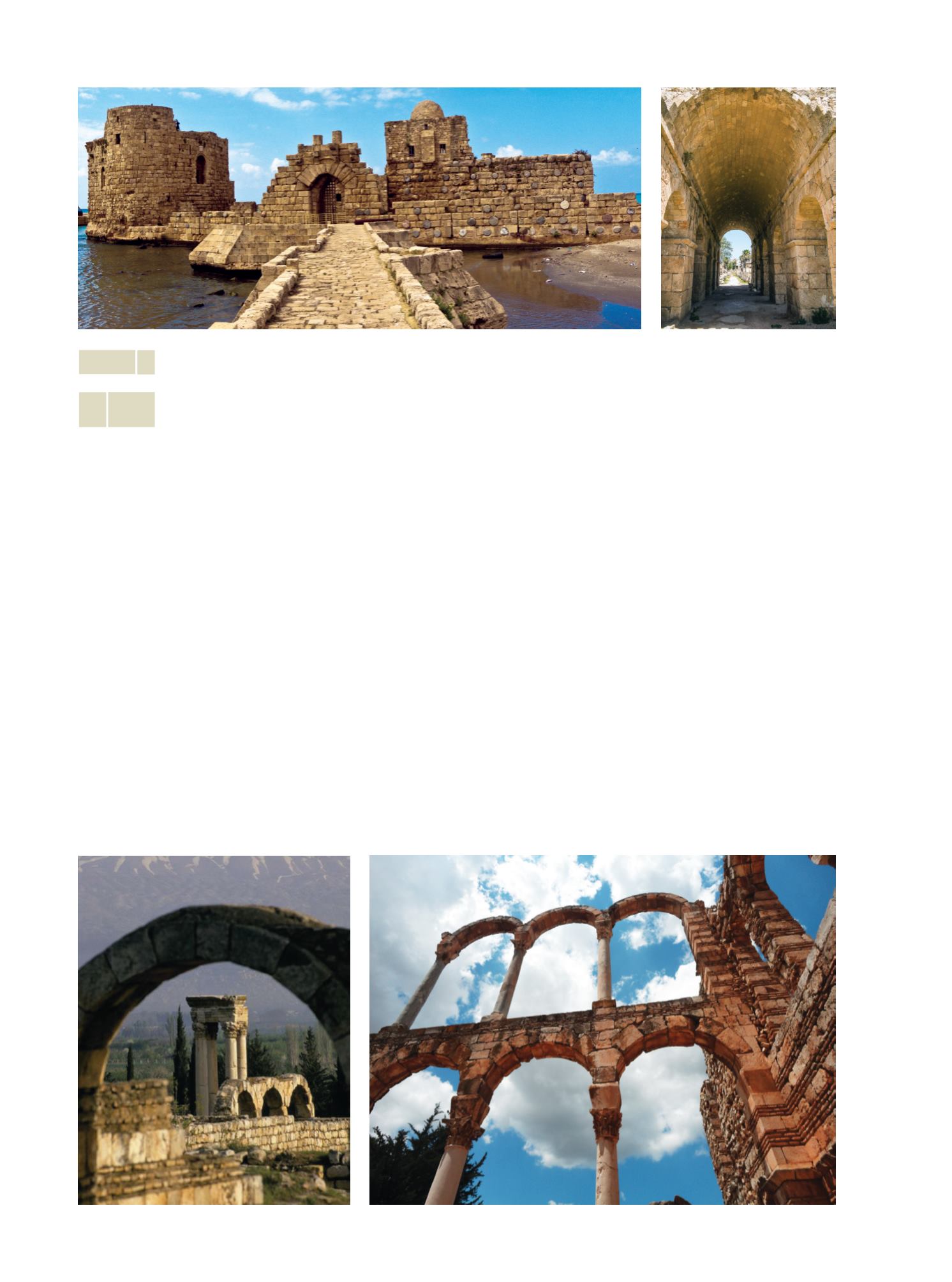
Estos vestigios muestran palacios, mercados, ter-
mas, columnas, torres y murallas que acercan la ima-
ginación del turista a la vida cotidiana de los Omeyas,
cuyo imperio se extendió de Damasco a España en Oc-
cidente, y hasta la India al Oriente. El lugar es espec-
tacular y se dice que fue el sitio de descanso del califa
Ibrahim Al Walid. La verdad sobre Aanjar tiene muchas
incógnitas. ¿Por qué fue construido con más de 600
tiendas? ¿Era un lugar de comercio donde se daban
cita caravanas y mercaderes para finiquitar transac-
ciones? ¿Era un sitio de descanso o placer? El tiempo
y las investigaciones aclararán estas dudas.
Many valuable pieces of the “necropolis of
Sidon” are in museums such as the Louvre in Paris,
the Topkapi, Istanbul and some other European
buildings. There are three cemeteries, the Magharet
Ablún, Ayaa and Ain el Helwe. The sarcophagus of
Echmunazar II, Phoenician king, was found in the
first mentioned and was taken to the Louvre.
Aanjar:
The Glory of the Umayyad Empire in Lebanon.
The valley of the Bekaa, which divides the high-
lands called “Mount Lebanon” and “Anti-Lebanon”,
68 kilometers from Beirut, we find the ruins of the
city palace of the Umayyad Caliphate Damascene,
discovered in 1949. It was founded in the eighth cen-
tury by Caliph Al Walid Ibn Abdel IbrahimMalik.
These remains show palaces, markets, baths,
columns, towers and walls that approach the tour-
ists imagination to the everyday life of the Umayy-
ads, whose empire stretched from Damascus to
Spain in the West to India in East. The place is
spectacular and it is said to be the resting place of
the Caliph Al Walid Ibrahim. The truth about Aan-
jar has many interrogations. Why was it built with
more than 600 stores? Was it a place where trading
caravans and merchants came together to finalize
transactions?Was it a place of rest or pleasure? Time
and research will clarify these doubts.
44 y 45. Castillo
del Mar en Saida,
la mítica Sidón.
/
Saida Sea Castel,
mythical Sidon.
46 y 47. Detalles de
sus formas arqui-
tectónicas y arcos
de medio punto.
/
Details of
its architectures
forms and
semicircular archs.
44
46 47
45


