·amura·
54
compás int • int compass
The Cedars: Lebanese Identity Symbol
Inwriting about Lebanese flora, a particular tree
always stands out: the cedar. Even with the disas-
trous deforestation registered, we see large areas
which conserve the giving shade tree along with its
presence in the mountains of Lebanon.
Compared with ancient times, cedars are less
common today, but Lebanon has the privilege of
owning a surprising number of dense forests, the
largest of which, in any geographic space of the
Middle East, is near the town of Tannourine Had-
dadt - the Jebbe, which has an area of almost 60
hectares and over 50,000 cedars also Barouk the im-
mense forests in the western mountains, particu-
larly in themountainous zone of the Chouf. Smaller,
but significant and beautiful since it is one of the
most visited, is the neighboring forest of Bcharre,
north Lebanon, birthplace of Gibran Khalil Gibran.
This forest is described as “the Forest of the Cedars
of God” and receives each year hundreds of thou-
sands of tourists. The greenery of Lebanon also has
large reserves of pine, oak has generous presence,
and the coasts are filled with fig and almond trees.
The e reforestation work carried out stand out and
numerouscausesareeagertohelp,suchastheCommit-
tee of Friends of the Forest of the Cedars, near Becharre,
chaired by architect Rashed Kayrouz, the momentum
was marked with a book from the author Desiree Leba-
nese Aziz, the solidarity of the Greek singer Dalida and
strong fellowshipof Lebanese descentMexicanphilan-
thropist, AlfredoHarpHelu, amongothers.
Los Cedros: Símbolo de la identidad libanesa
Al escribir sobre la flora libanesa resalta siempre el
árbol que es emblema nacional: el cedro. Aún con las
nefastas deforestaciones registradas, vemos gran-
des áreas en las cuales se conserva el árbol regalando
sombra y presencia en la sierra de Líbano.
Comparado con la antigüedad, el cedro es menos
común en la actualidad, pero Líbano tiene el privilegio
de poseer un número sorprendente de bosques den-
sos, el mayor de los cuales, en toda el área geográfica
del Medio Oriente, es el cercano al pueblo de Tannou-
rine Haddadt - El Jebbe, que tiene una extensión de
casi 60 hectáreas y más de 50,000 cedros; asimismo,
los inmensos bosques de Barouk, en las montañas
occidentales, específicamente en la zona serrana del
Chouf. Más pequeño, pero por su significación y belle-
za el más visitado, es el bosque vecino a la población
de Becharre, al norte libanés, cuna de Gibran Kahlil
Gibran. Este bosque es calificado como “el bosque de
los cedros de Dios” y recibe por año a cientos de miles
de turistas. La frondosidad de Líbano tiene también
amplias reservas de pinos, el encino es de presencia
generosa, y en las costas hay higueras y almendros.
Destacan los trabajos de reforestación que se lle-
van a cabo y que son numerosos, como el del Comité
de Amigos del Bosque de los Cedros, cercanos a Be-
charre, que preside el Arq. Rashed Kayrouz, el impulso
que se tuvo con un libro de la autora libanesa Desiree
Aziz, la solidaridad de la cantante griega Dalida y la fir-
me comunión del filántropo mexicano de ascendencia
libanesa, Alfredo Harp Helú, entre otras.
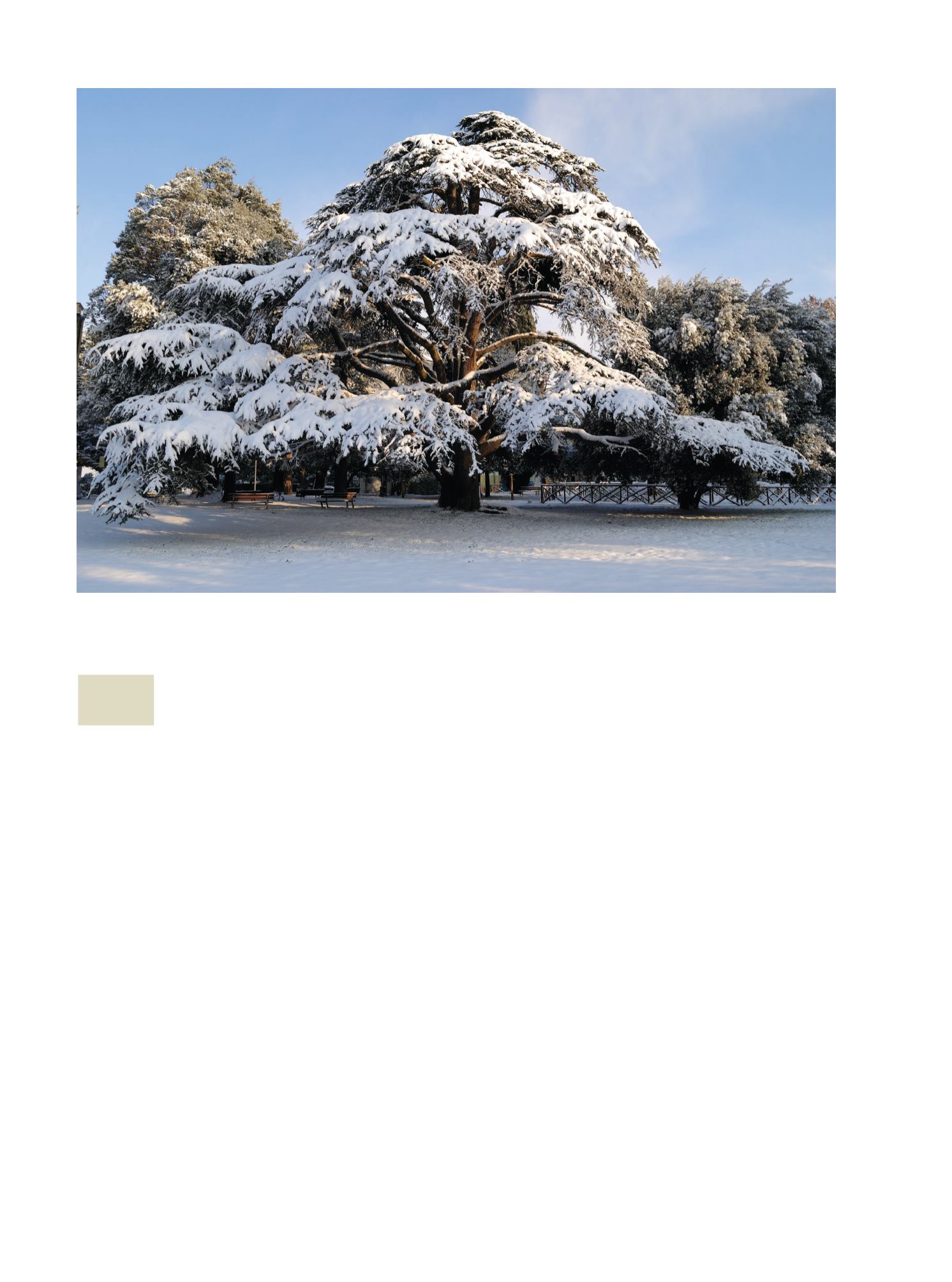
49. Cedros
majestuosos
cubiertos por la
nieve.
/ Majestic
cedars covered by
snow.
49


