·amura·
46
compás int • int compass
Biblos:
Puerto fenicio y cuna del alfabeto fonético
La ciudad de Adonis y Astarté, reconocido centro
antiguo de cultura, es hoy una población situada 39
kilómetros al norte de Beirut. Al sudeste de este puer-
to natural, conocido hoy como Jbail, se descubrieron
ruinas de diversos tiempos. Según la leyenda, el dios
cananeo EL, hijo de Cronos, fundó la urbe y la amuralló.
La región, estuvo habitada desde antes del VII milenio
a.C. y muestra a un pueblo neolítico que algunos ase-
guran que tiene nueve mil años de antigüedad.
Era una urbe cultural y comercial, que entra en la
historia 3,000 años a. C., donde se utilizaban los jero-
glíficos egipcios, hasta que los fenicios dieron al mun-
do su legado más sobresaliente: el alfabeto fonético.
Aún se admira un castillo, una muralla y la Igle-
sia de San Juan, construidos en los siglos XII y XIII.
Al sudeste del recinto franco, se eleva una fortaleza
de tres pisos y cuatro torres que, en ciertas partes,
tiene veinte metros de altura. Las columnas de gra-
nito gris, importado en la época romana de Egipto,
se volvieron a utilizar en su construcción. De la ciu-
dad romana quedan algunos conjuntos como el tea-
tro semicircular, un trozo de columnata y una fuen-
te monumental. El teatro cae sobre el mar y data del
siglo III de nuestra era.
Hay hoteles, restaurantes, un museo de cera, una
calle techada con comercios de artesanías y una mez-
quita. El turista puede pasear por el Mediterráneo li-
banés en lancha.
Byblos:
PhoenicianPortandcradleof thephoneticalphabet
The city of Adonis and Asarte, well known ancient
cultural center, is today town located 39 kilometers to
thenorthof Beirut. To theSoutheast of thenatural port,
known todayas Jbail,many ruins of ancient timeswere
discovered. According to the legend, the God of Canan
EL, son of Cronos, founded this city and set it behind a
wall. The region was inhabited before the VII millen-
niumB.C. and it shows aneolithic townwhichsome as-
sure, countswithnine thousandyears of history.
It was a cultural and commercial city, that encoun-
tershistory in the year 3,000B.C. where Egyptianhiero-
glyphicswereused,untilthePhoeniciangavetheworld
theirmost outstanding legacy: ThePhonetic alphabet.
A castle can be still found, a wall and the church
of Saint John, built in the XII and XIII centuries. To the
southeast of the French enclosure, a fortress of three
stories high and four towers rises, which in certain
parts has over twenty meters of height. The columns
of grey granite, imported at the moment during the
Roman period in Egypt, were used once more in its
construction. From the Roman city certain landmarks
remain,suchasasemicirculartheater,apieceofcolum-
nata and amonumental fountain. The theater bestows
upon the sea anddates of the III centuryof our era.
There are hotels, restaurants and a waxmuseum
available; a roofed street with commerces of crafts
and a Mosque. A tourist can take a ride on the Leba-
nese Mediterranean on a speedboat.
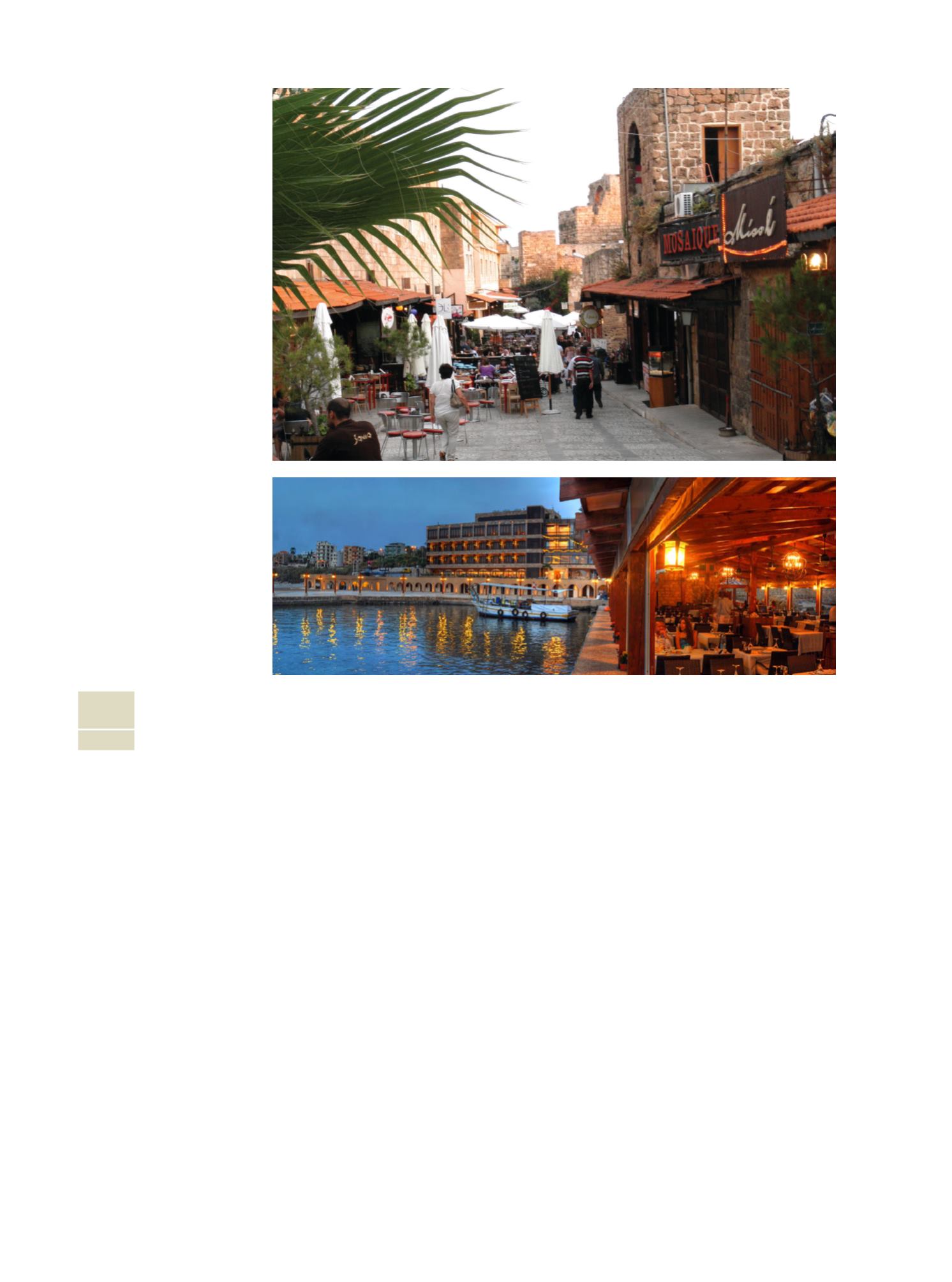
34. Mercado Viejo de
Biblos.
/ Byblos Old
Market
35. Puerto en Byblos,
lugar idóneo para
pasear y disfrutar
de la gastronomía
libanesa.
/ Port of
Byblos, suitable
place to walk and
enjoy lebanese
gastronomy.
35
34


