·amura·
50
compás int • int compass
Tyre: The Jewel of the Mediterranean
It is one of the jewels of ancient Phoenicia, known
todayby thenameof Sour (wall of rock). Ruinsandscat-
tered remains of works of art, along with traces of an-
cient glory, are the framework that travelersarrive to in
thisplacethatholdscenturiesofhistory.Locatedsouth
of theLebanese coast, it has 117,000 inhabitants.
Tyre was integrated to the continental mainland
and an island, to which King Hiramwidened with two
islands more, turning the city into a commercial cen-
ter of the easternMediterranean. This shook relations
with the Aegean world and gave the alphabet to the
Greeks by Cadmus, themythical first educator, andhis
sister Europa, whowas kidnapped by Zeus in the form
of a bull. It took its name the continent.
It has remains such as the monumental arch,
aqueducts, public buildings, a theater and baths.
In the Necropolis carved stones can be seen, marble
sarcophagi Roman and Byzantine, some Greek texts
that indicate the rank of the deceased, or figures
that recall parts of the life of Achilles. There is a Ro-
man hippodrome of the II century of our era which
fits 20,000 spectators, widely used for car racing.
These traces that are carefully tended for travelers
to enjoy forever.
Finally, relevant information from the spe-
cialist Daniel Asade, makes us learn that “a team
of archaeologists, led by L. Badre, from the Ameri-
can University of Beirut, have discovered the first
Phoenician temple of Tyre. The temple is the the
first to be fully discovered in Lebanon. During
this second season (08/18/2013 to 09/14/2013),
archaeologists doubled the size of the excava-
tion, in order to determine the total size of the
temple. It is rectangular (20 x 6.5 m) and has a six
feet high podium , on which an altar used for sac-
rifices rises”.
Tiro: La joya del Mediterráneo
Es una de las joyas de la antigua Fenicia, conocida
hoy con el nombre de Sour (muralla de roca). Ruinas y
restos dispersos de obras de arte, junto a vestigios de
gloria antigua, son el marco que encuentran los viajeros
al llegar a este lugar que atesora siglos de historia. Situa-
da al sur de la costa libanesa, tiene 117,000 habitantes.
Tiro se integró con un área continental y un
islote, al que el rey Hiram ensanchó con dos islas,
convirtiendo la ciudad en un centro comercial del
Mediterráneo oriental. Estrechó relaciones con el
mundo egeo y dio el alfabeto a los griegos a través
de Cadmus, el mítico primer educador, y su herma-
na Europa, secuestrada por Zeus en forma de toro.
De ella tomó su nombre el continente.
Tiene vestigios como la arcada monumental, el
acueducto, los edificios públicos, un teatro y las ter-
mas. En la necrópolis hay piedras esculpidas, sarcó-
fagos de mármol romanos y bizantinos, algunos con
textos griegos que señalan el rango del muerto, o fi-
guras que recuerdan partes de la vida de Aquiles. Hay
un hipódromo romano del siglo II de nuestra era, para
20,000 espectadores, muy utilizado para las carreras
de coches. Vestigios que son cuidados con esmero
para que los viajantes lo disfruten siempre.
Por último, una información pertinente del espe-
cialista Daniel Asade nos hace conocer que “un equipo
de arqueólogos, dirigido por L. Badre, de la Universidad
Americana de Beirut, ha descubierto el primer templo
fenicio de Tiro. El templo es el primero completo des-
cubierto en Líbano. Durante esta segunda temporada
(18/8/2013 al 14/9/2013), los arqueólogos duplicaron
el tamaño de la excavación, con el fin de determinar el
tamaño total del templo. El templo es de planta rec-
tangular (20 x 6,5 m), posee un podio de dos metros
de altura, sobre el cual se levanta un altar que se utili-
zaba para los sacrificios”.
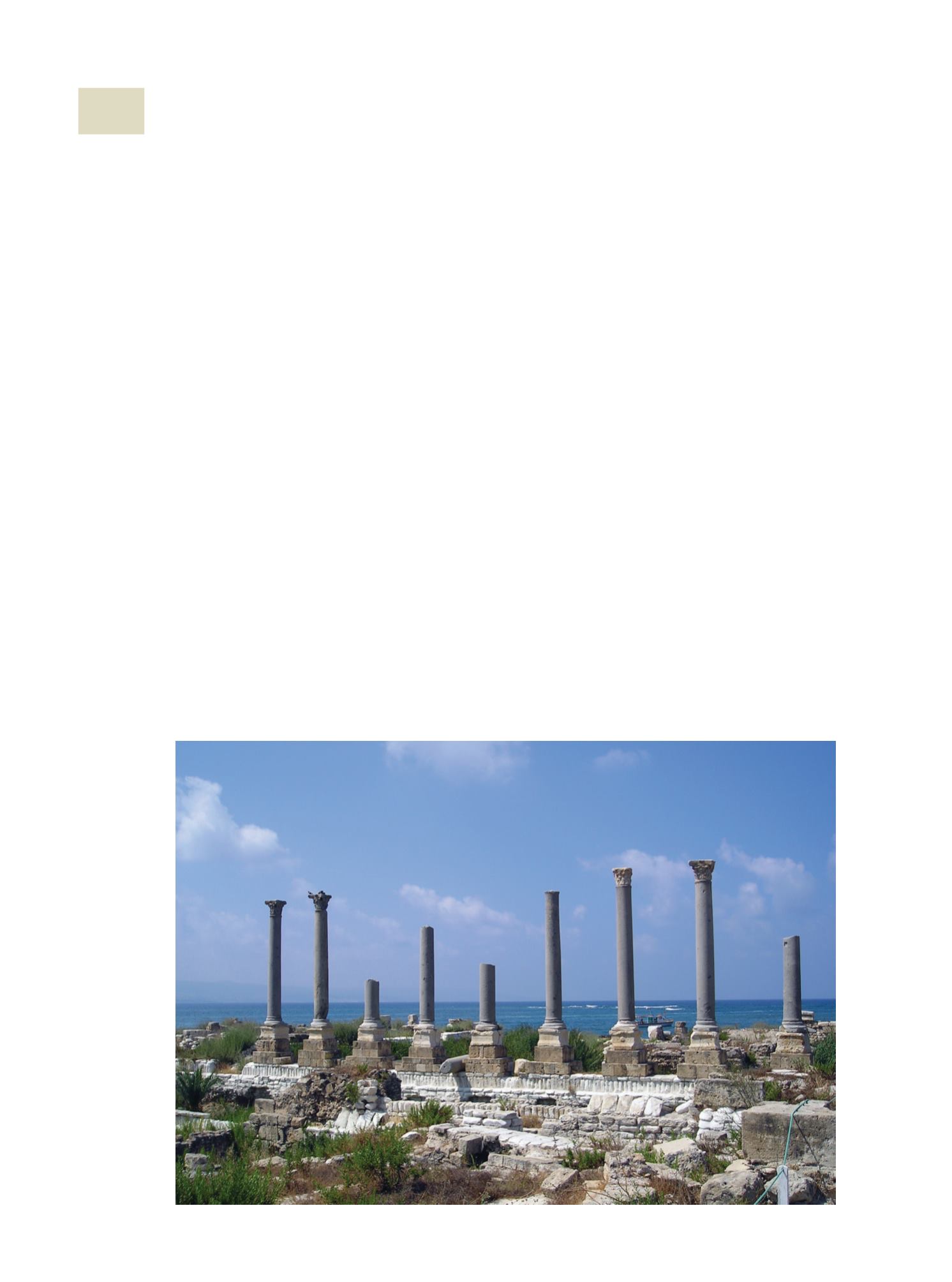
42. Costa de Tiro,
histórico empla-
zamiento.
/ Tyre´
s
coast, historic place.
42


