·amura·
51
compás int • int compass
Sidón: La reina fenicia de los mares
Saida (la célebre Sidón de la antigüedad) se levanta
en una colina bellamente recortada entre las olas azu-
les, que conservó largo tiempo el rango de la ciudad fe-
nicia más importante. Hoy habita una cosmopolita po-
blación con decenas de miles de habitantes dedicados
a la pesca, el comercio y las artesanías. Los sidonios, al
lado de los turistas, se pasean por el puente medieval
que une tierra firme con Qala’at El Bahr, la fortaleza
marítima de los cruzados. Su arquitectura mezcla un
marcado estilo francés de los siglos XII y XIII con to-
ques musulmanes de la era mameluca. Tiene dos torres
unidas por un muro, siendo la occidental la mejor pre-
servada. Columnas romanas sirven de travesaños a las
paredes externas. Cuando San Luis, monarca francés,
viajó a Sidón, le fue aumentada una parte al castillo,
que es un sitio obligado para el visitante.
Incluido en todo recorrido está el majestuoso templo
de Echmoun, ubicado sobre el Río Awali, que sirvió para
rendir culto a Mithra, deidad solar de los persas. En Saida
se inventó el vidrio transparente y el sistema para tra-
bajarlo. En ella, nació el color púrpura, destinado a teñir
vestiduras reales, como indica la colina del Múrice, mon-
tículo cubierto con conchas de ese molusco al que le ex-
traían el líquido púrpura dedicado a trajes solemnes de la
realeza y para las vestimentas cardenalicias.
Saida es la capital de la gobernación de Líbano Sur
y tercera ciudad importante de Líbano. Hay que visi-
tar su antiguo mercado y el albergue franco, un sitio
construido para alojar comerciantes y mercancías, con
un patio rectangular, su fuente al centro y sus galerías
cubiertas. De gran interés turístico es el castillo de
San Luis, la Gran Mezquita y la colina del Múrice con
su elevación artificial y una de cuyas partes es ahora
el cementerio de los musulmanes chiitas de la ciudad.
Sidon: The Phoenician Queen of the Seas
Saida (The celebrated Sidon of the ancient world)
stands on a hill between the beautifully trimmed blue
waves, it long retained the rank of themost important
Phoenician city. Today it owns a cosmopolitan popu-
lation with tens of thousands of inhabitants engaged
in fishing, trade and crafts. The Sidonians, alongside
tourists take strolls through the medieval bridge
linking the mainland with Qala’at El Bahr, a maritime
fortress of the Crusaders. Its architecture combines
French style marked by the twelfth and thirteenth
centuries, alongMuslimtouches of theMamluk era. It
has two towers connectedby awall, thewestern tower
is better preserved. Roman columns serve as rails to
external walls. When Saint Louis, French monarchy,
travelled to Sidon, a part of the castlewas added, mak-
ing it an obliged site for visitors se see.
Included in all the tour is the majestic Echmoun
Temple, located on the Awali River, which served to
worship Mithra, the Persian sun god. In Saida trans-
parent glass was invented as well as the system to
work with it. In it, the color purple was born, des-
tined to dye royal robes, as indicated by the Murex
Hill, mound covered with shells of this mollusk from
which they extracted the purple liquid solemn dedi-
cated to royal attires and garments for cardinals.
Saida, capital of South Lebanon governorship
and third major city in Lebanon. You have to visit
the old market and the French hostel a site built to
accommodate merchants and goods, with a rectan-
gular courtyard, its fountain is located in the center
and has covered passages. The Castle of St. Louis is of
great interest, theGrandMosque andMurexHill, with
its artificial elevations is now part of which is now
the Shiite Muslim cemetery in the city.
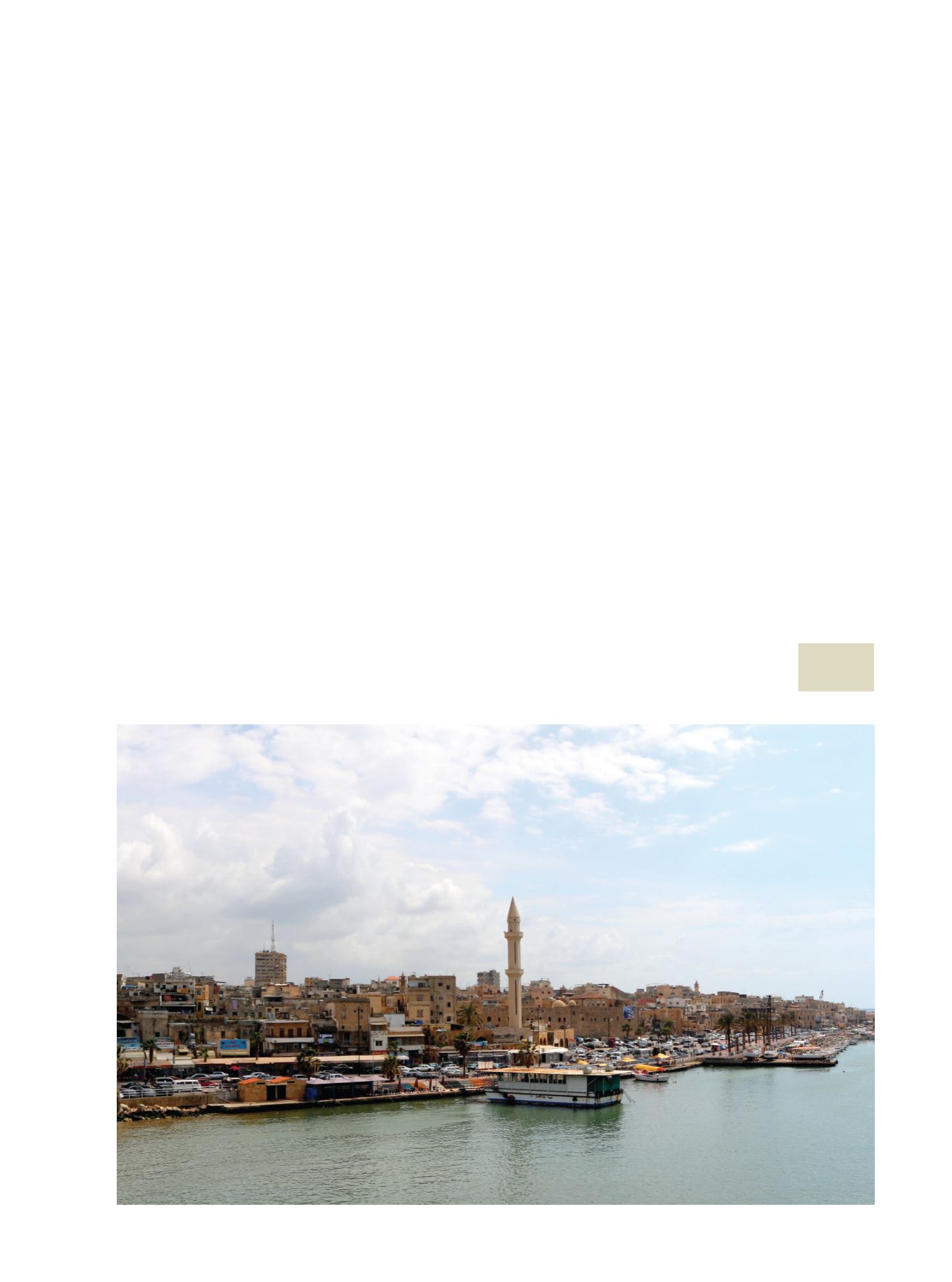
43. Saida, capital
de Líbano Sur. /
Saida, capital of
South Lebanon.
43


